Sugihara Visa Archive

命のビザ
The journey · where, and when

Where they came from — and where they went

Every documented traveller crossed from Kaunas to the Pacific and scattered. Click a destination on the map, or any country below, to see exactly who the archive has traced there. Further down, the days themselves: which doors were open, and for how long.

NemanVistulaDaugavaNerisrefugees east, from autumn 193960 mileseast to Moscow, and the railwayBalticSeaGulf of RigaDanzigKönigsbergSuwałkiGrodnoLidaBrestŠiauliaiPanevėžysDvinskMinskJelgavaBaranowiczeWarsawGerman-occupied, Sept 1939BiałystokSoviet side of the partitionVilnato Lithuania, Oct 1939Kaunasboth consulatesTelšiaithe Telz yeshivaMemelannexed by Germany, 1939Rigade Decker's legationMirthe Mir yeshiva100 miles at 55°NNTHE GROUND THEY CROSSEDPoland · Lithuania · 1939–1940
Where it started. Poland was partitioned in September 1939 and hundreds of thousands fled east; the largest number reached Vilna, which the Soviets handed to still-independent Lithuania that October. From there it was sixty miles to Kaunas, the one city where a Dutch consul and a Japanese consul were both still issuing. Coastline, lakes and rivers are drawn from public-domain survey data; there are no borders on this map, because between September 1939 and August 1940 this ground changed hands three times and the archive holds no source for where a line ran on a given day. The dates are in the labels instead.
VilnaKaunasMoscowOmskIrkutskVladivostokKobeUnited States · 53British Palestine (Israel) · 15Shanghai · 15Canada · 10Australia · 11India · 1S. Rhodesia · 1
Where they ended up · every destination the archive has traced
Country of origin

Follow the escape

438 people traced

Pick a country on the map, or any destination above, to see who reached it — and open each person's record.

The whole register, in one flow

The map above follows one destination at a time. Here is the same journey for everyone at once — from the citizenship on the passport Sugihara stamped, through Kaunas and Japan, to wherever the record last places them.

Poland → Kaunas, 1940 1,990 people 100% of everyone leaving “Poland” 93% of everyone reaching “Kaunas, 1940” Kaunas, 1940 → reached Japan 1,470 people 69% of everyone leaving “Kaunas, 1940” 100% of everyone reaching “reached Japan” reached Japan → moved to Shanghai 804 people 55% of everyone leaving “reached Japan” 97% of everyone reaching “moved to Shanghai” Kaunas, 1940 → no arrival recorded 667 people 31% of everyone leaving “Kaunas, 1940” 100% of everyone reaching “no arrival recorded” reached Japan → left Japan directly 666 people 45% of everyone leaving “reached Japan” 100% of everyone reaching “left Japan directly” no arrival recorded → trail ends here 639 people 96% of everyone leaving “no arrival recorded” 100% of everyone reaching “trail ends here” trail ends here → onward journey not recorded 587 people 92% of everyone leaving “trail ends here” 72% of everyone reaching “onward journey not recorded” moved to Shanghai → United States 386 people 46% of everyone leaving “moved to Shanghai” 62% of everyone reaching “United States” left Japan directly → United States 223 people 33% of everyone leaving “left Japan directly” 36% of everyone reaching “United States” moved to Shanghai → onward journey not recorded 128 people 15% of everyone leaving “moved to Shanghai” 16% of everyone reaching “onward journey not recorded” left Japan directly → Canada 105 people 16% of everyone leaving “left Japan directly” 55% of everyone reaching “Canada” left Japan directly → onward journey not recorded 98 people 15% of everyone leaving “left Japan directly” 12% of everyone reaching “onward journey not recorded” moved to Shanghai → Canada 82 people 10% of everyone leaving “moved to Shanghai” 43% of everyone reaching “Canada” moved to Shanghai → Australia 77 people 9% of everyone leaving “moved to Shanghai” 64% of everyone reaching “Australia” left Japan directly → Palestine (Israel) 75 people 11% of everyone leaving “left Japan directly” 49% of everyone reaching “Palestine (Israel)” moved to Shanghai → Palestine (Israel) 61 people 7% of everyone leaving “moved to Shanghai” 40% of everyone reaching “Palestine (Israel)” Lithuania → Kaunas, 1940 60 people 100% of everyone leaving “Lithuania” 3% of everyone reaching “Kaunas, 1940” moved to Shanghai → elsewhere 50 people 6% of everyone leaving “moved to Shanghai” 51% of everyone reaching “elsewhere” Germany → Kaunas, 1940 43 people 100% of everyone leaving “Germany” 2% of everyone reaching “Kaunas, 1940” left Japan directly → elsewhere 41 people 6% of everyone leaving “left Japan directly” 41% of everyone reaching “elsewhere” left Japan directly → Australia 40 people 6% of everyone leaving “left Japan directly” 33% of everyone reaching “Australia” other citizenship → Kaunas, 1940 30 people 100% of everyone leaving “other citizenship” 1% of everyone reaching “Kaunas, 1940” no arrival recorded → moved to Shanghai 28 people 4% of everyone leaving “no arrival recorded” 3% of everyone reaching “moved to Shanghai” left Japan directly → Burma 23 people 3% of everyone leaving “left Japan directly” 79% of everyone reaching “Burma” left Japan directly → New Zealand 19 people 3% of everyone leaving “left Japan directly” 86% of everyone reaching “New Zealand” moved to Shanghai → South America 19 people 2% of everyone leaving “moved to Shanghai” 100% of everyone reaching “South America” trail ends here → Palestine (Israel) 18 people 3% of everyone leaving “trail ends here” 12% of everyone reaching “Palestine (Israel)” trail ends here → United States 17 people 3% of everyone leaving “trail ends here” 3% of everyone reaching “United States” left Japan directly → Argentina 15 people 2% of everyone leaving “left Japan directly” 94% of everyone reaching “Argentina” Britain → Kaunas, 1940 11 people 100% of everyone leaving “Britain” under 1% of everyone reaching “Kaunas, 1940” left Japan directly → South Africa 9 people 1% of everyone leaving “left Japan directly” 69% of everyone reaching “South Africa” trail ends here → elsewhere 8 people 1% of everyone leaving “trail ends here” 8% of everyone reaching “elsewhere” moved to Shanghai → Brazil 7 people under 1% of everyone leaving “moved to Shanghai” 50% of everyone reaching “Brazil” left Japan directly → Brazil 7 people 1% of everyone leaving “left Japan directly” 50% of everyone reaching “Brazil” moved to Shanghai → Burma 6 people under 1% of everyone leaving “moved to Shanghai” 21% of everyone reaching “Burma” left Japan directly → Mexico 5 people under 1% of everyone leaving “left Japan directly” 50% of everyone reaching “Mexico” moved to Shanghai → Mexico 5 people under 1% of everyone leaving “moved to Shanghai” 50% of everyone reaching “Mexico” trail ends here → Australia 4 people under 1% of everyone leaving “trail ends here” 3% of everyone reaching “Australia” Netherlands → Kaunas, 1940 3 people 100% of everyone leaving “Netherlands” under 1% of everyone reaching “Kaunas, 1940” left Japan directly → Chile 3 people under 1% of everyone leaving “left Japan directly” 100% of everyone reaching “Chile” moved to Shanghai → New Zealand 3 people under 1% of everyone leaving “moved to Shanghai” 14% of everyone reaching “New Zealand” moved to Shanghai → Cuba 3 people under 1% of everyone leaving “moved to Shanghai” 60% of everyone reaching “Cuba” trail ends here → Canada 3 people under 1% of everyone leaving “trail ends here” 2% of everyone reaching “Canada” left Japan directly → Cuba 2 people under 1% of everyone leaving “left Japan directly” 40% of everyone reaching “Cuba” moved to Shanghai → South Africa 2 people under 1% of everyone leaving “moved to Shanghai” 15% of everyone reaching “South Africa” trail ends here → South Africa 2 people under 1% of everyone leaving “trail ends here” 15% of everyone reaching “South Africa” moved to Shanghai → Britain 1 people under 1% of everyone leaving “moved to Shanghai” 50% of everyone reaching “Britain” moved to Shanghai → Argentina 1 people under 1% of everyone leaving “moved to Shanghai” 6% of everyone reaching “Argentina” moved to Shanghai → stayed in Japan 1 people under 1% of everyone leaving “moved to Shanghai” 100% of everyone reaching “stayed in Japan” left Japan directly → Britain 1 people under 1% of everyone leaving “left Japan directly” 50% of everyone reaching “Britain” Poland 1,990 people — 93% of the register to: Kaunas, 1940 1,990 Poland 1990 Lithuania 60 people — 3% of the register to: Kaunas, 1940 60 Lithuania 60 Germany 43 people — 2% of the register to: Kaunas, 1940 43 Germany 43 other citizenship 30 people — 1% of the register to: Kaunas, 1940 30 other citizenship 30 Netherlands 3 people — under 1% of the register to: Kaunas, 1940 3 Netherlands 3 Kaunas, 1940 2,137 people — 100% of the register from: Poland 1,990, Lithuania 60, Germany 43, other citizenship 30 to: reached Japan 1,470, no arrival recorded 667 Kaunas, 1940 2137 reached Japan 1,470 people — 69% of the register from: Kaunas, 1940 1,470 to: moved to Shanghai 804, left Japan directly 666 reached Japan 1470 no arrival recorded 667 people — 31% of the register from: Kaunas, 1940 667 to: trail ends here 639, moved to Shanghai 28 no arrival recorded 667 moved to Shanghai 832 people — 39% of the register from: reached Japan 804, no arrival recorded 28 to: United States 386, onward journey not recorded 128, Canada 82, Australia 77 moved to Shanghai 832 left Japan directly 666 people — 31% of the register from: reached Japan 666 to: United States 223, Canada 105, onward journey not recorded 98, Palestine (Israel) 75 left Japan directly 666 trail ends here 639 people — 30% of the register from: no arrival recorded 639 to: onward journey not recorded 587, Palestine (Israel) 18, United States 17, elsewhere 8 trail ends here 639 United States 626 people — 29% of the register from: moved to Shanghai 386, left Japan directly 223, trail ends here 17 United States 626 Canada 190 people — 9% of the register from: left Japan directly 105, moved to Shanghai 82, trail ends here 3 Canada 190 Palestine (Israel) 154 people — 7% of the register from: left Japan directly 75, moved to Shanghai 61, trail ends here 18 Palestine (Israel) 154 Australia 121 people — 6% of the register from: moved to Shanghai 77, left Japan directly 40, trail ends here 4 Australia 121 Burma 29 people — 1% of the register from: left Japan directly 23, moved to Shanghai 6 Burma 29 New Zealand 22 people — 1% of the register from: left Japan directly 19, moved to Shanghai 3 New Zealand 22 South America 19 people — under 1% of the register from: moved to Shanghai 19 South America 19 Argentina 16 people — under 1% of the register from: left Japan directly 15, moved to Shanghai 1 Argentina 16 Brazil 14 people — under 1% of the register from: moved to Shanghai 7, left Japan directly 7 Brazil 14 South Africa 13 people — under 1% of the register from: left Japan directly 9, moved to Shanghai 2, trail ends here 2 South Africa 13 Britain 11 people — under 1% of the register from: moved to Shanghai 1, left Japan directly 1 to: Kaunas, 1940 11 Britain 11 Mexico 10 people — under 1% of the register from: left Japan directly 5, moved to Shanghai 5 Mexico 10 Cuba 5 people — under 1% of the register from: moved to Shanghai 3, left Japan directly 2 Cuba 5 Chile 3 people — under 1% of the register from: left Japan directly 3 Chile 3 stayed in Japan 1 people — under 1% of the register from: moved to Shanghai 1 stayed in Japan 1 onward journey not recorded 813 people — 38% of the register from: trail ends here 587, moved to Shanghai 128, left Japan directly 98 onward journey not recorded 813 elsewhere 99 people — 5% of the register from: moved to Shanghai 50, left Japan directly 41, trail ends here 8 elsewhere 99
Every one of the 2,137 people in the consulate's register, followed from the citizenship on the passport Sugihara stamped to wherever the record last places them. Each country is drawn in the colours of its own flag; each ribbon is a count of register lines. Palestine (Israel) is one destination under two names. “No arrival recorded” and “onward journey not recorded” are silences in the sources, not fates.

Boats of escape

Every one of them left by sea.

The visa was paper; the escape was a ship. Between Kaunas and safety lay two separate voyages — a small steamer across the Sea of Japan, then a liner across the Pacific — and it is on the ships that the paperwork was finally tested, because a manifest asks questions a visa never does: how old, born where, going to whom, carrying how much. The archive can put 211 register entries aboard a named ship, and holds arrival evidence of some kind for 803 of the 2,140. The rest crossed on ships nobody here has yet identified.

The short crossing

Vladivostok to Tsuruga, three or four days across the Sea of Japan. This is the leg where the papers were checked and where people were turned back.

Amakusa Maru

2,346 tons · Vladivostok to Tsuruga

The small coastal steamer that carried most of them across the Sea of Japan — three or four days, no more than about 350 at a time, some twenty voyages in all. It is the ship on which the seventy-four were refused at Tsuruga on 13 March 1941 and sent back towards Vladivostok, and the ship the Dutch consul Niek de Voogd reached by radio, through the Nipponkai Kisen shipping office at Tsuruga, before she entered Soviet waters. She belonged to the Osaka Shosen Kaisha.

40 people on the register can be placed aboard

Harbin Maru

5,169 tons · Kawasaki, Kobe, 1914 · Vladivostok to Tsuruga

The second steamer on the short run, so that one ship could be sailing for Japan while the other went back. Built at Kobe in 1914 for the Osaka Shosen Kaisha and put on the Dairen route; sold north to Otaru in 1937 and chartered to the army as a hospital ship in the China war; transferred to Nipponkai Kisen in January 1940, which is how she came to be carrying refugees the following year. Requisitioned by the army that November, she was torpedoed by the USS Stingray south of Hainan on 10 January 1942.

And she raises a question this archive cannot yet settle. Bob Hackett's record of her movements has her arriving at Tsuruga from Vladivostok on 28 March 1941, when “Japanese authorities bar entry to a group of Jewish refugees who boarded the ship in Lithuania.” But the famous refusal — the seventy-four, and the consular stationery that brought them back — is dated to the Amakusa Maru on 13 March, with the Legation certificate signed on the 18th and the landing on the 23rd. So either refugees were turned back at Tsuruga twice that month, on two different ships, or the ship in the familiar story has been misremembered. The archive states both and settles neither.

Nobody on the register is yet placed aboard.

Kehi Maru

Nipponkai Kisen · Vladivostok to Tsuruga · from April or May 1941

Took over the crossing from the Harbin Maru, and belonged to Nipponkai Kisen — the same line whose Tsuruga office the Dutch consul walked into to reach a ship at sea. Her sister the Gassan Maru gives the measure of these boats: 4,515 tons, built at the Uraga Dock Company in 1938, and torpedoed by the USS Croaker on 24 October 1944 with the loss of seventeen crew and forty-three soldiers. The refugee route itself closed on 22 June 1941, when Germany invaded the Soviet Union and the road through Siberia shut behind everyone still waiting.

Nobody on the register is yet placed aboard.

The ocean crossing

Out of Yokohama or Kobe for Seattle, San Francisco, Vancouver or Shanghai. By now the Curaçao declaration had done its work and what mattered was the visa for wherever they were actually going.

Hie Maru

Kobe 4 May · Yokohama 7 May · Seattle 18 May · Vancouver 20 May 1941

A passenger and cargo ship of the Orient–Vancouver–Seattle line. Her manifest for this sailing survives in full, transcribed by David Rosen for the Immigrant Ships Transcribers Guild, and it is the most complete crossing this archive holds: 235 passengers, with each person's age to the month, birthplace, American visa number, and the relative they were going to. Requisitioned as a submarine depot ship, she was torpedoed near Truk in November 1943.

31 people on the register can be placed aboard

Hikawa Maru

Yokohama · Seattle, 25 February 1941

The Seattle run in the depth of winter. She survived the war — the only one of the great Japanese liners of the 1930s to do so — and is moored at Yokohama today.

36 people on the register can be placed aboard

Heian Maru

Yokohama 27 May · Seattle 7 June 1941

Thirty of her passengers were marked detained on arrival and released within two days.

56 people on the register can be placed aboard

Taiyo Maru

Kobe · Shanghai, 18 May 1941

Not across the Pacific but down to Shanghai — the destination for the roughly one thousand who had no onward visa when Japan required them to leave.

1 person on the register can be placed aboard

The exchange sailing

1942, and no longer a rescue.

Why Burma

Burma is the fifth most common onward destination recorded on the register — after the United States, Canada, Palestine, Australia — and it is the one that stops a reader short. 29 people on Sugihara's list were headed there, 23 of them with the help of Tadeusz Romer, Poland's ambassador in Tokyo. Nobody fled Kaunas hoping to reach Rangoon.

The answer is that somebody negotiated it for them. On 1 December 1941 a Perth newspaper, The Westralian Judean, printed four lines under the heading “Burma: Jewish Refugees Arrive”: “Thirty-five Polish Jews who had been stranded in Kobe (Japan) and Shanghai (China) arrived in Rangoon. Twenty-eight received Burmese visas through the Polish Legation at Tokio.”

Twenty-eight. Three bodies of record that never saw each other agree on that number — the newspaper, George Bluman's destination column, and the table in Andrew Jakubowicz's chapter on the escape through the East. So Burma was not a clerk's shorthand for somewhere else and not a port of call on a longer permit. It was a country that agreed to take them, and Romer's legation is what got them in.

That matters because the alternative was plausible and is wrong. This archive holds British transit visas of 1941 that authorise “unavoidable transit through Burma, Ceylon and British India” for people travelling to Palestine, granted under a telegram from the Government of Burma of 6 August 1941. Those are real, and they are a different thing: where a document meant a corridor it said so, and the relief committee's own file of the Bombay sailings is headed en route to Palestine. Nothing of the kind is written beside these twenty-eight.

Then the war caught them. Rangoon was bombed from 23 December 1941 and fell in March 1942, and the men who had just reached it had to leave again. Marian Posluszny, No. 73, a manufacturer of fifty-seven, and his son Kazimir, No. 69, a student of seventeen, reached Sydney in June 1942. An Australian paper put it more plainly than any archive could: “Blasted out of Warsaw and Rangoon by German and Japanese bombers, an elderly Pole and his son have arrived in Sydney.” Jakob Dymant, No. 884, a Warsaw law graduate, went the other way, into India; he was still in Bombay in 1946, advertising in a Melbourne Jewish paper for a friend he had lost.

Some of the people on this list escaped Europe to a place that was overrun within weeks of their arrival, and had to escape it too. Of the twenty-eight, the archive can so far follow three the whole way.

Why the ships matter more than the names

A name search finds one person, and only if the index spells the name the way you guessed. Sugihara's register is a damaged typescript — on 934 lines the first letter of a name is missing — so a great many of these people are invisible to any name search anywhere, for ever. A manifest is different. It lists everyone who sailed, in order, and can be read straight through. One sheet of the Hie Maru gave this archive twenty-five people in an afternoon, nine of whom had no line of their own in the register at all.

If you know of a surviving manifest for any sailing above — or for a ship not listed here — tell us. It is the single most useful thing anyone can send.

When the doors were open

A Sugihara visa is dated, and the date is the most misread thing on it. What follows puts the register's own working days against what was happening around them — which consulate was still issuing, which border could still be crossed, which gate at the far end was still letting people through — so a date on a document can be read for what it meant at the time.

54 days, counted from the register

Everything below starts here. Sugihara's register carries 2,140 numbered lines, each with the day its visa was issued, running from 9 July 1940 to 31 August 1940. Counted by day it is not a steady stream at all. It is 5 visas in the first fortnight, then a wall.

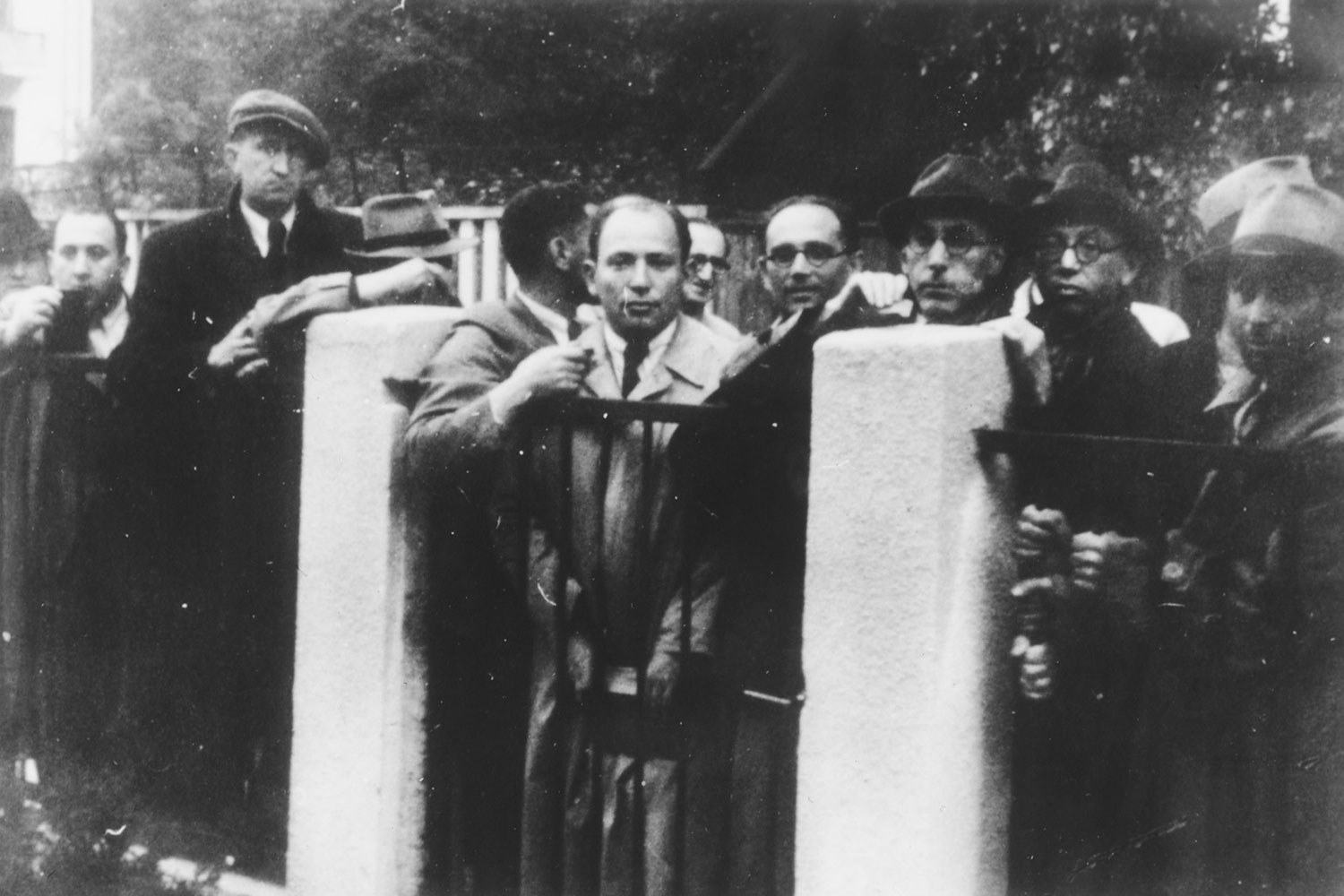
Jewish refugees crowded against the fence and gate posts of the Japanese consulate in Kaunas, Lithuania, waiting for transit visas, July 1940
Jewish refugees lined up outside the Japanese Consulate in Kaunas, Lithuania, waiting to receive transit visas from Chiune Sugihara, July 1940. Courtesy of Nobuki Sugihara via the United States Holocaust Memorial Museum.
01002009 July 1940, Tuesday — 1 visa10 July 1940, Wednesday — no visas issued11 July 1940, Thursday — no visas issued12 July 1940, Friday — no visas issued13 July 1940, Saturday — no visas issued14 July 1940, Sunday — no visas issued15 July 1940, Monday — 1 visa16 July 1940, Tuesday — 1 visa17 July 1940, Wednesday — no visas issued18 July 1940, Thursday — no visas issued19 July 1940, Friday — 2 visas20 July 1940, Saturday — no visas issued21 July 1940, Sunday — no visas issued22 July 1940, Monday — no visas issued23 July 1940, Tuesday — no visas issued24 July 1940, Wednesday — 4 visas25 July 1940, Thursday — 4 visas26 July 1940, Friday — 14 visas27 July 1940, Saturday — 41 visas28 July 1940, Sunday — no visas issued29 July 1940, Monday — 120 visas30 July 1940, Tuesday — 259 visas31 July 1940, Wednesday — 145 visas1 August 1940, Thursday — 154 visas2 August 1940, Friday — 135 visas3 August 1940, Saturday — 138 visas4 August 1940, Sunday — no visas issued5 August 1940, Monday — 166 visas6 August 1940, Tuesday — 127 visas7 August 1940, Wednesday — 211 visas8 August 1940, Thursday — 17 visas9 August 1940, Friday — 36 visas10 August 1940, Saturday — 21 visas11 August 1940, Sunday — no visas issued12 August 1940, Monday — 11 visas13 August 1940, Tuesday — 93 visas14 August 1940, Wednesday — 60 visas15 August 1940, Thursday — 19 visas16 August 1940, Friday — 53 visas17 August 1940, Saturday — 54 visas18 August 1940, Sunday — no visas issued19 August 1940, Monday — 86 visas20 August 1940, Tuesday — 81 visas21 August 1940, Wednesday — 51 visas22 August 1940, Thursday — 18 visas23 August 1940, Friday — 3 visas24 August 1940, Saturday — 2 visas25 August 1940, Sunday — no visas issued26 August 1940, Monday — 7 visas27 August 1940, Tuesday — 1 visa28 August 1940, Wednesday — 1 visa29 August 1940, Thursday — 1 visa30 August 1940, Friday — 1 visa31 August 1940, Saturday — 1 visano visasno visasno visasno visasno visasno visasno visas9 Jul15 Jul22 Jul29 Jul5 Aug12 Aug19 Aug26 Aug31 AugVisas per day on the register — grey columns are SundaysThe register's first line1The Dutch consulate opens the endorsement to everyone2Five refugee representatives put the case to Sugihara3A Sunday. Nothing.4Zwartendijk's highest numbered endorsement5Lithuania is incorporated into the USSR; the Dutch consulate is shut6The second peak — and then it stops7The ledger jumps from 189 to 2008The last day at the consulate9Five more, one a day10
Visas issued per day, from Sugihara's register as this archive holds it. Point at any day — or tab into the chart and walk it with the arrow keys — to see what was issued and which register numbers it covers. The numbered flags are the dated events below.

The shape carries the whole story. 4 visas on 24 July, 14 two days later, 41 the day after that. Then 259 on 30 July 1940 — a Tuesday — the busiest day of the eight weeks. 68% of the entire register, 1,455 visas, was written in the ten working days from 29 July to 7 August.

And from 24 July, once the queues had formed, there are exactly 5 days on which no visa was written at all — 28 July, 4 August, 11 August, 18 August and 25 August 1940. Every one of them is a Sunday, and every Sunday in those weeks is one of them. The gaps are not missing pages. They are a consulate keeping a six-day week while the queue outside grew.

Then it stops. 211 visas on 7 August, 17 the next day. The collapse is as sharp as the rise, and the archive cannot fully explain it: the Dutch endorsements that gave refugees a destination had ended four days earlier, and the queue may simply have exhausted the people holding one. That is a hypothesis, and it belongs with the open questions rather than being told as history.

What was open when

A transit visa was one link. It was worth nothing without a destination written somewhere, a Soviet exit permit, a seat on the railway, a ship, and somebody at the far end willing to let a stateless family off it. Each of those had its own opening and its own closing date, and a visa issued a fortnight later or earlier ran into a different set of them.

The first of those doors opened and shut a year before Sugihara wrote a single line. Nobody queued in Kaunas who had not first crossed out of Poland into Lithuania, and that crossing was only briefly a matter of walking.

The way in, from Poland

Before any of the rest of it, you had to be standing in Lithuania. That door opened and shut a year before the visas were written.

Crossing into Lithuania — while it could be done openlySeptember – mid-November 1939

Refugees had been crossing into still-neutral Lithuania since the invasion, but the wide opening came on 10 October 1939, when the Soviet Union announced it was handing the Vilna region to Lithuania. Free movement into Vilna lasted to the end of that month, and thousands walked in out of Soviet-held Poland. The border between Lithuania and the Soviet Union was closed in mid-November.

Source: Yad Vashem, “The Story of the Jewish Community of Vilna”

Crossing into Lithuania — closed, and crossed anywaymid-November 1939 – 15 June 1940

Shut, and still crossed: the smuggling routes ran all winter, and the Lithuanian interior ministry's own registrations climb from 18,000 refugees at the start of December 1939 to about 27,000 by February 1940. The Soviet occupation of 15 June 1940 ended it. Every man and woman who later queued at Sugihara's gate had come through this door first.

Source: We Refugees Archive, “Vilnius 1939/40”

The consulates in Kaunas

Who was still issuing, and until when.

Dutch consulate, Kaunas — Curaçao endorsements22 July – 3 August 1940

Jan Zwartendijk · Nine days if you count from the refugee crowd of 24 July, eleven from the first endorsements written into Dutch passports on the 22nd. The archive does not pick between them.

Source: Jan Brokken, The Just (2021)

Japanese consulate, Kaunas — transit visas9 July – 26 August 1940

Chiune Sugihara · 9 July is the register's own first dated line. The 26th is the day the literature gives for the consulate's last; the register carries five lines after it.

Source: Lucas Bruijn, “The Numbers Game in the Sugihara Curaçao Visas”

The Hotel Metropol — issuing after the consulate closedlate August – 4 September 1940

Chiune Sugihara · Ordered out with the other foreign missions, he moved to a hotel and went on writing until he left the city.

Source: Yukiko Sugihara, Visas for Life (1995)

The road east

The Soviet exit permit, the railway, the ships — a visa was only as good as the next leg.

Soviet exit permits, sold through Intouristautumn 1940 – 22 June 1941

Payable in hard currency, which is why the Joint's money mattered as much as the visas did.

Source: Zorach Warhaftig, oral history

Trans-Siberian: Moscow to Vladivostoklate October 1940 – 22 June 1941

Ten or eleven days in a closed train, then about six days waiting at the port. Closed for good when Germany invaded the Soviet Union.

Source: Zorach Warhaftig, oral history

Vladivostok to Tsuruga, across the Sea of Japanlate October 1940 – 22 June 1941

Saburo Nei, consul at Vladivostok · The last checkpoint before the ship. Nei let refugees board on irregular and expired papers.

Source: Flight and Rescue

Kobe — transit stays, renewed in ten-day stepswinter 1940 – autumn 1941

Jewcom, and Setsuzo Kotsuji · A visa good for ten days held thousands for the better part of a year, one renewal at a time.

Source: Kobe City, “Kobe and Jewish Refugees”

The gates at the far end

Where a ten-day transit stay could be turned into somewhere to live.

United States immigration visas issued at Kaunasuntil the consulate closed, late summer 1940

A few dozen in all before the consulate closed — the Polish quota was small and long oversubscribed. A transit visa was the common paper precisely because this one was not obtainable.

Source: The safe-conduct pass of Markus Nowogrodzki

Onward destination visas from the Polish embassy in Tokyowinter 1940 – autumn 1941

Ambassador Tadeusz Romer · Around a thousand refugees were found a final destination this way. The rest were sent on to Shanghai.

Source: “The Curaçao Visa”, Netherlands Embassy in Tokyo

Shanghai — the destination for those who got no otherthe second half of 1941, and the rest of the war

Roughly 1,100 were moved on from Japan in the second half of 1941, and stayed for the rest of the war.

Source: “The Curaçao Visa”, Netherlands Embassy in Tokyo

Oct 1939Jan 1940AprJulOctJan 1941AprJulOct
The way in Kaunas The road east The gates at the far end a faded end is a date the archive cannot fix to a day

The chronology

Every entry names where its date comes from. Where the sources disagree — and on the two most quoted dates of the whole story, the day Zwartendijk stopped and the day Sugihara stopped, they do — both readings are given and neither is picked.

  1. ·
    1 September 1939 · Poland
    Germany invades Poland
    Hundreds of thousands of Jews flee east. The largest number end up in Vilna, which the Soviets hand to still-independent Lithuania that October; by the end of the year more than 30,000 Polish-Jewish refugees are crowded there. Vilna is the waiting room for everything that follows.
    SourceFlight and Rescue — United States Holocaust Memorial Museum exhibition and collection
  2. ·
    15 June 1940 · Kaunas
    Soviet troops enter Lithuania
    The country the refugees had reached stops being neutral ground. From here the consulates in Kaunas are working on borrowed time, and everyone in the queues knows it.
    SourceFlight and Rescue — United States Holocaust Memorial Museum exhibition and collection
  3. 1
    9 July 1940 · Kaunas
    The register's first line
    No. 1. Then a visa on the 15th, one on the 16th, two on the 19th — five in a fortnight. Whatever was about to happen had not started yet.
    SourceSugihara's register — the numbered lines as this archive holds them
  4. ·
    11 July 1940 · Riga
    The sentence that made a destination
    The Dutch ambassador in Riga, L. P. J. de Decker, writes into Pessla Lewin's passport that no visa is required for admission to Curaçao — leaving out that admission still lay with the colonial governor. He authorises the wording for a handful of Dutch nationals and no one else.
    Source“The Curaçao Visa”, Netherlands Embassy in Tokyo — exhibition opened 21 February 2023, later touring Japan
  5. ·
    22 July 1940 · Kaunas
    Zwartendijk copies the wording
    Into the papers of the Lewin household and of the Dutch yeshiva student Nathan Gutwirth. This is still the narrow, authorised version of the thing: five or six people who hold Dutch passports.
    SourceJan Brokken, The Just (2021) — the standard life of Jan Zwartendijk
  6. 2
    24 July 1940 · Kaunas
    The Dutch consulate opens the endorsement to everyone
    Gutwirth asks Zwartendijk whether he will write it for refugees who are not Dutch citizens, and Zwartendijk says at once that he will give it to anyone who comes to his office. Warhaftig sends word to the yeshivot and the shtetls. Warhaftig's own visa is dated this day. The register jumps from single lines to four, then fourteen, then forty-one.
    Source“The Curaçao Visa”, Netherlands Embassy in Tokyo — exhibition opened 21 February 2023, later touring Japan
  7. 3
    27 July 1940 · Kaunas
    Five refugee representatives put the case to Sugihara
    The meeting that turned a trickle into an operation. Two days later the register records 120 visas in a day, and the day after that, 259 — the high-water mark of the whole eight weeks.
    Source“The Curaçao Visa”, Netherlands Embassy in Tokyo — exhibition opened 21 February 2023, later touring Japan
  8. 4
    28 July 1940 · Kaunas
    A Sunday. Nothing.
    The first of five blank Sundays. Every single Sunday inside the busy window is empty in the register, and no other weekday is. The gaps are not missing pages — they are a consulate keeping a six-day week through the most desperate month of its existence.
    SourceSugihara's register — the numbered lines as this archive holds them
  9. 5
    2 August 1940 · Kaunas
    Zwartendijk's highest numbered endorsement
    No. 2,345, for Eliasz Kupinski. He had written the first thirteen hundred or so by hand in four days before having a rubber stamp cut.
    SourceJan Brokken, The Just (2021) — the standard life of Jan Zwartendijk
  10. 6
    3 August 1940 · Kaunas
    Lithuania is incorporated into the USSR; the Dutch consulate is shut
    Zwartendijk's office was a room in the Philips works, and the Soviets close it. He burned the record of who he had helped rather than leave it to be found, which is why his endorsements can be counted but not named.
    ContestedThe archive's own documents run out at 2 and 3 August; the Netherlands Embassy's account has him continuing in secret after the office was shut, with the records burned in mid-August. Both readings are on the record and this archive does not choose.
    SourceJan Brokken, The Just (2021) — the standard life of Jan Zwartendijk
  11. 7
    7 August 1940 · Kaunas
    The second peak — and then it stops
    The second peak, and the end of the flood: 17 the next day, 36 the day after. Two-thirds of every visa on the register was written in the ten working days from 29 July to 7 August. What broke on the 8th the archive cannot yet say — the Curaçao endorsements had stopped four days earlier, and the queue may simply have run out of people holding one.
    ContestedOffered as a question, not an explanation. If you know what happened at the consulate that week, the archive would like to hear it.
    SourceSugihara's register — the numbered lines as this archive holds them
  12. 8
    24 August 1940 · Kaunas
    The ledger jumps from 189 to 200
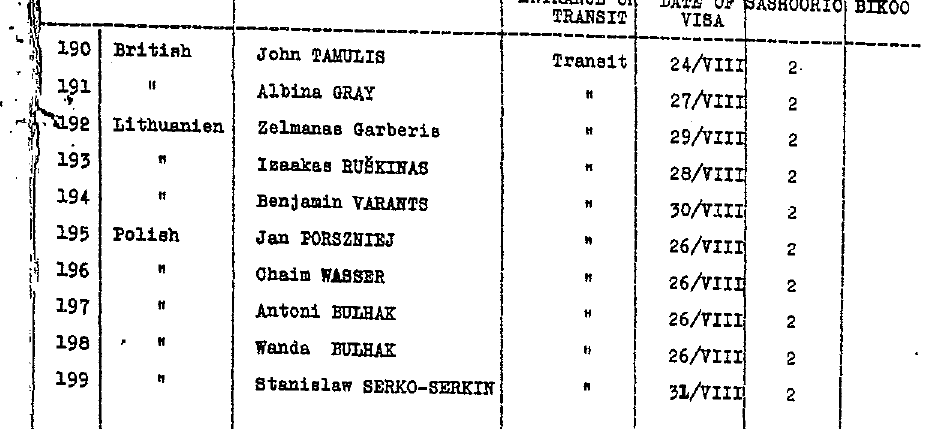
    On the fifth page of the register the numbering runs 189, then straight to 200 — and somebody noticed: the jump is circled by hand on the page, with a note in Japanese written beside it. The ten numbers it skips are not lost. They are on a sheet of their own, with its own column header, ten typed lines and the rest of the page left blank, every one of them issued between 24 and 31 August — the consulate's final week. This archive reads that as a transcription that lost a range and recovered it. The list was typed up after the fact, in Prague, and typed in number order; these ten belonged early in the sequence but were written in the last week, so when the typist reached 189 they were not in front of him. He went on to 200 and added them afterwards, on a page of their own. That accounts for the low numbers, the late dates and the fresh column header at once — and the note in the margin says as much. Read for this archive in August 2026, it reports that the skipped numbers are carried on the next sheet. Whoever ringed the jump was not flagging a problem; he was pointing the reader forward.
    Register page five: the number column runs 189 straight to 200, the jump circled by hand with a note in Japanese in the margin. Brucha and Emanuel Pat are the two lines it falls between.
    Register page five: the number column runs 189 straight to 200, the jump circled by hand with a note in Japanese in the margin. Brucha and Emanuel Pat are the two lines it falls between.
    The next page: a sheet of its own, its own column header, the ten missing numbers 190–199, and nothing after them. Every date reads VIII — August.
    The next page: a sheet of its own, its own column header, the ten missing numbers 190–199, and nothing after them. Every date reads VIII — August.

    From the Foreign Ministry register held by this archive — pages five and six.

    SourceThe Foreign Ministry typescript — the original 33-page register, read page by page — this archive holds a scan
  13. 9
    26 August 1940 · Kaunas
    The last day at the consulate
    Seven lines, among them No. 2,139 — Abelis Chaimas, the highest number on the register. The published accounts end the story here.
  14. 10
    27 August – 31 August 1940 · Kaunas
    Five more, one a day
    27, 28, 29, 30, 31 August: a single visa on each — Albina Gray, Izaakas Ruškinas, Zelmanas Garberis, Benjamin Varants, Stanislaw Serko-Serkin. All five are on that same held-back sheet, beside five more dated the 24th and the 26th. Turned out of the consulate, Sugihara took a room at the Hotel Metropol and went on writing; one page carrying ten names is what the register has to say about those last days.
    ContestedThe literature dates the last visa to 26 August. These five lines are in the register this archive holds, on a sheet whose ten entries all fall in the final week, and are shown as they stand.
    SourceSugihara's register — the numbered lines as this archive holds them
  15. ·
    4 September 1940 · Kaunas
    Sugihara leaves Kaunas
    By his wife's account he was still handing papers through the window of the train as it pulled out. He went on to Berlin, then Prague, where the list itself was finally typed up.
    SourceYukiko Sugihara, Visas for Life (1995) — her husband's departure from Kaunas, in her account
  16. ·
    25 October 1940 · Moscow → Vladivostok
    The first organised groups start east
    Warhaftig travels with one of them: Moscow, then ten or eleven days in a closed train across Siberia, then about six days waiting at Vladivostok for a small ship on the Tsuruga run. A visa written in July is not used until the end of October — the gap between the date on the paper and the day of the journey is normal, and often months.
    SourceZorach Warhaftig, oral history — United States Holocaust Memorial Museum, Flight and Rescue, RG-50.494.0019
  17. ·
    1 November 1940 · Tsuruga · Kobe
    Tsuruga, and the winter in Kobe
    The gangplank came down at Tsuruga in Fukui, where a landing permit was stamped into the papers — this archive holds sixty-three of them. From there to Kobe, where the Jewish community met each ship and carried thousands through the winter on the Joint's money, and where a Hebrew scholar named Setsuzo Kotsuji spent months getting ten-day visas renewed for people with nowhere to go.
    SourceKobe City, “Kobe and Jewish Refugees” — the city's own account of the winter of 1940–41
  18. ·
    18 March 1941 · Tsuruga · Tokyo
    Seventy-four refused at the gangplank
    Japan's transit policy tightened, and a shipload was refused landing at Tsuruga. The Netherlands Legation in Tokyo certified all seventy-four by name so that they could be admitted. Thirty-five of them held no Sugihara visa at all — proof, in one document, that the route carried more people than the register lists.
    SourceThe Netherlands Legation certificate, Tokyo, 18 March 1941 — signed by Minister J. C. Pabst, naming all 74 travellers — in this archive
  19. ·
    22 June 1941 · The Soviet Union
    Germany invades the Soviet Union — the railway closes
    The land route across Siberia ends on this date and does not reopen. Anyone still holding an unused transit visa in Lithuania is now holding a piece of paper.
    SourceFlight and Rescue — United States Holocaust Memorial Museum exhibition and collection
  20. ·
    1 August 1941 · Kobe → Shanghai
    Japan moves the refugees on to Shanghai
    Around a thousand had been found a real destination through Ambassador Romer's embassy in Tokyo. Roughly 1,100 more, with nowhere else to be sent, were put on ships for Shanghai, where they sat out the war.
    Source“The Curaçao Visa”, Netherlands Embassy in Tokyo — exhibition opened 21 February 2023, later touring Japan
  21. ·
    8 December 1941 · The Pacific
    Pearl Harbor
    The Pacific crossing closes behind them. Whether a family reached the United States or spent four years in Shanghai was decided by which side of this date their onward visa fell on — and that, more than the visa from Kaunas, is what the dates on this page are for.
    SourceFlight and Rescue — United States Holocaust Memorial Museum exhibition and collection

Reading a date on a visa

VII is July and VIII is August. The months on these documents are written in Roman numerals, in ink, by a hand working at speed, and the commonest error in the whole archive is a stroke lost between the two. When this archive audited its own dated documents in 6 August 2026, the misreadings ran in one direction: August visas transcribed as July. One register line, No. 879, was carried here as 27 August until the document was read again and plainly said 24 July. It is corrected, and the correction is on the record like every other.

A second date is not a second visa. The red mark in the lower corner of many of these documents is a landing permit stamped at Tsuruga on arrival in Japan, often months after the visa was written. Read as an issue date it puts Sugihara at his desk on days he was nowhere near Kaunas.

Zwartendijk's serial number dates his endorsements better than the ink does. He was at about No. 1,300 after four days and reached No. 2,345 by 2 August, so a number will settle an ambiguous month where the handwriting will not.

The date on the paper is not the date of the journey. The first organised groups did not leave for Moscow until the end of October 1940. A visa written on the busiest day of the register sat in a pocket for three months before anyone boarded a train on it.

This page is about days. There is a second timeline in the archive, on Anatomy of a Visa, about the documents themselves — Sugihara's hand giving way to a rubber stamp as the queue outgrew him, and Zwartendijk's making the same journey a fortnight earlier. Read together they answer different halves of the same question: what was happening that week, and what the paper from it looks like.

Dates are given as the sources give them. Where a date is contested it is marked contested and both readings are shown; where it rests on a document in this archive, that is said. If you hold a paper that settles one of them — a dated letter, a stamped passport page, a consular record — the archive would be glad to see it. Contribute a document →