Leiba Levin
Leiba Levin received transit visa no. 13 at the Japanese consulate in Kaunas on 25 July 1940. Aged 29 in 1940.
Documents
Click a document to see it larger.
What the register records
- Nationality as recorded
- Polisch
- Age in 1940
- 29
- Family, per the Kitade-Bluman list
- wife of #17
The journey
Reached Japan; aided by the Polish ambassador Tadeusz Romer; registered in Kobe for USA.
What is known
Pessla Lewin, a Dutch national, approached the Dutch legation in Kaunas in July 1940 seeking a destination visa. Ambassador de Decker altered her passport to state that no entry visa was required for Curacao, omitting the governor's permit requirement, and Zwartendijk copied the same phrasing for her Dutch family. With these documents her family obtained Japanese transit visas from Sugihara, enabling escape via Japan.
In late June 1940 Pessla Lewin, a former Dutch citizen married to the Pole Isaac Lewin, sought help escaping Soviet-occupied Lithuania. Ambassador de Decker wrote in her Polish passport on July 11, 1940 that no visa was required for Curacao and other Dutch possessions in the Americas, creating the first 'Curacao visa.' On July 26, 1940 the Lewin family (Isaac, Pessla, young son Nathan, plus Pessla's mother Rachel Sternheim and brother Levi Sternheim) presented these visas to Sugihara, establishing the Curacao visas' credibility for subsequent refugees.
Mrs. Pessla Lewin, formerly of Dutch nationality and married to the Polish rabbi Isaac Lewin, initiated the Curacao visa scheme by obtaining from Dutch ambassador De Decker a note that no visa was required for Curacao and Surinam, then had Zwartendijk copy it. Sugihara granted the family Japanese transit visas on 25 and 26 July 1940 (their son Nathan included). The family eventually obtained a Palestine visa and a Soviet transit/exit visa, leaving Vladivostok for Japan on 31 December 1940 and arriving in Kobe on 2 January 1941.
"Could we leave out the part about needing to obtain a permit?" Pessla asked. Once Pessla's family had their pseudo-destination visas to Curaçao, they went to the Japanese consulate to apply for transit visas through Japan.
for the admission of aliens to Surinam, Cura fao and other Dutch possessions in the Americas, an entry visa is not required. Both of these fCura fao visas f appear in Isaac Lewin fs book. His son Nathan, who escaped with his parents as a 5-year old, still has the originals.
LEVIN , Leiba Polnisch 25 July No.13 LEVIN , Isak Polnisch 26 July No.17 Transit Visa 26 VII 1940. Seen for the journey to Curaçao and Surinam through Japan. 100. Lewin Izaak Age 30 Born in Wieliczka; Profession: Rabbi; Date of arrival 2.1.1941, coming from Vilno
Where this comes from
- List of Refugees, Vilna, 1940 — JDC Archives, New York, collection AR 33/44, file 00876. The contemporary register of Polish Jewish refugees in Lithuania, running to more than nine thousand numbered entries; the fullest independent check…
The 1940 Vilna refugee list has, at entry 3335, Lejb Lewi, born 1909 at Wilno, who had come from Warsaw; the year agrees with the register's age. - List of Refugees, Vilna, 1940 — JDC Archives, New York, collection AR 33/44, file 00876. The contemporary register of Polish Jewish refugees in Lithuania, running to more than nine thousand numbered entries; the fullest independent check…
The 1940 Vilna refugee list has a Leja Lewit at entry 8032, born 1911 at Warszawa, who had come from Warszawa; the register spells the surname Lewin, so the archive shows the entry as a lead, not as this person's record. - Oral history interview with Nathan Lewin — USC Shoah Foundation Visual History Archive, in… — transcript read 24 Aug 2026 (streams online; interviewed Potomac, Maryland, 17 April 2024, interviewer Ginny Glickman; captions in 14 languages)
USC Shoah Foundation VHA interview 62029: Nathan Lewin — his mother Pessla — gave a testimony (catalogue: born Jan 31 1936, Łódź (Łódź, Poland)); born Lodz 31 Jan 1936; parents Isaak and Doba (Pessla) Lewin, Nos.17 and 13 - "California, San Francisco, Passenger Lists, 1893-1953", FamilySearch — index entry for Pessla Lewin, 1941: born about 1912, Poland. Digitised from NARA microfilm publication M1410 (passenger lists of vessels arriving at San Francisco).…
FamilySearch's index of the San Francisco passenger lists, read by the archive on 20 September 2026, has Pessla Lewin, born about 1912 in Poland, arriving at San Francisco in 1941. The register's compiled line gives 1911, and the two are 1 year apart. The name occurs once on the register, and a Polish-born passenger landing at San Francisco in 1941 fits the route through Japan, so the entry is taken as this person's under the archive's rule of 19 September 2026 for records from the route. - "California, San Francisco, Passenger Lists, 1893-1953", FamilySearch — index entry for Lejma Lewin, 1946: born about 1916, Poland. Digitised from NARA microfilm publication M1410 (passenger lists of vessels arriving at San Francisco). R…
FamilySearch's index of the San Francisco passenger lists, read by the archive on 20 September 2026, has Lejma Lewin, born about 1916 in Poland, arriving at San Francisco in 1946. The register's compiled line gives 1911. A lead only: the register carries 2 lines of this name, and the index entry cannot be assigned to one of them without the manifest sheet. - Manifest of alien passengers, M.S. Kamakura Maru, sailing from Kobe 11 June 1941, arrived San Francisco date not read (US National Archives, M1410, film 370; read on FamilySearch's copy)
The Kamakura Maru's manifest, Kobe to San Francisco in June 1941 (US National Archives, read on FamilySearch's copy), lists Pessla Lewin, 29, born in Baligród and last living in Łódź, admitted as a visitor and going to her husband Izaak Lewin in Brooklyn. Sugihara's list writes her given name as Leiba. - Chiune Sugihara Facts - The Sugihara Curaçao Visas
- Sugihara Database
- Jan Zwartendyk Jr., "Jan Zwartendijk — his activities as Dutch consul in Lithuania, 1940" (remember.org, updated 3 December 2005)
- Alyza D. Lewin, Times of Israel/JTA (26 Apr 2016): "How my grandmother's chutzpah helped Japan's consul save thousands of Jews" — Peppy Sternheim Lewin obtained the FIRST Curaçao formula (de Decker, Riga, 11 Jul 1940 in her passport; Zwa…
- Oral history interview with Nathan Lewin — USC Shoah Foundation Visual History Archive, in… — transcript read 24 Aug 2026 (streams online; interviewed Potomac, Maryland, 17 April 2024, interviewer Ginny Glickman; captions in 14 languages)
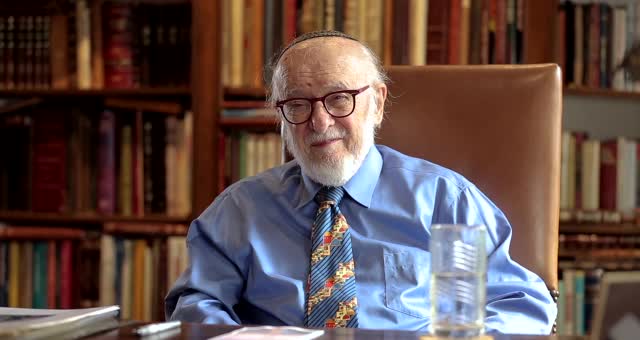
- Catalogue still for the oral history of Nathan Lewin — USC Shoah Foundation Visual History Archive, interview 62029 (the archive's public catalogue frame, 352x240); links to the testimony at vha.usc.edu/testimony/62029