Majska Riwa
Majska Riwa received transit visa no. 1545 at the Japanese consulate in Kaunas on 8 August 1940. Aged 46 in 1940.
Documents
Click a document to see it larger.
What the register records
- Nationality as recorded
- Polnisch
- Age in 1940
- 46
- Family, per the Kitade-Bluman list
- children (Mira (18), Saul (12)), mother of #1544
The journey
Reached Japan; aided by the Polish ambassador Tadeusz Romer; registered in Kobe for USA.
Travelled with, and never given a number
- Mira (later Mira Appel) — daughter, aged 18
- Szloma (Shlomo, later Saul Manski) — son, aged 12
The register recorded visa holders. It did not reliably record the wives and children who travelled on somebody else’s visa, so these people have no entry of their own and cannot be searched for. Where the archive has recovered a name, it is here.
What is known
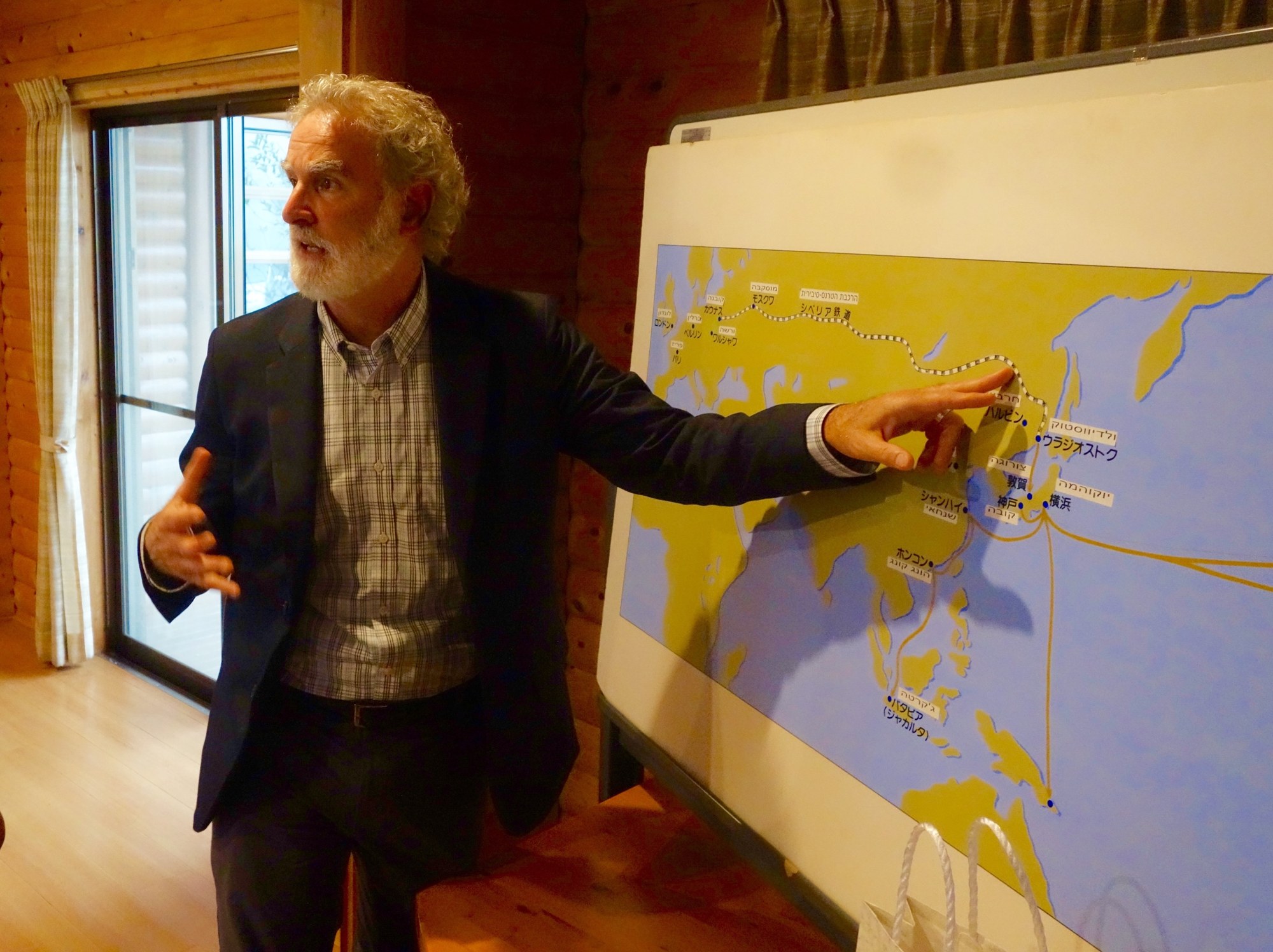
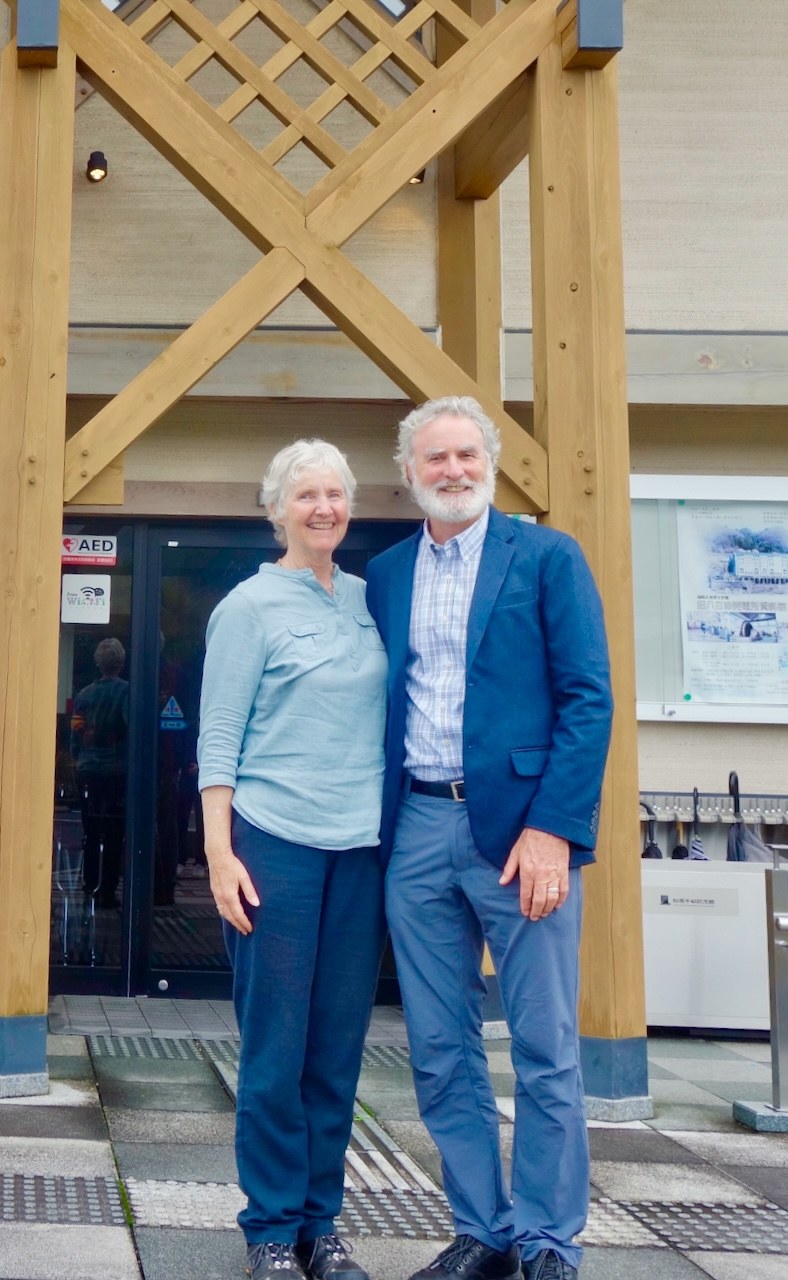
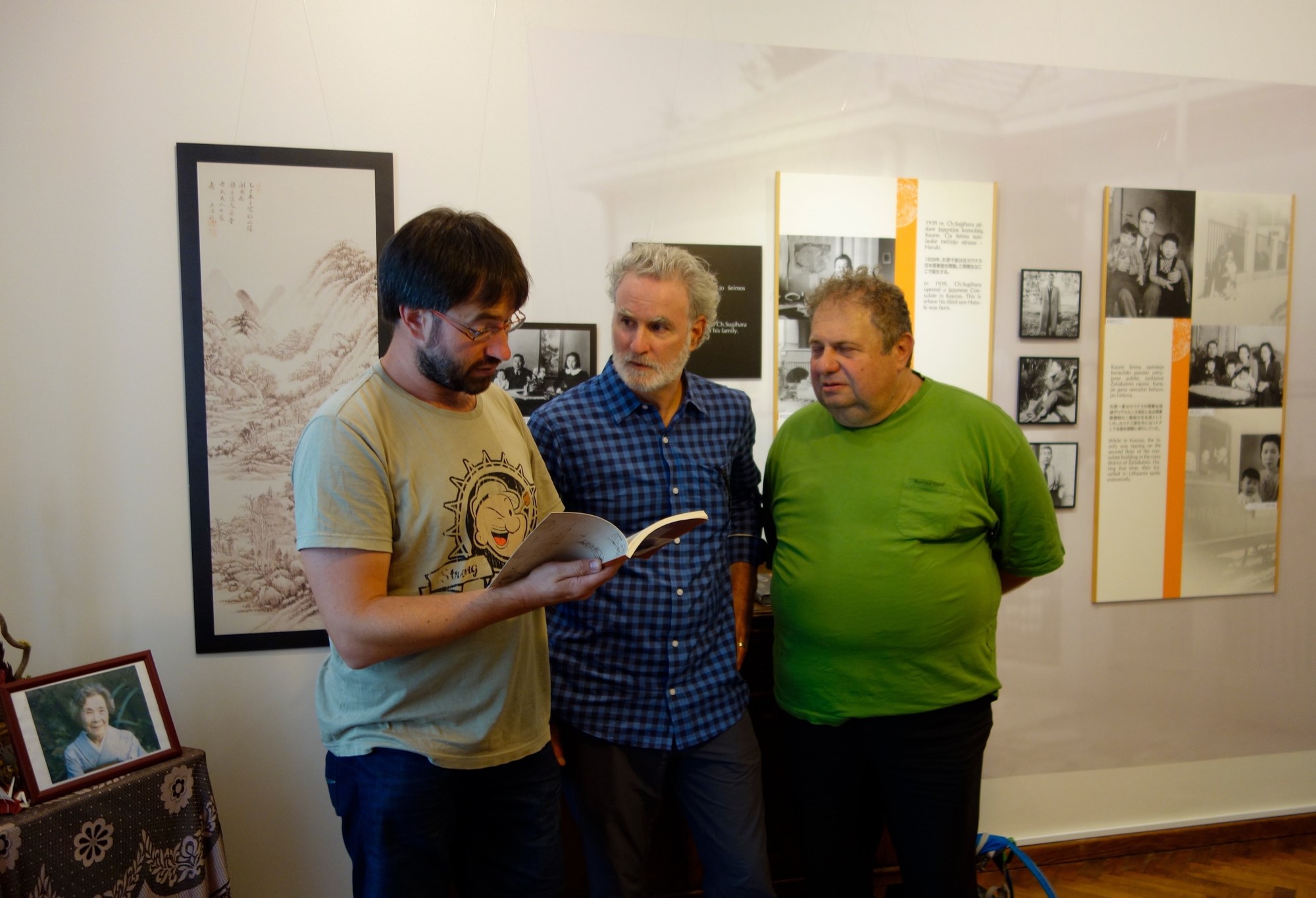
The family's journey retraced, 2017. David Manski, Rywa's grandson and Saul's son, and his wife spent six weeks in the late summer of 2017 following the family's route from Lida to Kaunas, across Siberia to Tsuruga, Kobe and Yaotsu. He wrote this account for the archive in October 2026.
In late summer 2017, my wife, Shira Singer, and I spent about six weeks retracing my family's 1939–1941 escape from their hometown of Lida, Poland (now Belarus), to the United States. They survived the Holocaust thanks to the humanity and generosity of Japanese diplomat Chiune Sugihara, who issued my father's family two transit visas to travel east. My father, Saul Manski, was about 11 when the journey began. We started in Lida and then went to Kaunas, Lithuania, to visit the former Japanese consulate, now the Sugihara House Museum. We arrived nearly 77 years to the day after my family received their visas at that very location. We met with museum director Simonas Dovidavičius and museum historian Dr. Linas Venclauskas to talk about our family's connection to Sugihara. Remarkably, a group of students, their principal, and the deputy mayor of Yaotsu, Japan (Sugihara's hometown) arrived during our visit, and as the son of a Sugihara survivor, I was asked to speak to them. It was powerful for all of us to stand in the place where Sugihara enabled my family and thousands of other Jewish refugees to survive. We then followed my family's route east, taking the Trans-Siberian Railway from Moscow to Vladivostok and a ferry to Japan. We wanted to visit Japan to pay our respects and give thanks at the museums dedicated to Sugihara. We first went to Tsuruga, where my father and his family arrived in January 1941. At the Port of Humanity Museum, a memorial to the community's efforts to welcome people in need, including Jewish refugees fleeing the Nazis in 1940–1941, director Nishikawa Akinori and Mayor Takanobu Fuchikami received us with overwhelming kindness, likely much as my family was received. We also visited Kobe, where my family and other refugees lived during their stay in Japan. Finally, we went to the Chiune Sugihara Memorial Hall in Yaotsu, where the museum director and the deputy mayor we had met in Kaunas greeted us warmly. Both museums have excellent exhibits in Japanese, Hebrew and English that tell the story of the Holocaust, explain Sugihara's role in saving Jewish refugees, and share survivors' testimonies. Retracing my family's complete journey was emotional and memorable. It also allowed us to thank the Japanese people for keeping Sugihara's memory alive and for teaching today's generation that hatred, prejudice and violence have no place in this world. — David Manski, 3 October 2026
Where this comes from
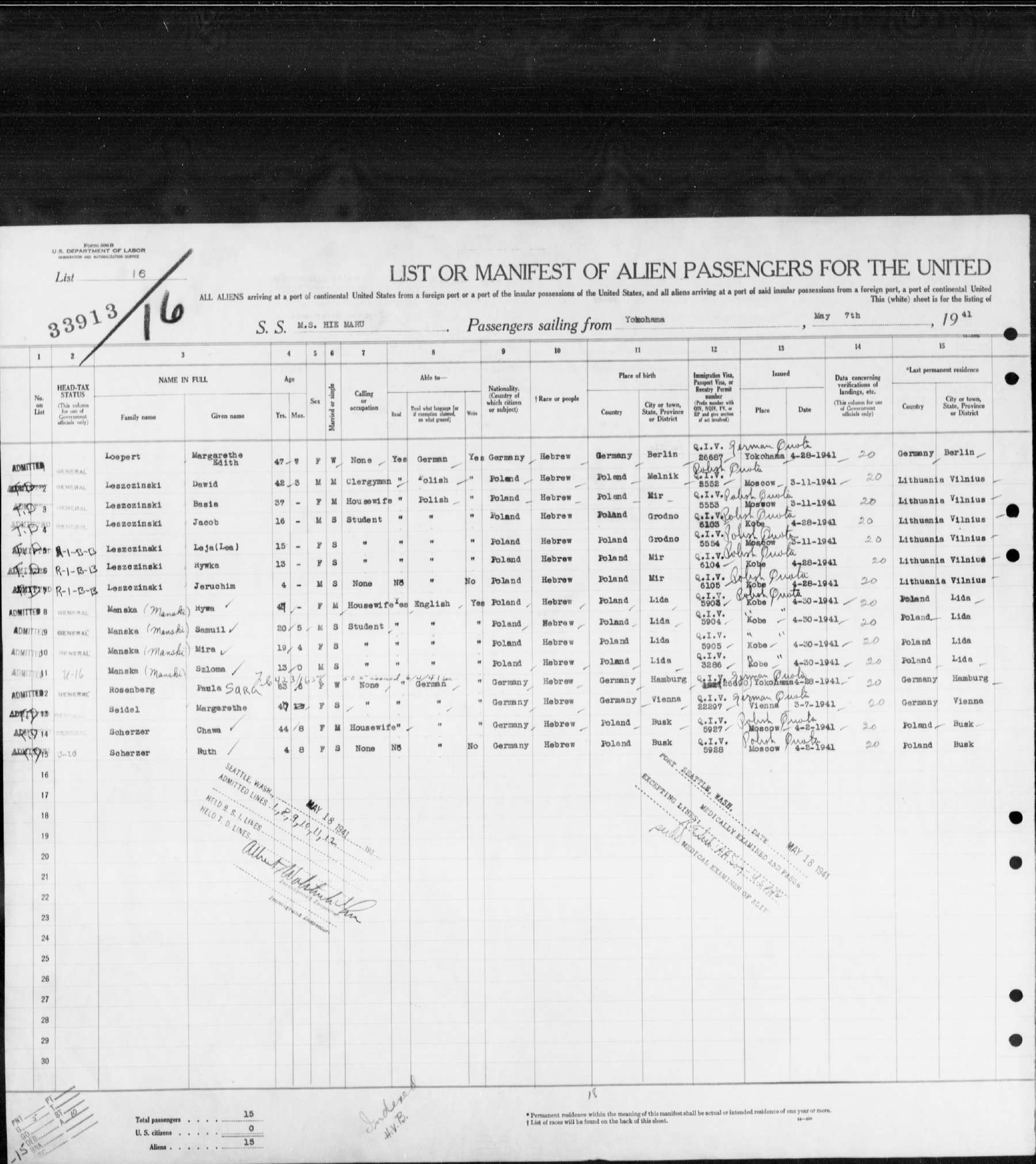
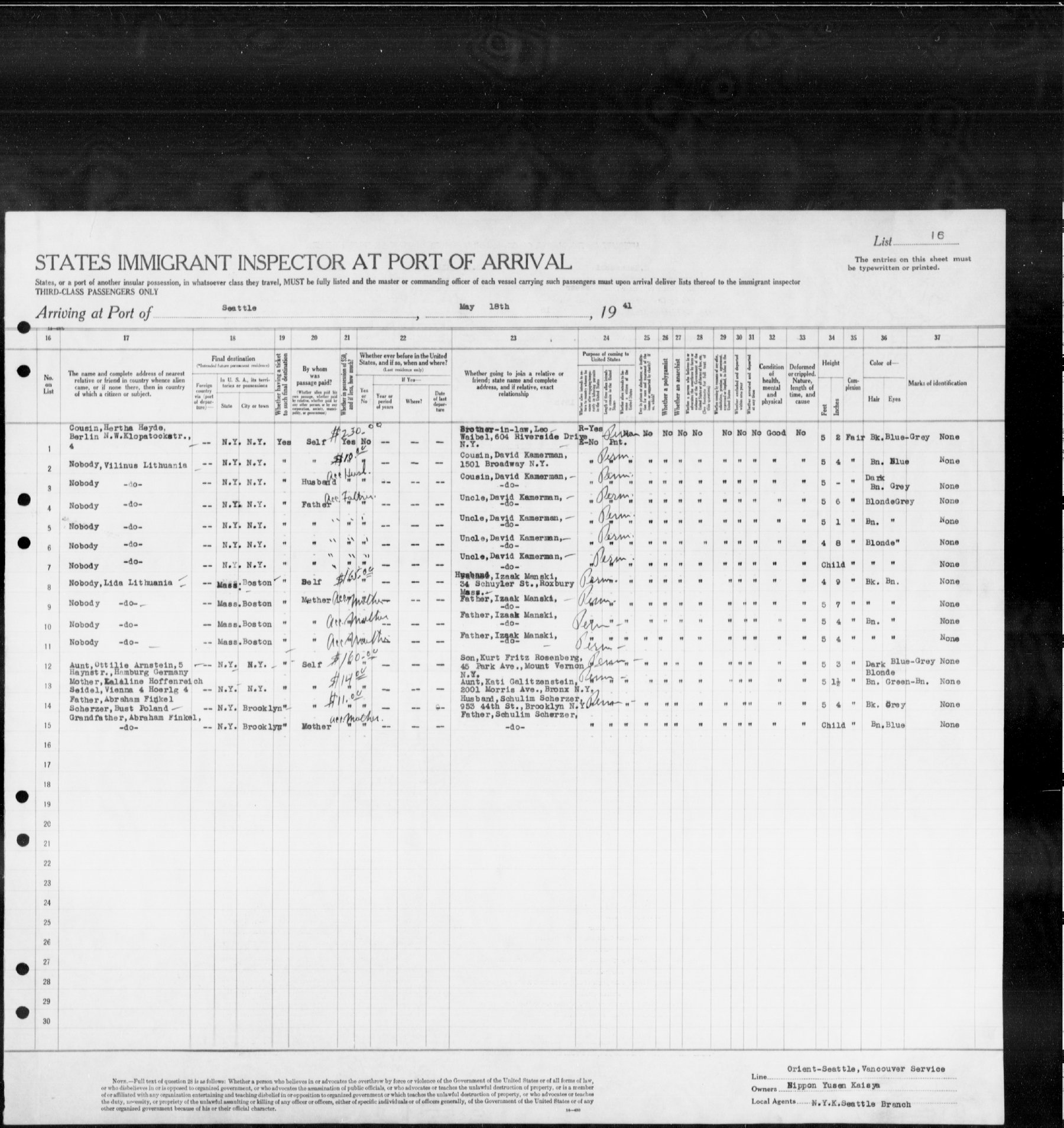
- M.S. Hie Maru, Kobe 4 May – Yokohama 7 May – Seattle 18 May 1941, sheet 5 of 11 — transcribed for the Immigrant Ships Transcribers Guild by David Rosen
Hie Maru passenger no. 109; Housewife; b. Lida, Poland; last residence Lida, Poland; US visa Q.I.V.5903, issued Kobe, 4-30-1941; to Boston, Mass.; joining Husband, Izaak Manski, 34 Schuyler St. Roxbury, Mass.; nearest relative left behind: Nobody, Lida, Lithuania - M.S. Hie Maru, Kobe 4 May – Yokohama 7 May – Seattle 18 May 1941, sheet 5 of 11 — transcribed for the Immigrant Ships Transcribers Guild by David Rosen
Hie Maru passenger no. 111; 19y 4m; Student; b. Lida, Poland; last residence Lida, Poland; US visa Q.I.V.5905, issued Kobe, 4-30-1941; to Boston, Mass.; joining Father, Izaak Manski, 34 Schuyler St. Roxbury, Mass.; nearest relative left behind: Nobody, Lida, Lithuania; daughter of No. 1545 — Bluman’s note on her mother’s line reads "children Mira (18), Saul (12)"; not separately on the register - M.S. Hie Maru, Kobe 4 May – Yokohama 7 May – Seattle 18 May 1941, sheet 5 of 11 — transcribed for the Immigrant Ships Transcribers Guild by David Rosen
Hie Maru passenger no. 112; 13y 0m; Student; b. Lida, Poland; last residence Lida, Poland; US visa Q.I.V.3286, issued Kobe, 4-30-1941; to Boston, Mass.; joining Father, Izaak Manski, 34 Schuyler St. Roxbury, Mass.; nearest relative left behind: Nobody, Lida, Lithuania; son of No. 1545, the "Saul (12)" of Bluman’s note, here as Szloma aged 13; not separately on the register - "Washington, King, Seattle, Passenger Lists, 1890-1957", FamilySearch — index entry for Rywa Manska or Manski, 1941: born about 1894, Poland. Digitised from NARA microfilm publication M1383 (passenger and crew lists of vessels arriving a…
FamilySearch's index of the Seattle passenger lists, read by the archive on 20 September 2026, has Rywa Manska or Manski, born about 1894 in Poland, arriving at Seattle in 1941. The register's compiled line gives 1894, and the two agree. The name occurs once on the register, and a Polish-born passenger landing at Seattle in 1941 fits the route through Japan, so the entry is taken as this person's under the archive's rule of 19 September 2026 for records from the route. - The JEWCOM register — the refugee register kept by the Refugee Committee of the Jewish Community of Kobe (Ashkenazim) at No. 6 Yamamoto-dori, 1-chome, whose cable address was 'JEWCOM Kobe'. Eighty-four pages on the committee's own printe…
Entry 450 of the Kobe Jewish Community's refugee register: aged 47, listed with Mira, 19 (entry 451), and Szloma, 13 (entry 452); arrived in Japan from Vilnius on 13 February 1941. The family writes (David Manski, 2 October 2026) that Mira and Szloma travelled on their mother's visa, having none of their own. - David Manski (Bar Harbor, Maine), letters to the archive of 2 October 2026 — the family of Rywa Manska (No. 1545): her children Mira (later Mira Appel) and Shlomo (Saul) travelled east on her Sugihara visa without lines of their own; Sau…
The family's own account, given by David Manski, her grandson, on 2 October 2026: Rywa's daughter Mira and her son Shlomo travelled east on her Sugihara visa without lines of their own, Mira about seventeen and Shlomo about twelve. Shlomo turned thirteen on 18 May 1941 and had his bar mitzvah at Kobe; the family sailed for the United States soon after. Later Saul Manski, he died on 22 April 2015; his sister, later Mira Appel, died on 11 November 2017. In 2017 David Manski and his wife retraced the family's route from Lida through Kaunas, the Trans-Siberian Railway, Tsuruga, Kobe and Yaotsu. - JDC Archives, New York, collection AR 33/44 file 53 (the Jewish Community of Kobe's returns to the JDC, 1941; Set I, item 00761) — Set… — "List of refugees who left Japan to places other than Shanghai in the month of May 1941", Nos. 1–321
She left Yokohama on the Hie Maru on 7 May 1941, bound for the USA (the Jewish Community of Kobe's list of departures, May 1941 (JDC Archives, AR 33/44 file 53)). The list reads: No. 33–35: "Manski [given name faint: Rywa/Ewa?], ″ Mi[r]a, ″ S[a]l[o]m[o]n? (faint carbon)". (Hie Maru, Yokohama, 7 May 1941.) - National Archives and Records Administration, Alien Case Files (Record Group 566), catalog descriptions read through the NARA Catalog API
The National Archives holds an alien case file for Rywa Manska, born 1 January 1894 in Poland, who entered the United States at Seattle on 18 May 1941 (file A7538041, NARA catalog NAID 40211227). The name and the birth year agree with the register's line, and the port and date of entry are the route's. - A ship, arriving at Seattle in 1941: list or manifest of alien passengers, the sheet that names Jacob Leszczinski — US National Archives, Record Group 85 (Immigration and Naturalization Service), Passenger and Crew Lists of Vessels Arriv…
- David Manski, '2017 Journey Retracing the Manski Family's Escap… — his account written for the archive, 3 October 2026, with three photographs from the journey (the Sugihara House Museum, Kaunas; the Chiune Sugihara Memorial Hall, Yaotsu)
- Arriving at Seattle: the continuation sheet, with the relatives named and the destinations, for the sheet that names Jakob Leszczynski — US National Archives, Record Group 85 (Immigration and Naturalization Service), Passenger and Crew L…