Oskar Schenker
Oskar Schenker received transit visa no. 476 at the Japanese consulate in Kaunas on 31 July 1940. The register records mechanic, aged 40.
Documents
Click a document to see it larger.
What the register records
- Nationality as recorded
- Polnisch
- Age in 1940
- 40
- Occupation
- Mechanic
- Family, per the Kitade-Bluman list
- brother of #477
The journey
Reached Japan; reached Shanghai; aided by the Polish ambassador Tadeusz Romer; registered in Kobe for USA.
What is known
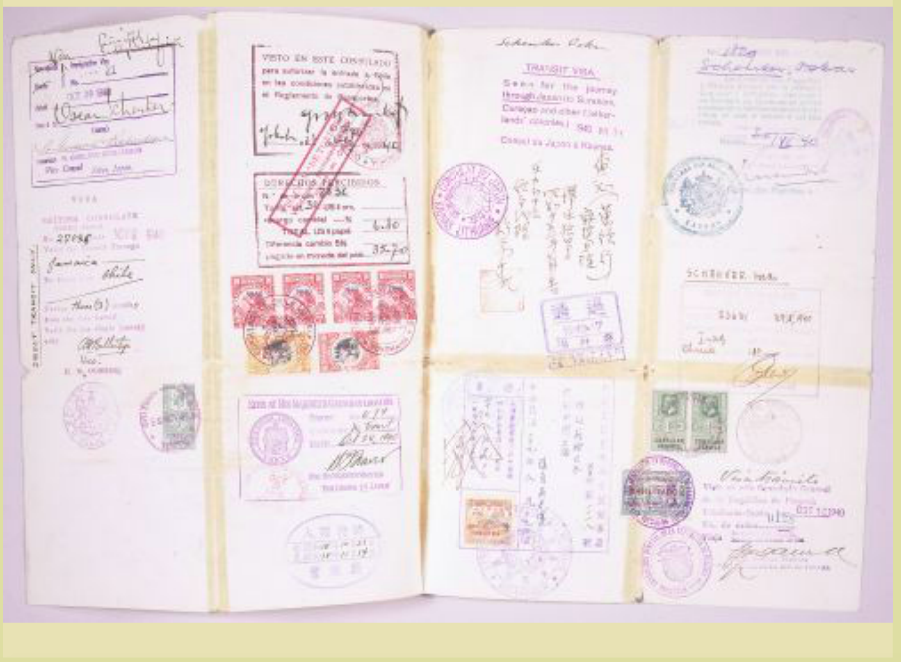
An open passport belonging to Oscar Schenker showing multiple visa stamps, including a Curacao-type transit visa reading 'Seen for the journey through to the Netherlands' colonies via Japan.' The passport contains Japanese transit stamps and other consular visas (including references to Jamaica and Chile), indicating an escape route through Japan.
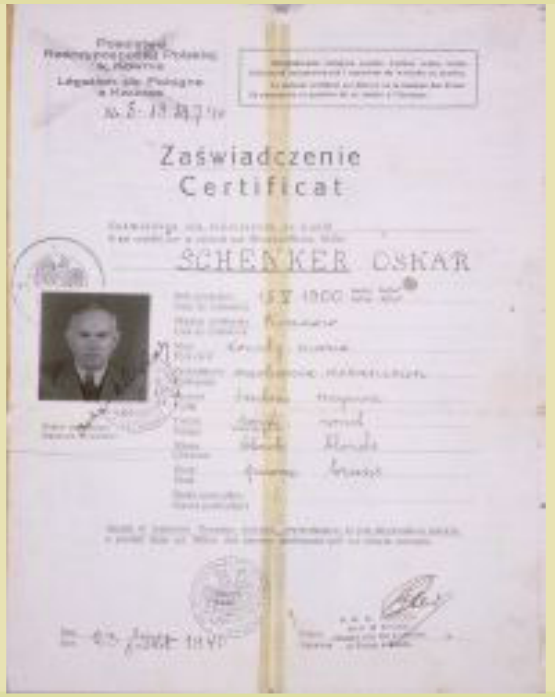
A Polish Legation certificate (Zaświadczenie/Certificat) issued in Kaunas for Oskar Schenker, born 1900. The document bears the stamp of the Polish Legation (Poselstwo Rzeczypospolitej Polskiej w Kownie) and includes a photograph of the holder.
Oskar Schenker, a Polish Jewish judge from Krakow, fled with his family to Lwów after the German invasion in September 1939, then went to Vilna with his brother to obtain transit visas for Japan. He received a transit visa stamped by Chiune Sugihara in Kaunas in July 1940 and arrived in Japan in October 1940, later sailing from Yokohama aboard the M.S. Tatuta Maru on 6 March 1941 with an American visa. His son Alexander and wife Gizela were deported to a Soviet labor camp in Siberia in 1940, later surviving the war in Stalinabad (Dushanbe, Tajikistan) and immigrating to the United States in 1947.
TRANSIT VISA Seen for the journey through to Curacao and other Netherlands' colonies Consul in Japan & Kovno
Poselstwo Rzeczypospolitej Polskiej w Kownie Légation de Pologne a Kovno Zaświadczenie Certificat SCHENKER OSKAR
Oskar received a transit visa stamped by the Japanese consul in Kaunas, Chiune Sugihara, in July 1940 and arrived in Japan in October 1940. He received an American visa and sailed out of Yokohama on 6 March 1941 aboard the M.S. Tatua Maru. Included is Oskar’s Polish citizenship certificate with the Sugihara transit visa stamp, U.S.S.R. State Travel Company Intourist tickets from Kaunas to Vladivostok
Where this comes from
- Library and Archives Canada, Tadeusz Romer fonds, MG 31 D 68, reel C-10451, frame 349, via Canadiana Heritage — Romer's private letter ('Mój Drogi'), Tokyo 5 March 1941, sent by air mail from San Francisco with the group of Polish citize…
Named in Ambassador Romer's private letter of 5 March 1941 (Romer fonds, reel C-10451 frame 349): 'Dr. Oskar Schenker, district judge (sedzia grodzki) from Malopolska', sailing from Japan on the Tatuta Maru on 5 March 1941 to his brother at 475 S. New Hampshire Ave., Los Angeles (c/o Jan Erteszek) — 'truly helpful and devoted in the refugee work'; the letter itself went with him by air mail from San Francisco. NOTE: the register carries Oskar Schenker twice (Nos. 476 and 1321). - "California, Los Angeles, Passenger Lists, 1907-1948", FamilySearch — index entry for Oskar Schenker, 1941: born about 1901, Poland. Digitised from NARA microfilm publication M1764 (passenger lists of vessels arriving at Los Angeles). Re…
FamilySearch's index of the Los Angeles passenger lists, read by the archive on 20 September 2026, has Oskar Schenker, born about 1901 in Poland, arriving at Los Angeles in 1941. The register's compiled line gives 1900. A lead only: the register carries 2 lines of this name, and the index entry cannot be assigned to one of them without the manifest sheet. - "California, Los Angeles, Passenger Lists, 1907-1948", FamilySearch — index entry for Oskar Schenker, 1941: born about 1901, Poland. Digitised from NARA microfilm publication M1764 (passenger lists of vessels arriving at Los Angeles). Re…
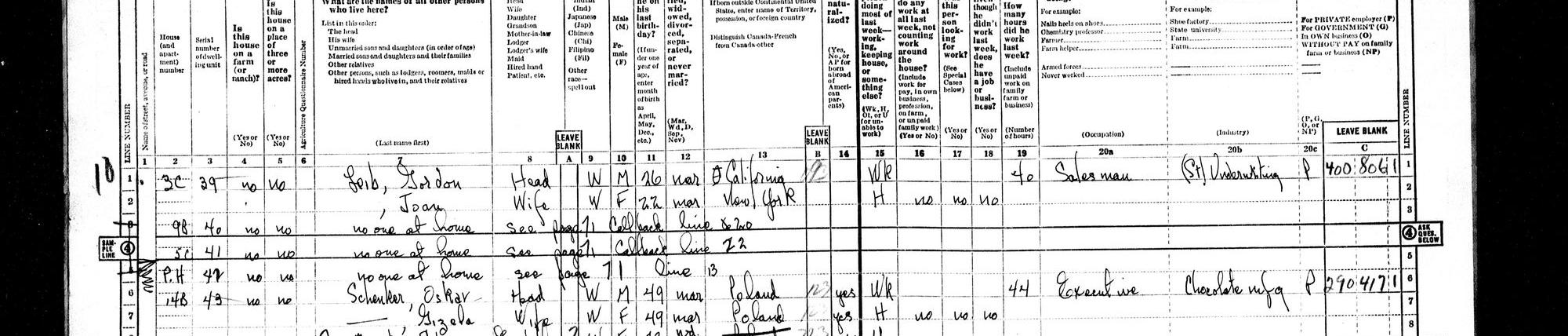
The Tatuta Maru sailed from Yokohama on 6 March 1941, took shore leave at Honolulu on the 14th and landed at San Francisco on 20 March 1941; its manifest has Oskar Schenker, aged 40, married, a judge, Polish, born at Kraków, last residence Vilnius, on a Polish quota immigration visa, No. 5451, issued at Tokyo on 3 March 1941, on the line below his brother Alfred. The four passengers on the page were admitted as shown. The register gives his age as 40 and makes him Alfred's brother; it calls him a mechanic, where the manifest says judge. The register also carries a second entry for the same man elsewhere on the list. (The sheet is in the National Archives' passenger lists of vessels arriving at San Francisco, microfilm M1410; the archive read FamilySearch's copy.) - The 1950 United States census, Manhattan, enumeration district 31-1308, sheet 4, lines 6–7: Oskar and Gizela Schenker (US National Archives, 1950census.archives.gov)
In April 1950 the United States census found him in Manhattan, New York, aged 49, born in Poland and naturalised, an executive in a chocolate-manufacturing firm, in a household with Gizela Schenker, whom the census records as his wife; Sugihara's ledger has her as his sister (National Archives, 1950 census, read 20 October 2026). - The open passport of Oskar Schenker (No. 476): the Sugihara transit visa, Zwartendijk's Curaçao declaration, and consular visas and fee stamps.
- The certificate of identity issued by the Polish Legation in Kaunas to Oskar Schenker (No. 476), 1940, with his photograph.
- Collections Search - United States Holocaust Memorial Museum
- Library and Archives Canada, Tadeusz Romer fonds, MG 31 D 68, reel C-10451, frame 349, via Canadiana Heritage — Romer's private letter ('Mój Drogi'), Tokyo 5 March 1941, sent by air mail from San Francisco with the group of Polish citize…
- The 1950 United States census, Manhattan, enumeration district 31-1308, sheet 4, lines 6–7: Oskar and Gizela Schenker (US National Archives, 1950census.archives.gov)