Before the visas: the waiting room in Vilna
The escape did not begin in Kaunas. When Germany invaded Poland on 1 September 1939, hundreds of thousands of Jews fled east, and the largest number washed up in Vilna (Vilnius) — a city the Soviets handed to still-independent Lithuania that October. By the end of 1939 more than 30,000 Polish-Jewish refugees were crowded there: rabbis and yeshiva students, lawyers and shopkeepers, whole families. Vilna was the waiting room of the whole rescue — where the refugees sat out a bitter winter while they searched for a way out.
They were kept alive by others. Refugee writers formed a Komitet in November 1939 to record what had befallen Polish Jewry; the YIVO institute appealed to the American Jewish Joint Distribution Committee to fund the work; and the JDC's Vilna delegate, Moses Beckelman, organised the money that fed and housed them. It was in this crowded, anxious city that word began to pass — carried by the refugee lawyer Zorach Warhaftig, who had it from the Dutch student Nathan Gutwirth — of a strange paper destination that might just open a road to the Pacific: Curaçao. From Vilna the refugees made their way the sixty miles to Kaunas, where two consuls were still open.
Voices from Vilna — refugees' own testimonies, taken down in 1939–40 — are preserved in the We Refugees Archive, alongside Herman Kruk's diary and the YIVO/JDC appeal of 20 November 1939.
The visa that needed a destination
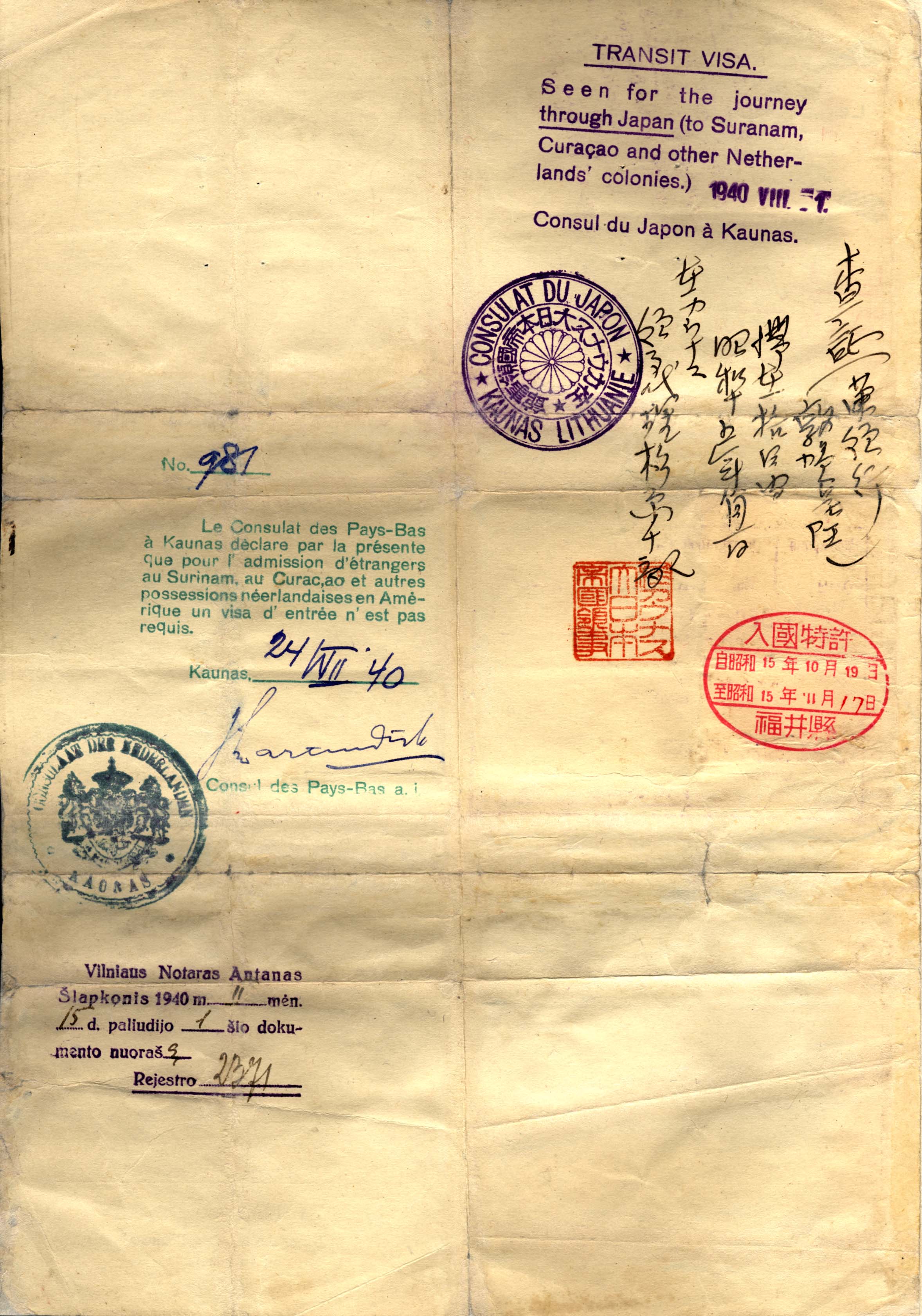
By the summer of 1940 the refugees stranded in Soviet-occupied Lithuania faced a paradox. Japan would grant a transit visa — permission to pass through — only to someone with an onward destination. But every real destination demanded its own visa, and the consulates were closing. Without an approved destination, there was no legal way out.
The island that asked for nothing
Why Curaçao, of all places? By the account of Nathan Gutwirth's family, the threads that met in that question were personal ones. Gutwirth, a Dutch student at the Telz yeshiva, had walked into the Philips office in Kaunas because the sign outside was the one familiar thing in the city; the Dutchman inside — Jan Zwartendijk, not yet consul — began passing him Dutch newspapers twice a week, and with so few Netherlanders in Lithuania the two became friends. When the German occupation of the Netherlands closed his way home, Gutwirth began looking instead toward the Dutch West Indies. Curaçao held his attention because it lay near the United States, where his Lithuanian fiancée Nechama had a sister.
The answer came from an unlikely quarter. The Dutch colonies of Curaçao and Surinam required no ordinary entry visa — admission was technically left to the discretion of the colonial governor. Two Dutch nationals stranded in Lithuania saw the opening: Nathan Gutwirth, a student at the Telz yeshiva, and Pessla (née Sternheim) Lewin. Both turned to the Dutch ambassador in Riga, Latvia, L. P. J. de Decker, asking him to write into a passport that Curaçao required no entry visa. De Decker asked Pessla to send him her passport, and stamped only hers, on 11 July 1940 — by the account given to this archive, he declined Gutwirth's broader request that anyone who asked be given the stamp, and instead instructed Zwartendijk to copy Pessla's wording into the passports and leidimas of her husband, mother and brother, and of Gutwirth himself. The wording left out the one thing that mattered — that admission still lay with the colonial governor, whose authorisation was almost never granted. That omission was the whole trick: no visa is required, where the honest sentence would have been no visa is given — a deliberate half-truth that suggested permission without granting it. And whose idea it was remains an open question: it has been credited to de Decker, to Pessla Lewin, and to Gutwirth, who says he asked for it in July 1940 — and whose family's account, drawn from his own memoir, is that he put the omission to de Decker himself, asking that the declaration leave the governor's landing permit out.
What happened next is the hinge the rest of the rescue turns on. Gutwirth had his endorsement, and the one person he told was the refugee lawyer Zorach Warhaftig. Between them stood the question that mattered: with hundreds of yeshiva students trapped in Lithuania, would the Dutch consul write this for refugees who were not Dutch citizens? By the account given to this archive, it was Gutwirth himself who sought and won Zwartendijk's agreement — he put the question to the consul in Kaunas, and Zwartendijk said at once he would give it to anyone who came to his office. Warhaftig sent word through the yeshivot, the shtetls and the cities to reach the Dutch consulate quickly. That is when the lines began. If you hold a letter, a memoir or an interview that puts this on the record, the archive would like to see it.
A correction, recorded in the open: this page used to say that word spread to thousands from Pessla Lewin's case. It did not. Her endorsement saved her household — her husband Isaac, their small son Nathan, her mother Rachel and her brother Levi — and the movement that followed began with the question Gutwirth carried and the answer Zwartendijk gave.
In Kaunas, the man who turned that formula into an escape route was Jan Zwartendijk, the local director of Philips, and, since May 1940, the Dutch honorary consul. Seeing Pessla Lewin's Curaçao endorsement stamped in her Polish passport, he refined the wording and copied it into her husband Isaac Lewin's leidimas (a Lithuanian travel document used in place of a passport) for the whole family — including their three-year-old son, Nathan. Pessla's mother Rachel and brother Levi Sternheim held Dutch passports; Zwartendijk entered the same wording into theirs on 22 July. Isaac Lewin's leidimas was Zwartendijk's very first Curaçao endorsement — then he kept writing:
“The Netherlands Consulate hereby declares that no visa is required for the admission of aliens to Surinam, Curaçao, and other Dutch possessions in the Americas.” — the “Curaçao visa” formula, Kaunas, 1940
Here is the distinction that matters: de Decker had authorised the wording only for the handful of Dutch passport holders. Every one of the other roughly 2,345 endorsements Zwartendijk issued was his own decision — his own risk. He wrote the first roughly 1,300 endorsements by hand, in four days; when his hand could no longer keep pace he had a rubber stamp cut and pressed out a thousand more. It was a destination on paper only; no refugee this archive has heard of ever set foot on Curaçao. But the words were enough. He worked until the Soviets shut the consulate on 3 August 1940.
Two documents, one escape
Zwartendijk's endorsement and Sugihara's visa were useless apart and decisive together. The Curaçao destination visa was what enabled a refugee to obtain Sugihara's Japanese transit visa (though Sugihara sometimes bent the rules, especially after the Soviets closed the Dutch consulate in the Philips office and refugees began arriving without Curaçao endorsements); the transit visa, in turn, secured the Soviet exit permit — arranged through Intourist — that opened the Trans-Siberian railway to the Pacific.
A different reading of that tidy chain comes from George Bluman — whose own parents are on the register: by his count, more than half of those on Sugihara's list held no Zwartendijk endorsement at all. For them, Sugihara wrote the Curaçao destination into the transit visa himself — “(to Suranam, Curaçao and other Netherlands' colonies)” — a destination conjured inside the visa, with no Dutch paper behind it. He counts this the greatest thing Sugihara did: for perhaps a thousand register lines, the only consul standing behind the Curaçao fiction was Sugihara.
The man who never knew whether he had helped

Green House museum, Vilnius · public domain via Wikimedia Commons.
Zwartendijk returned to the occupied Netherlands and, for the duration of the war, feared for his own life and those of his wife and three children. For the rest of his life he also feared that the refugees he had sent toward an imaginary destination had been arrested and killed. He never learned otherwise. He died on 14 September 1976; a few days later, as his coffin was carried from the house, the answer arrived — a two-page handwritten report, dated 12 September 1976 and addressed to his son Jan Zwartendyk Jr., finding that about 95% of the refugees he had endorsed toward Curaçao had survived the war. It had been written two days before he died, and was already in the post. He never read it. The report was the work of Rabbi Marvin Tokayer, rabbi of the Jewish community of Japan from 1968 to 1976, who had spent those years tracing what became of the refugees who reached Japan; he broke his figures down by age, sex, occupation and onward country, and counted 2,178 survivors. In 1997, more than twenty years after his death, Yad Vashem named Jan Zwartendijk Righteous Among the Nations.
A correction, recorded in the open: this page used to credit that letter to the Simon Wiesenthal Center, as many accounts do. It cannot have come from there — the Center was not founded, in Los Angeles, until 1977, the year after Zwartendijk's death. Arlette Liwer-Stuip, who has seen the family's copy, reports that the two-page report was Rabbi Tokayer's own research and was sent by him. The letter is private family correspondence and is not reproduced here. If anyone holds evidence that Tokayer was working for another organisation when he compiled it, the archive would like to see it.
Jan Zwartendijk · in brief
- Who
- Jan Zwartendijk (1896–1976), Philips director & Dutch honorary consul, Kaunas.
- What
- The “Curaçao visa” — a declaration that no visa was required for admission to Surinam, Curaçao, and other Dutch possessions in the Americas.
- When
- 24 July – 2 August 1940 — nine days issuing to the refugee crowd, or eleven counted from the first Dutch-passport endorsements on 22 July; sources differ on where the count begins. The consulate closed 3 August.
- How many
- About 2,345 endorsements — the highest found, No. 2,345, went to Eliasz Kupinski on 2 August 1940.
- Authority
- Ambassador L. P. J. de Decker authorised the wording only for the Dutch passport holders — the rest Zwartendijk issued on his own initiative and at his own risk.
- Honours
- Righteous Among the Nations, Yad Vashem, 1997. In 2023, posthumously awarded the Netherlands' Medal for Acts of Humanity in Gold.
As the students remembered it
The memoir of the Mir yeshiva’s flight, Escape to Shanghai (Rabbi E. Y. Hertzman, translated by Rabbi C. U. Lipschitz; Maznaim, New York, 1981), tells the Kaunas story as the students understood it at the time, and the understanding is instructive. The honorary consul who wrote the Curaçao declarations appears as “Denmark’s consul, Philip Reiley”, a man of “the Philips factories” who “had permission to deal in matters of visas”: Jan Zwartendijk, the Dutch honorary consul and head of the Philips branch in Lithuania, remembered through the name of his company and the wrong country. The book also believed that the Netherlands had for years urged settlers to Curaçao and admitted anyone without a visa. The archive’s account of the loophole is above; the memoir’s version, with a Danish consul and a colony looking for settlers, is how it reached the students in the Kaunas queue, and what mattered to them was exactly what the book records next: a line on paper that the Japanese consul would accept. Quoted briefly from pages 30 and 31; the book is on the books list.
Did anyone ever get there?
Not that this archive knows. Across every document, roster, manifest and family story gathered here — hundreds of journeys, traced stamp by stamp — we have yet to find a single person who actually reached Curaçao. The destinations that appear on the onward papers are Kobe and Shanghai, Seattle and San Francisco, Vancouver, Wellington, Palestine, even Ciudad Trujillo — never Willemstad. The island did its work without ever being visited: it existed on the documents so that the journey could exist in the world. If your family's story ends differently — if someone you know of truly stood on Curaçao with one of these papers — we would very much like to hear it, and to be corrected.
The colony they actually asked for
Curaçao worked because nobody had to go there. But in the winter of 1941, with the refugees stranded in Kobe on transit visas that allowed them only a short stay, the Jewish community of Kobe tried to turn the same colonial door into a real one — not a destination on paper, but a place to live.
On 19 February 1941 JEWCOM wrote from No. 6 Yamamoto-dori to the Dutch consulate in Kobe — the same office whose consul, Niek de Voogd, would one month later hand over official stationery for the seventy-four turned back at Tsuruga. The report is signed by the community’s president, A. Ponevejsky. It sets out the position plainly: in Lithuania the Soviet authorities had begun requiring the refugees to take Soviet nationality, and those who refused faced the fate of the tens of thousands already exiled to Siberia. Japan had been accommodating — “the generous granting of transit visas” — and the result was that there were now in Japan “approximately 800 refugees who have no immediate emigration opportunities,” with the organisations still trying “to save at least another thousand.”
What JEWCOM asked for was that the Netherlands admit several hundred of them to one of its colonies, Suriname named as the example, on the same conditions that would later be applied to refugee groups taken in by the Netherlands, Denmark, Sweden and England. The proposal had a shape. The refugees would form two groups — one continuing religious study in a seminary, one training in agriculture and trades in preparation for Palestine; the Jewish Agency would guarantee their onward emigration to Palestine, at latest shortly after the war; and the Jewish organisations would pay for their maintenance meanwhile. The Jewish Agency, the Joint and the Council of Rabbis in America all had representatives in Japan that February, and the letter was written in consultation with them.
Whether it was ever answered, this archive does not know. No one on the register is recorded as having reached Suriname, and the destinations on the onward papers remain the familiar ones. But the request is worth having on the record for what it shows: that the people in Kobe did not regard the Dutch colonies as a legal fiction to be used and discarded. They asked, in writing, whether the door could be opened for real.
A note on the date, because it matters if the document is cited. The letterhead is typed 19 February 1940 on both pages, but the consulate’s receipt stamp reads 19 February 1941 (dossier F. 15/329), and the contents — the Soviet occupation of Lithuania, refugees already arrived in Japan — were not possible in February 1940. It is the ordinary slip of writing last year’s date in the new year. The letter is of 1941.
The document
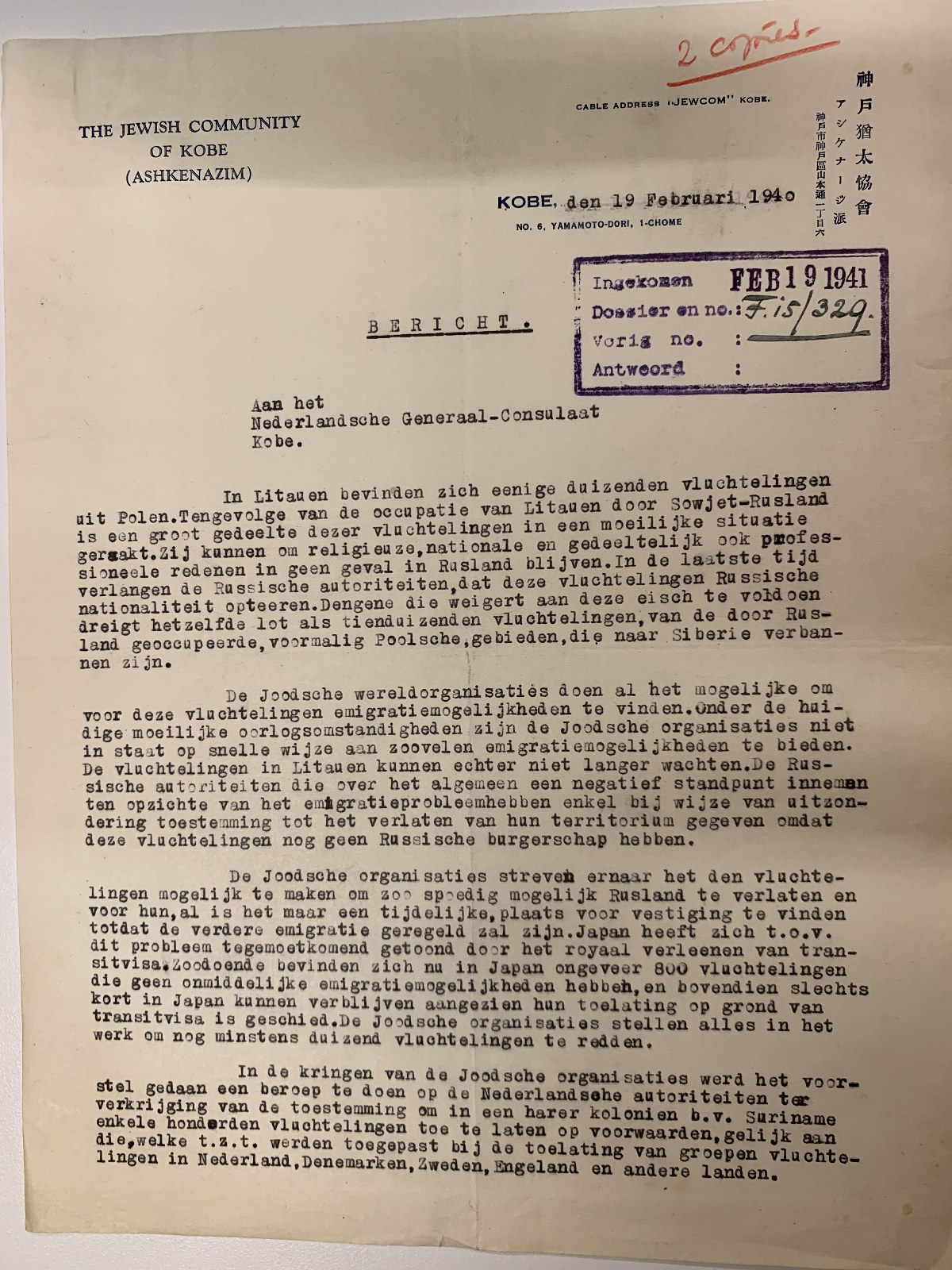
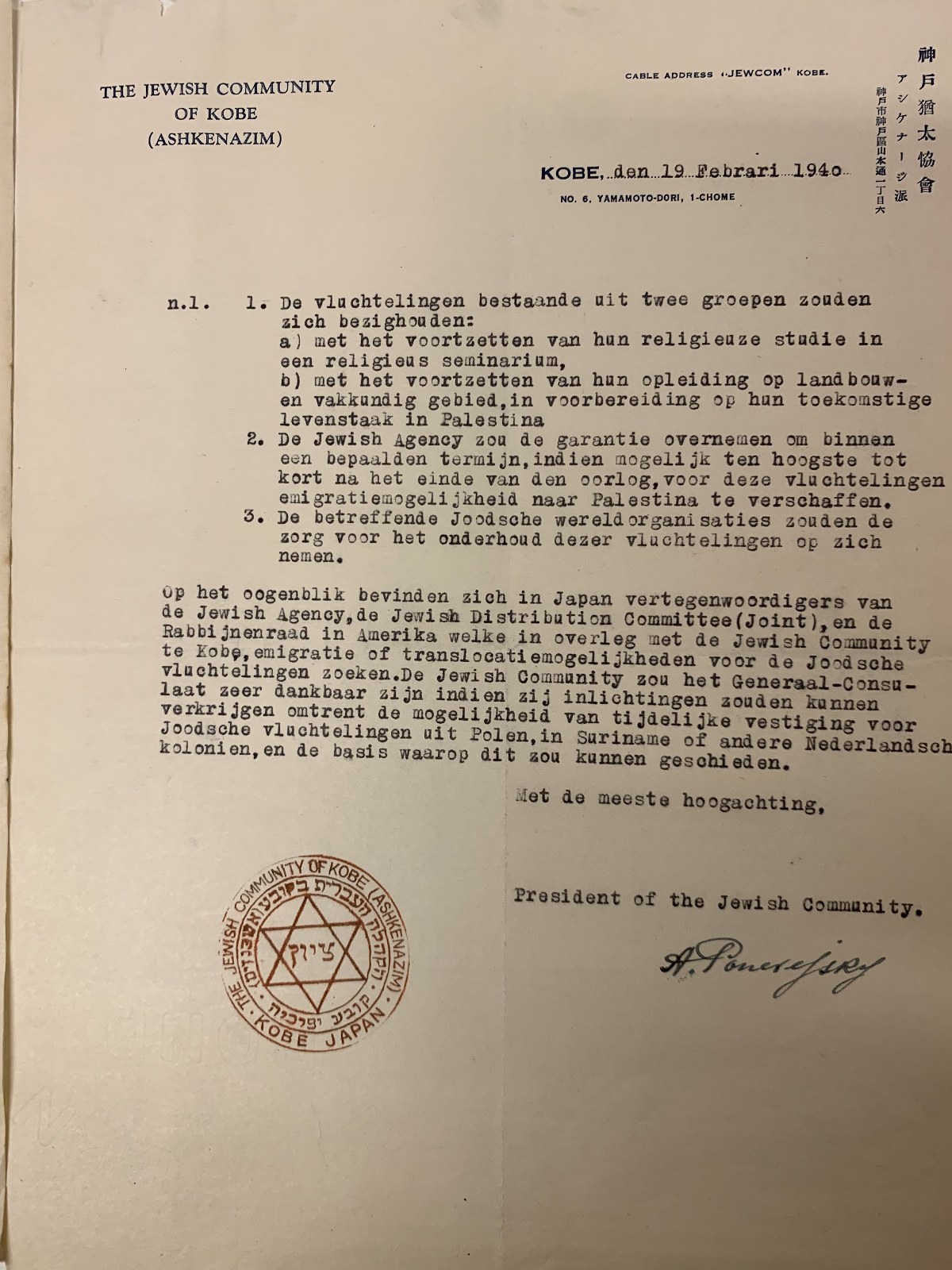
Nationaal Archief, The Hague, Consulaat-Generaal Kobe (2.05.65.01), the consulate’s dossier F. 15/329; photographed by Hans de Vries, 2026, and shown with the Archief’s credit. Given to this archive by Arlette Liwer in September 2026.
The report, in Tom Stuip’s translation
The Jewish Community of Kobe (Ashkenazim). Cable address “JEWCOM” Kobe. Kobe, the 19 February 1940. No. 6, Yamamoto-dori, 1-chome. [Received stamp: Received FEB 19 1941 / Dossier and no.: F. 15/329.]
REPORT. To the Dutch Consulate-General, Kobe.
In Lithuania, there are a few thousand refugees from Poland. As a consequence of the occupation of Lithuania by Soviet Russia, a large part of these refugees has ended up in a difficult situation. For religious, national, and partly also professional reasons, they cannot remain in Russia. Recently, Russian authorities started demanding that these refugees opt for Russian nationality. Anyone who refuses to comply with this demand is threatened with the same fate as tens of thousands of refugees from the former Polish territories occupied by Russia, who have been exiled to Siberia.
The Jewish world organizations are doing everything possible to find emigration opportunities for these refugees. Under the current difficult war circumstances, the Jewish organizations are not able to offer emigration opportunities to so many in a rapid manner. The refugees in Lithuania, however, cannot wait any longer. The Russian authorities, who generally take a negative stance with respect to the emigration problem, have only by way of exception given permission to leave their territory because these refugees do not yet have Russian citizenship.
The Jewish organizations strive to make it possible for the refugees to leave Russia as soon as possible and to find for them, even if it is only a temporary one, a place for settlement until further emigration will be arranged. Japan has shown itself accommodating toward this problem by the generous granting of transit visas. Consequently, there are now in Japan approximately 800 refugees who have no immediate emigration opportunities, and moreover can only stay a short time in Japan since their admission occurred on the basis of transit visas. The Jewish organizations are making every effort to save at least another thousand refugees.
In the circle of Jewish organizations, it was suggested to appeal to the Dutch authorities to get permission to admit several hundred refugees into one of its colonies, e.g., Suriname, on conditions equal to those that would later be applied for the the admission of groups of refugees in the Netherlands, Denmark, Sweden, England, and other countries. As follows:
1. The refugees consisting of two groups would occupy themselves: a) with the continuation of their religious studies in a religious seminary, b) with the continuation of their training in agricultural and vocational fields, in preparation for their future life work in Palestine.
2. The Jewish Agency would assume the guarantee to provide these refugees with emigration opportunities to Palestine within a certain period, if possible at the latest shortly after the end of the war.
3. The relevant Jewish world organizations would take upon themselves the care for the maintenance of these refugees.
At the moment, representatives of the Jewish Agency, the Jewish Distribution Committee (Joint), and the Council of Rabbis in America are present in Japan, who, in consultation with the Jewish Community of Kobe, are seeking emigration or relocation opportunities for the Jewish refugees. The Jewish Community would be very grateful to the Consul-General if they could obtain information regarding the possibility of temporary settlement for Jewish refugees from Poland, in Suriname or other Dutch colonies, and the basis upon which this could take place.
With the highest regards, President of the Jewish Community, [signature] A. Ponevsky.
Translated from the Dutch by Tom Stuip, 2026, and shown in full with his name by his and Arlette Liwer-Stuip’s leave. The letterhead’s “1940” is kept as the typist wrote it; see the note on the date above.
A letter that shows what the colonial door was for
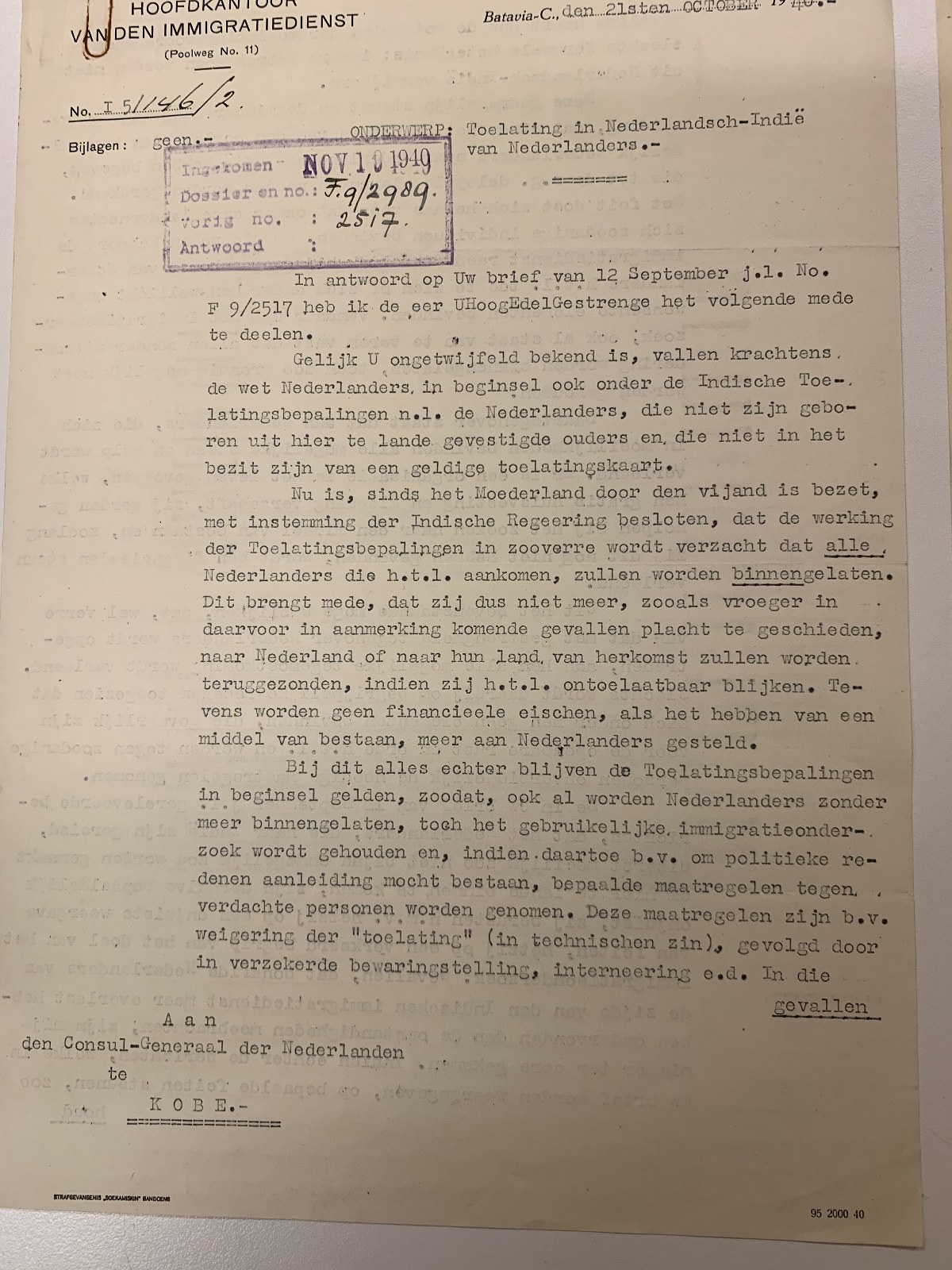
From the same consular dossier: on 21 October 1940 the head office of the Immigration Service at Batavia wrote to the Consul-General at Kobe that, with the Netherlands under occupation, every Dutch national arriving in the East Indies was to be admitted, the usual immigration investigation to run behind the admission rather than before it. It concerns Dutch nationals only and says nothing of the Polish refugees — which is exactly the point: the Indies were open to Netherlanders and not to the people the Curaçao papers described. The second sheet is not held.
What became of the idea, 1949
The Curaçao device had an afterlife, and it is not a comfortable one. In February 1949 the Netherlands Consul-General in Shanghai telephoned the American consulate to say he had evidence that fraudulent visas for entrance to Curaçao were being sold in the city. The Dutch vice-consul, Visscher, checked the papers being presented and found his office had issued almost none of them. He had been told that a Pole was working from an office in the Cathay Hotel and selling them for about three hundred dollars.
The American file on it was stamped SECRET and stayed closed until 2014. It is now open: Curaçao Visas, a file unit in the Classified Visa Files of the U.S. Consulate General at Shanghai, in the National Archives at College Park.
Almost everyone in that file is a stranger to this archive. The people the consulate was worried about were Shanghai residents of 1949 — trying to get out before the city fell to the Communists in May, and reaching for the one destination with a reputation for asking no questions. It was a different crisis and, with one exception, different people.
The exception matters, and it clears him rather than accusing him. The file names “Kamieniecki, Saweli and wife Rachel Theresia”, and Saweli Kamienecki is No. 80 on Sugihara's register — a cutter of neckties from Warsaw, born 1911, who reached Japan and then Shanghai. He is in the folder because the investigation swept in everyone holding a Curaçao paper. But the Dutch vice-consul's own evidence puts him on the other side of the line: when he handed the Americans the list of Netherlands West Indies visas his office had genuinely issued since November 1948, Kamieniecki was on it. His Curaçao visa was issued on 26 November 1948 and was real.
The American officer who opened the file was careful about his own evidence in a way later readers may not be, and his sentence is worth quoting exactly: “I don't know that they were fraudulent.”
We publish it because it is true and because it will be found by others, and a thing found without its context becomes something else. Nine years after Zwartendijk wrote his formula into a few thousand passports, the name of the island was still worth money to somebody in Shanghai. That is a fact about 1949. It says nothing whatever about the papers people carried out of Kaunas in 1940, and it must never be read as though it did.
Corrected 27 August 2026. This section first said that nobody in the investigation appeared on Sugihara's register. That was wrong: the file unit's own contents list names Saweli Kamienecki, and the error was ours — we had checked the five names on the pages we had read rather than the folder's full contents. Corrected within the hour, and the correction is left here rather than quietly swept away.
In this archive
Because a refugee usually carried the Curaçao endorsement and the Sugihara visa in the same passport or leidimas, the two documents often survive together — as on Majer Klejn's papers above. Yet the Curaçao endorsement is the rarer survivor, and part of this project is to reunite each Sugihara visa with the other documents of its journey. If your family still has a Curaçao endorsement or other related documents, we would be grateful to see them.
Further reading: Jan Brokken, The Just (2021), and reporting by JTA and The Times of Israel — all gathered on the Resources page. Nathan Gutwirth's own account of how he came to Curaçao, and of the report Rabbi Marvin Tokayer sent the Zwartendijk family in 1976, reach this archive from the Gutwirth family archive and his memoir, relayed with his grandson's assistance by Arlette Liwer-Stuip, August 2026.