15, counting only the ones this archive has actually read. People ask because they have seen a number quoted — 2,139, or 2,140, or six thousand — and want to know which list it came from. The answer is that Sugihara wrote one register, and almost everything else that gets called a Sugihara list is a different body's register that happens to name the same people.
Two of those numbers can now be told apart. 2,132 is the count of visas Sugihara reported to Tokyo; 2,139 is the count of people on the list he enclosed with the report; 2,140 is the number of lines this archive works from. And Kaunas was one post of seven — Japan's European consulates issued about 5,580 transit visas over fifteen months, of which Sugihara's five weeks were about two in five. Those totals count visas. How many people they add up to is a different question, and nobody has answered it.
His register is a list of departures. It gives a number, a name, a nationality and a date, and then it stops — it does not say where anyone was going, whether they got there, or who was travelling with them. Everything beyond that comes from somewhere else: relief committees, consulates, shipping agents and governments, each keeping its own register for its own reasons, none of them aware of the others. This page is what each one is, where the original is kept, and how much of the register it can account for.
1,330 of the 2,140 people on Sugihara's register appear on at least one other list. 810 appear on none of them.
62% traced to a genuinely second document · 38% still a line in one ledger and nothing more. Transcriptions of Sugihara's own list are not counted here: copying a page does not witness a person. Those 810 are the work: a name with no birth year, no town and no ship, and often a first letter missing from the name itself.

One register, read three times. What follows is not three lists but Sugihara's own register and two readings of it — which is why neither reading is counted in the figure above. Copying a page does not witness a person.
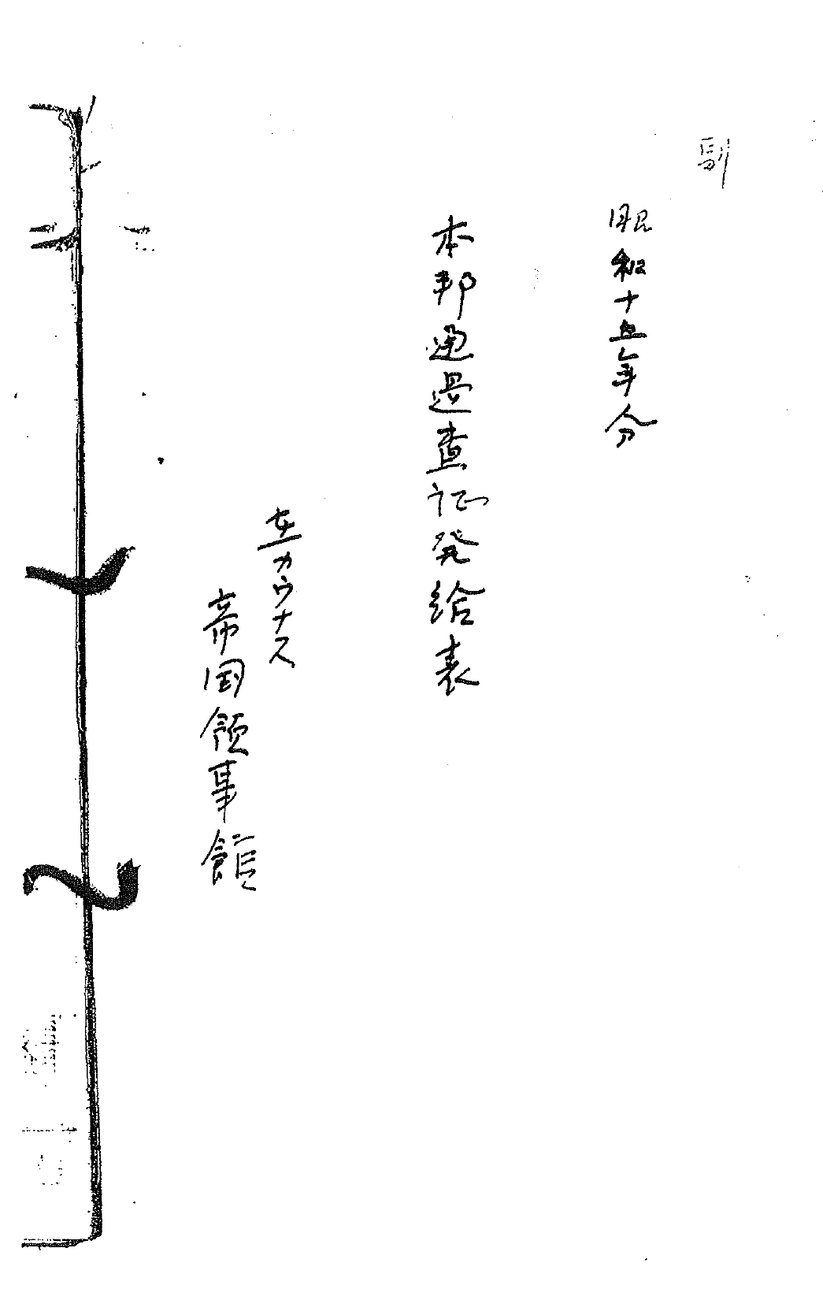
Why it exists at all. It is not a desk record kept while the visas were being stamped. It is an answer to an audit. On 4 February 1941 Foreign Minister Matsuoka cabled Sugihara — by then at Prague — demanding an accounting of the visas he had issued at Kaunas: the number, the names, the destinations and the date of each. Sugihara replied the next day with totals, and on 28 February he posted a list running to 32 pages, giving serial number, nationality, name, whether entry or transit, date, fee and reference for 2,139 people. That enclosure is this register. It was written six months after the work it describes, from a different country, by a man reconstructing what he had done — which is worth knowing before treating any single line as a contemporaneous record.
George Bluman's Chiune Sugihara Lists. Not more names but a reading, and by far the most useful one: age, trade, family, whether the person reached Japan, whether they reached Shanghai, where they went next, and which lines are the same person entered twice. Most of what this archive knows beyond a name begins here. Published openly at the University of British Columbia and still being corrected — several of the corrections on this site came from him this year.
The museum's Flight and Rescue transcription. The United States Holocaust Memorial Museum's own reading, made for its exhibition. Its value is as a second pair of eyes on a damaged page: where it reads a name differently from Bluman, one of the two is wrong and that line is worth going back to.
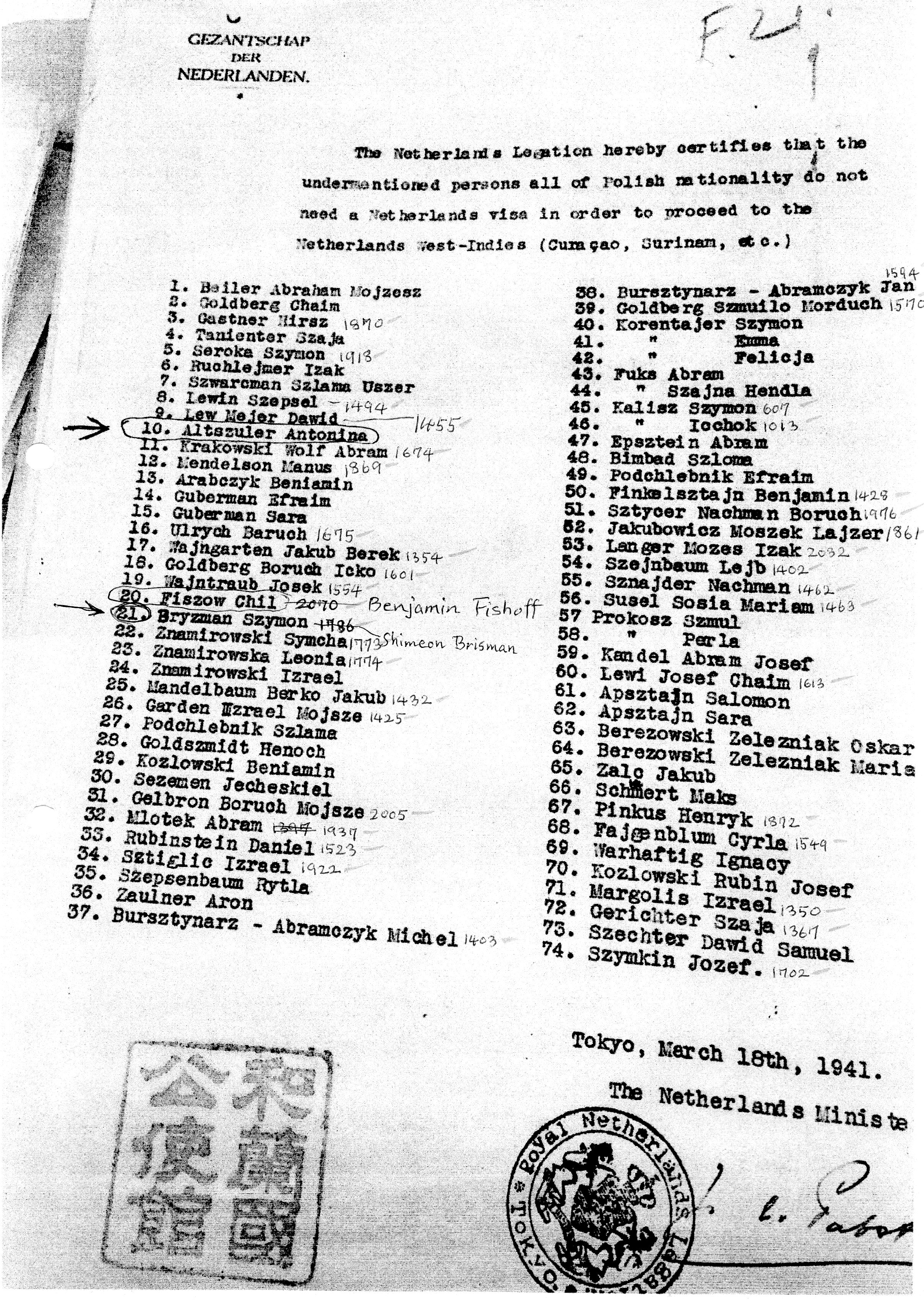
And the researchers who keep correcting it. A list is not read once. Akira Kitade, whose Visas of Life and the Epic Journey and Emerging Heroes did more than any other work to put faces to these names, told this archive that a visa it had recorded as Sugihara's was not his at all — it was written by Saburō Nei at Vladivostok, for a different man, and the archive had attached it to the wrong person on the strength of a number. Mark Halpern has identified people in photographs and annotated the Netherlands Legation's list of seventy-four. Ruth Leiserowitz in Berlin has supplied kinship among the visa holders and the ship manifests that carry them onward. Hillel Levine's In Search of Sugihara remains the book that raised the hardest questions, including the uncomfortable ones about forged visas. Where this site is right about somebody, it is often because one of them said so; where it has been wrong, it is usually one of them who noticed.
Kaunas was not the only Japanese post writing transit visas, and the Foreign Ministry knew to the unit how many each had written. A secret report of 15 April 1941 totals the visas issued by Japan's European posts between January 1940 and March 1941 at 5,580. Kaunas accounts for 2,132 of them — about two in five. The other 3,448 were written in six cities that no one has made a film about.
| Post | Visas | |
|---|---|---|
| Hamburg | 1,414 | The largest issuer after Kaunas, and more than half again what Kaunas wrote in its five weeks. No memorial, no film, no list of names. |
| Vienna | 786 | Where the practice began. The consul-general Yamaji Akira put the question to Tokyo in September 1938, two years before Kaunas. |
| Berlin | 691 | The embassy, under Kurusu Saburō and then Ōshima Hiroshi. It also relayed the network-wide instruction of 23 July 1940 that set the terms every other post worked to. |
| Stockholm | 334 | Confirmed by the count and by nothing else the archive has found. Who signed them is not established here. |
| Moscow | 152 | The embassy, at the far end of the same railway the Kaunas refugees rode. |
| Prague | 71 | Sugihara's own next post. A page of a Prague list naming 36 people has been published; the rest is unaccounted for. |
| The six together | 3,448 | |
| Kaunas | 2,132 | Sugihara, five weeks of July and August 1940 |
| All European posts | 5,580 | Fifteen months, seven posts |
The six figures sum to 3,448, and 3,448 plus 2,132 is exactly 5,580. Because nothing is left over, the seven posts are the whole of it, not merely the ones somebody happened to list.
The total. “The situation of European refugees entering Japan”, a report classified secret, dated 15 April 1941, printed as document 69 in Sugihara Chiune and the Soviet Union: New Documents, New Perspectives, edited by David Wolff, Takao Chizuko and Ilya Altman (Slavic Eurasian Studies No. 35, Slavic-Eurasian Research Center, Hokkaido University, 2022), which is published free in full. The original is in the Diplomatic Records Office of the Japanese Foreign Ministry and is digitised at the Japan Center for Asian Historical Records under reference B04013209600.
The city-by-city breakdown is on weaker ground, and the difference matters. It is not in the Ministry’s report. It comes from a single secondary account — an article by the researcher Ōhori on Nichizui Kankei no Pēji, a long-running Japanese site on Japanese–Swiss relations, at ameblo.jp/nichizuikankei/entry-12474570056.html — which cites the Diplomatic Records Office and Bandō Hiroshi’s Japan’s Policy Toward the Jews, 1931–1945: from the “Jewish Question” documents of the Diplomatic Records Office (Miraisha, 2002). The archive has read neither the Ministry’s per-post figures at first hand nor Bandō’s book, and is seeking both. Until it has them, treat the total as documented and the six city figures as one researcher’s reading of a file the archive has not opened.
The reason the breakdown is quoted here at all, at that lower standing, is the arithmetic: an independent writer’s six numbers land exactly on a total published in a different decade for a different purpose, with nothing left over. That is hard to do by accident. It is not proof, and if either source is wrong the table is wrong with it — the archive would be glad to be corrected by anyone holding the file itself.
5,580 is a count of pieces of paper, and it should never be quoted as a number of human beings. Nobody has ever reconciled the seven columns against each other, and there is every reason to think they overlap. A family that fled Vienna for Prague and then for Lithuania could be written down at more than one window. A visa issued and never used still counts here. A person turned back at the Soviet border and re-papered later counts twice.
The register proves the principle at home, in the one list the archive holds complete: 39 of its own lines are somebody who is already on it — the same person entered a second time, under a second number. If a single register kept by a single man in a single room duplicates 39 times, seven consulates across fifteen months, none of them aware of the others, will do worse. Until somebody sets the seven side by side and matches them name by name, the honest sentence is that Japan's European posts issued about 5,580 transit visas, and how many people that was is not known.
Hamburg wrote 1,414 visas and there is no list of who received them. Vienna wrote 786 and there is no list. The reason is narrow and slightly absurd: only Sugihara was asked for one. The names on this site exist because Tokyo audited him in February 1941 and he answered with 32 pages. The other six posts were never audited, so their people are a number in a ministry report and nothing else — no names, no ages, no towns, no descendants who can look anybody up.
It is worth sitting with that. The reason Sugihara's people can be remembered one at a time, and Hamburg's 1,414 cannot, is not that he saved more or that he meant more by it. It is that somebody made him file a return.
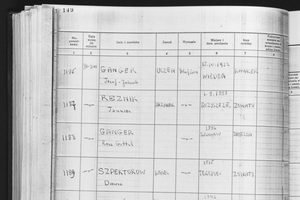
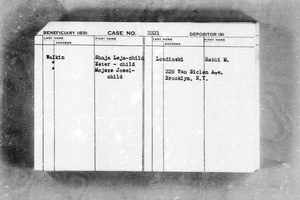
Each card carries a plate of the document where the archive is free to show one. Most of these registers belong to the JDC Archives, the Holocaust Museum, the Nationaal Archief or Library and Archives Canada, and holding a scan so as to read a document is not the same as having permission to reproduce it. Where a plate reads held, not shown, the archive has the pages and is asking. The line above each card says who owns the original, which is the more useful thing to know anyway.
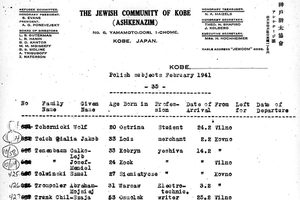
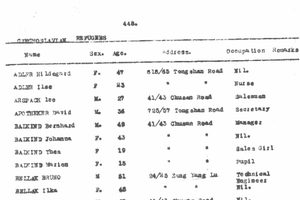
The register of Polish Jews who reached Lithuania — written before anyone knew who would get a visa. It is the largest and, because it was kept as people arrived rather than as they left, the most secure of them all. It gives a birth year and a home town, which is what separates two men of the same name everywhere else.
Kept by the people who met the boats. It records who arrived from Vilna, when, and what was done for them.
The same refugees, written down beside the relative abroad who might pay their passage. It is the only list that names the families waiting on the other side.
The yeshivot that crossed as whole communities — Mir, Kamieniec, Slonim, Kleck, Radin, Telz, Lubavitch. Birth year, birthplace and a relative's address on every line.
Barely worked. The archive has the pages and has read almost none of them.
A register of arrivals, kept as people walked in and gave their names — the opposite kind of book from Sugihara's. Birth date, birthplace, trade, address, passport. It is the document that most often turns a visa into a life.
An index to case files that never left China. It can say a person was in Shanghai being helped to leave. It cannot say who he was.
The seventy-four the consul at Kobe brought ashore. Its pencilled register numbers were written by someone matching it against Sugihara's list long before this archive existed.
Bluman's ticks are a second opinion on who really held a Sugihara visa — and his absent ticks are worth as much as his present ones.
Not an escape but a diplomatic exchange, a year into the war.
A manifest is a different animal from a compiled list and belongs in its own paragraph. It was not made to record refugees; it was made because a shipping line had to account for every body aboard. That makes it the best evidence in the archive, because it asks questions a visa never does — how old, born where, last resident where, going to whom, carrying how much money — and answers five or six of them at once, on the same line, for a person who is otherwise a surname.
Three sailings have been read sheet by sheet: the Hie Maru of May 1941 and of June 1941, and the Heian Maru of 27 May 1941. The archive holds no sheets at all for the Tatuta Maru, the Asama Maru or the Taiyo Maru. If you know of a surviving manifest for any sailing out of Japan in 1940 or 1941, it is the single most useful thing anyone can send.
Naming these is not an apology. A reader is entitled to know the shape of the hole, because it is the difference between a person who is absent from the record and a person the record was never asked about.
It also works. Five of the seven below changed on 31 August and 1 September 2026, within a day of being written down as gaps — and not one of them changed because a new document surfaced. Two turned out to be free and open all along and simply unlooked-at; one turned out to be far smaller than the legend; one turned out never to have existed as a document at all; and one was already inside the reading this archive works from, uncredited. The amendment notes say what each entry used to claim. Writing down precisely what you do not have is the cheapest research method there is, which is why the list stays even as it empties.