1
2
3
4
5
6
7
8
9
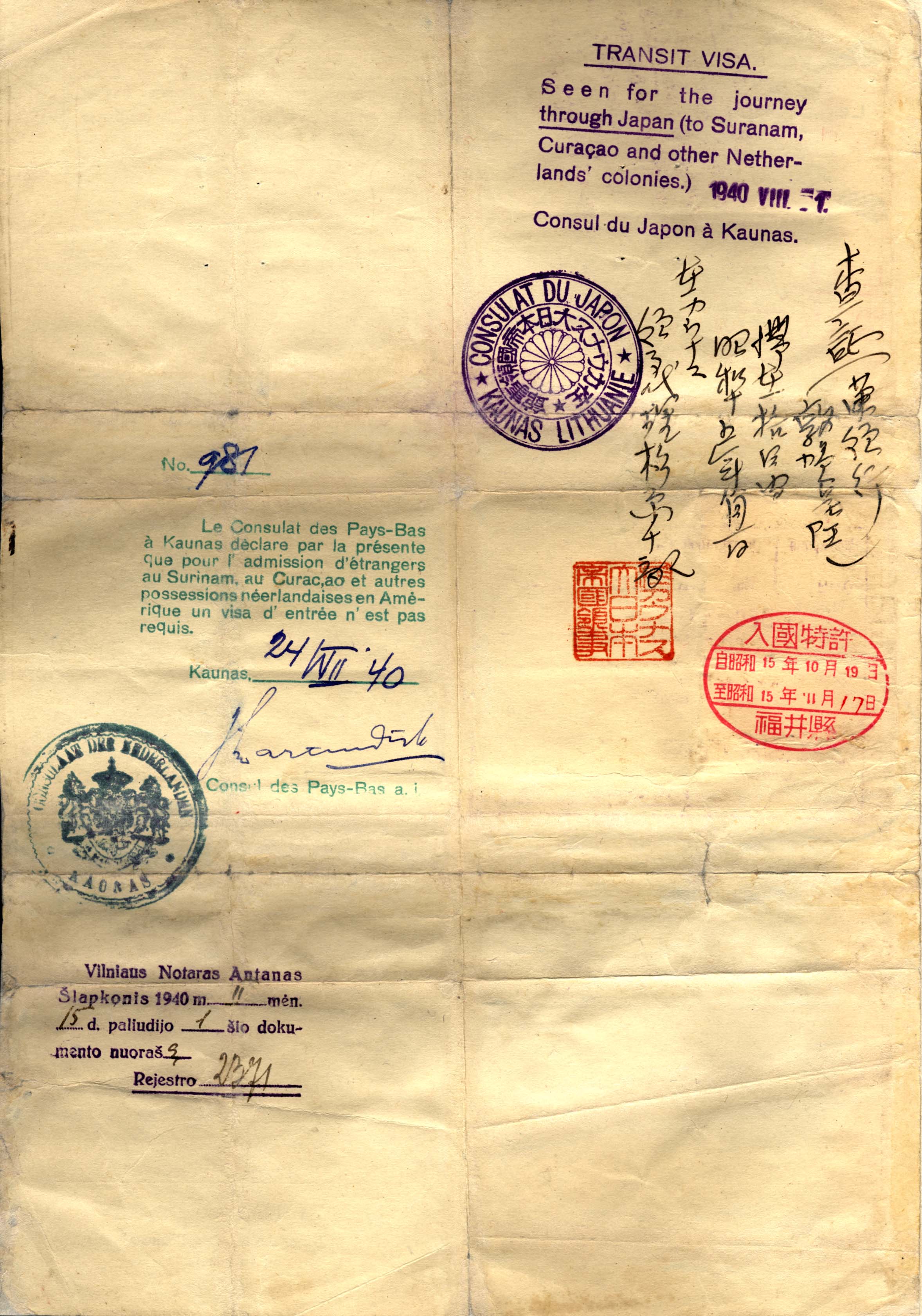
The travel document of Majer Klejn (list No. 453). Both Kaunas endorsements sit side by side in colour: Jan Zwartendijk's Curaçao declaration and signature on the left, and Chiune Sugihara's Japanese transit visa — with the imperial consulate seal, his brushed signature and vermilion hanko — on the right, stamped again in red on landing at the port of Tsuruga.
▸ Hover (or tap) any numbered mark on the document
A visa is permission from one country to someone another country vouches for. That is what had collapsed. Poland had been partitioned out of existence in 1939; Lithuania was being absorbed into the Soviet Union as these papers were written. The people queuing outside the consulate were not short of a stamp — they were short of a state willing to say who they were, which is why so many of the documents in this archive are certificates of identity rather than passports, issued by legations of a country that no longer governed anything.
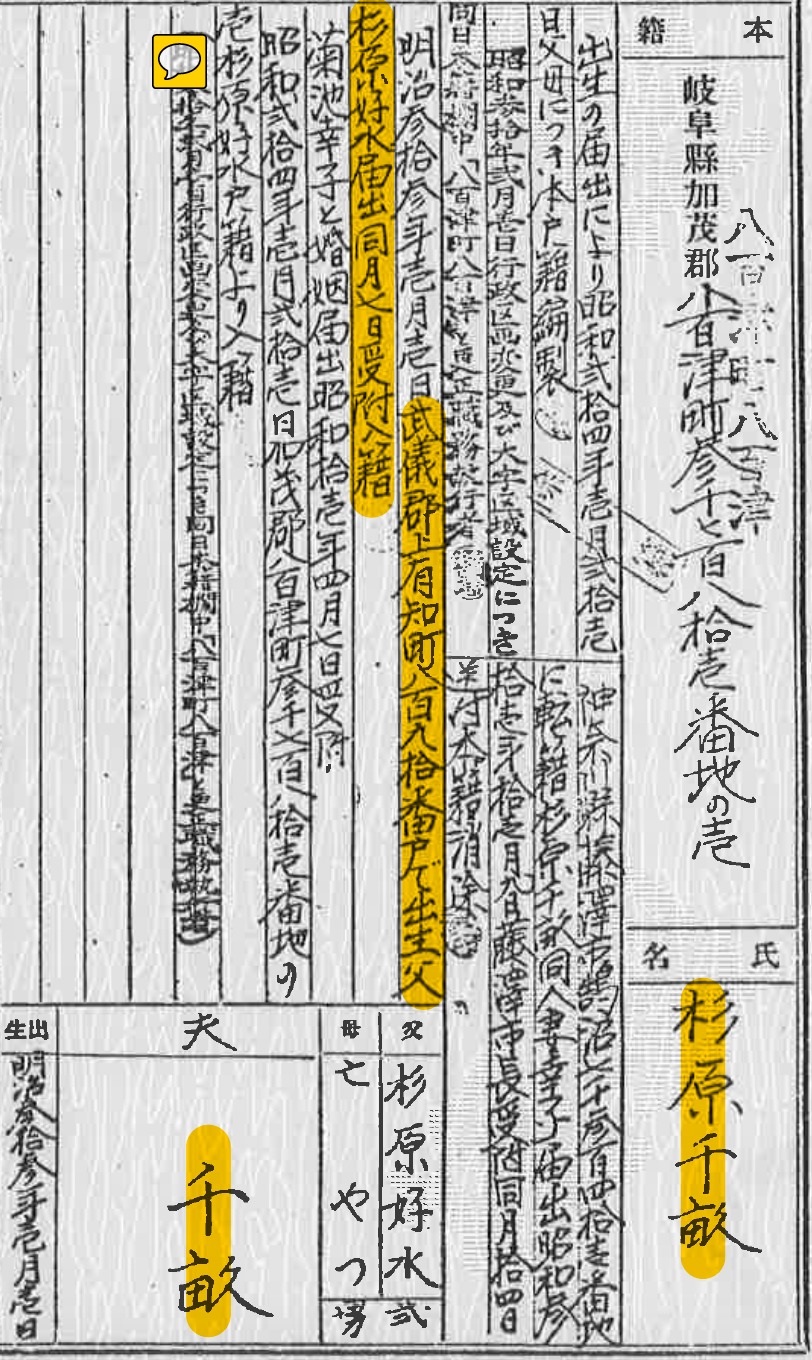
The other side of that coin: Sugihara's own koseki, the Japanese family register. It records him as the state saw him — 杉原千畝, permanent domicile Yaotsu in Gifu prefecture, plot 381-1; father Yoshimizu, mother Yatsu; born on the first day of the first month of Meiji 33, 1 January 1900, in a house numbered 890 in Kōzuchi. Four generations of belonging, written down and kept.
He spent six weeks handing that thing he had — documentary existence — to people who had lost it. And the paper cut both ways: the same registry that made him legible to his government made him easy to dismiss from it. The ministry let him go after the war. The entry in Yaotsu's register outlasted the career.
The Curaçao trick was never a local improvisation that died when Kaunas closed. On 25 January 1941 — five months after Zwartendijk shut his office and burned his records — A. M. de Jong, the Dutch consul-general in Stockholm, wrote the identical sentence for Leiba Pruski and his wife Chanah, and posted it to them in Lithuania: that for admission to Curaçao and the other Netherlands possessions in the Americas, un visa d'entrée n'est pas requis — no entry visa is required. Same wording, same silence about the colonial governor's discretion, a different consul in a different country. The document is here.
De Jong's postwar testimony is the closest thing we have to an explanation of where the idea came from: he said it grew out of what Dutch officials had already been doing for refugees in Scandinavia. De Decker devised the wording in Riga, Zwartendijk used it two thousand times in Kaunas, de Jong was still using it from Stockholm in 1941. What looks like one man's brainwave was a formula passed between colleagues — which is the more useful history, because formulas can be taught.
The stamps on this page were copied — at the time, and for the best of reasons. Scholars of the Polish underground in Kaunas record that intelligence officers working alongside the consulate forged roughly 2,900 further transit visas after the genuine supply stopped, and refugees themselves made copies to survive: one man on this register, Samuel Iwry (No. 1046), carried a Polish safe-conduct he is frank in his memoir about having forged. Survivor family testimony also records forged Sugihara visas being sold in 1940 — one memoir names the man who made them, a fellow refugee who survived the war and later lived in Israel, where buyer and forger met again decades on.
Can a reader tell? Rarely, and not from a photograph. The consulate used one seal and one pair of hands for six weeks, so the genuine impressions vary among themselves: ink thins as a pad dries, a stamp lands crooked at the end of a long day, the same date is written three different ways in a single week. Collectors do circulate side-by-side comparisons of a genuine and a forged impression, and the archive keeps such a reference pair in its own files. It does not publish verdicts on individual documents from them. A stamp that looks wrong in a scan is not evidence that a family's paper was false, and the cost of being wrong falls entirely on the family.
This matters for reading any document on this site. A visa whose number appears nowhere in the consulate's ledger may be one Sugihara wrote and never recorded — his family estimate perhaps a thousand such — or a copy that was never his at all. The archive does not treat the difference as shameful either way: in the winter of 1940 a forged stamp moved a family across the same border as a real one, and saved the same lives. Where the archive doubts a specific document, it records that doubt internally rather than publishing an accusation; where a forgery is part of a survivor's own story, it is told as such.
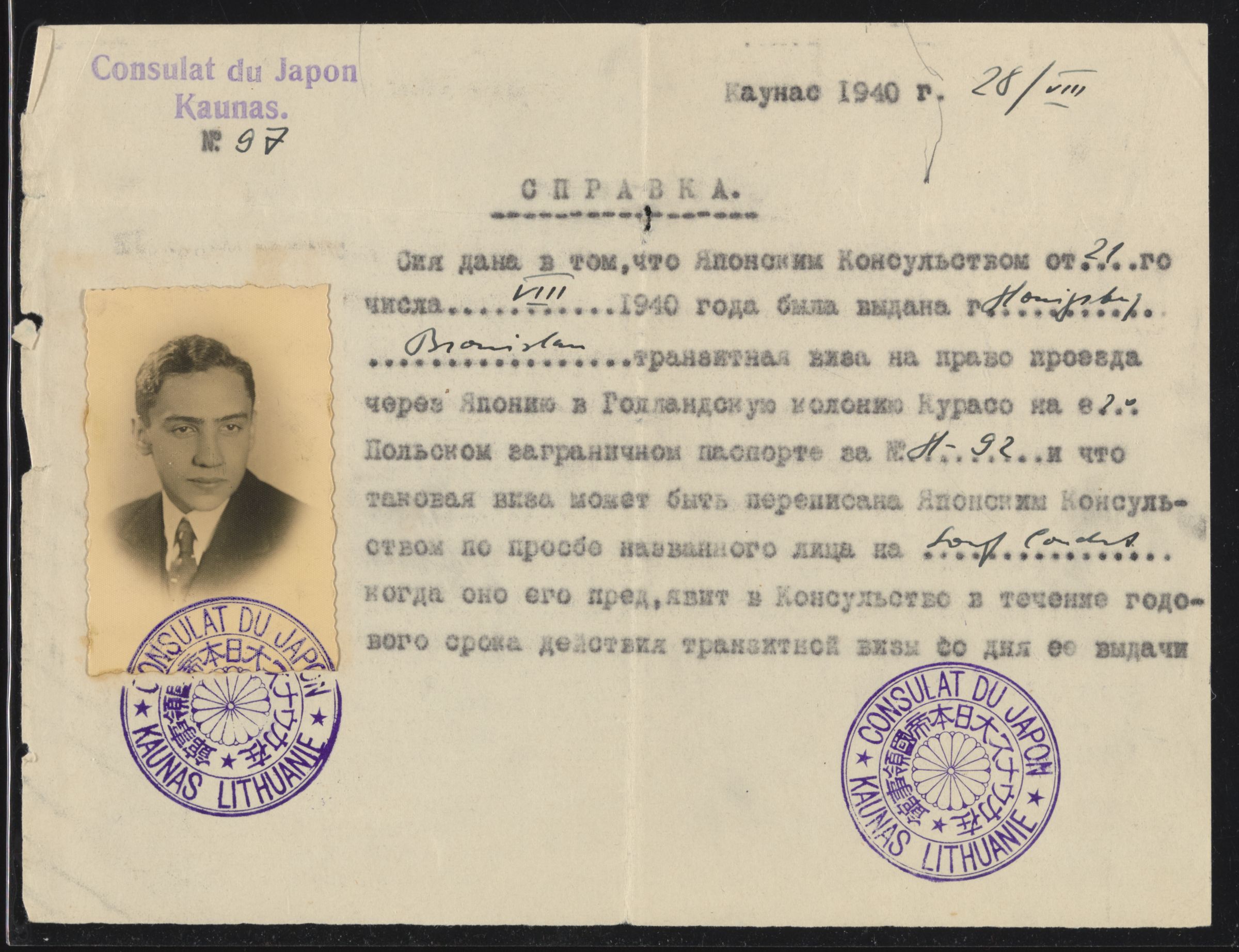
Not every Sugihara visa was a stamp inside a passport. The consulate also issued a separate typed certificate — справка, in Russian — attesting that a transit visa had been granted. On a printed form the clerk filled in the holder’s name, the date and the passport number by hand, pressed the chrysanthemum seal of the Consulat du Japon, Kaunas, and often affixed the applicant’s photograph. For a refugee whose passport was thin, expiring, or about to be exchanged, this was the portable proof of the visa — and it said so on its face: the visa could be re-copied onto another passport, at the holder’s request, within a year of issue.
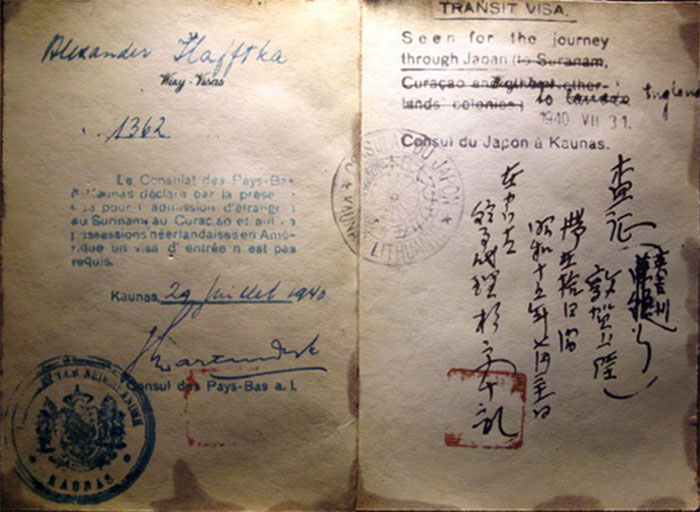
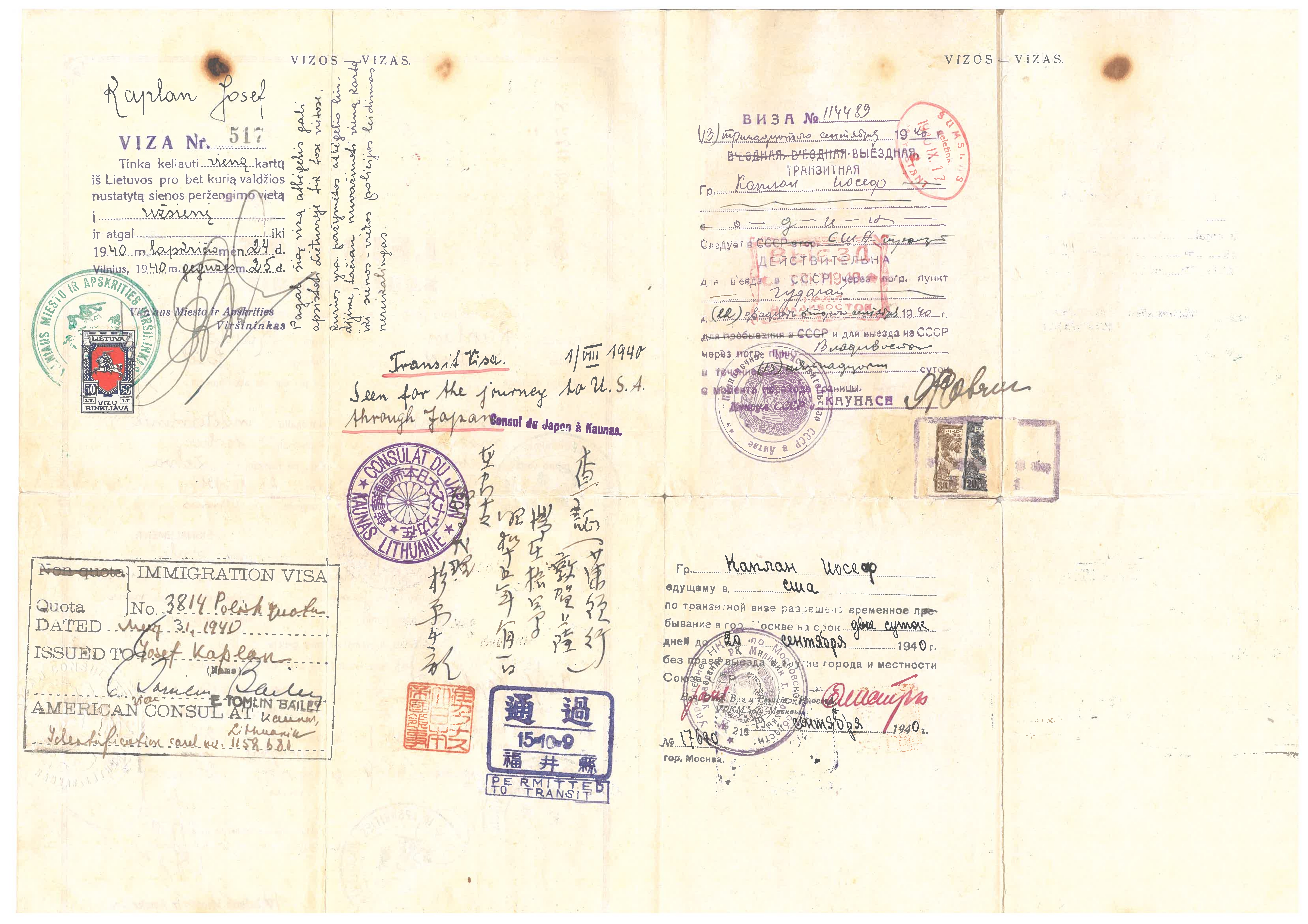
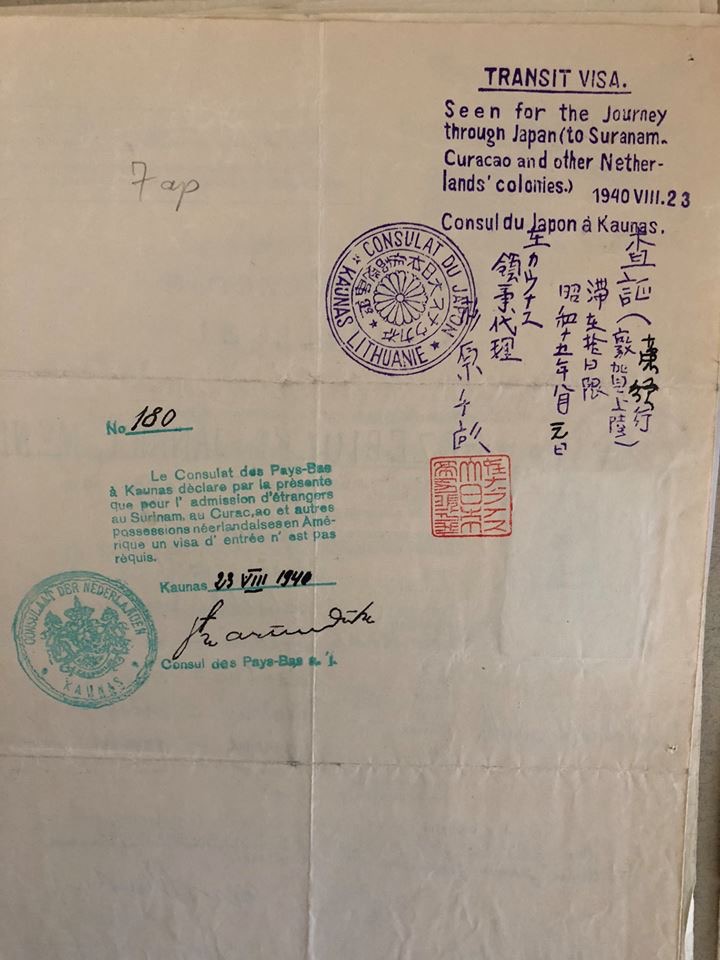
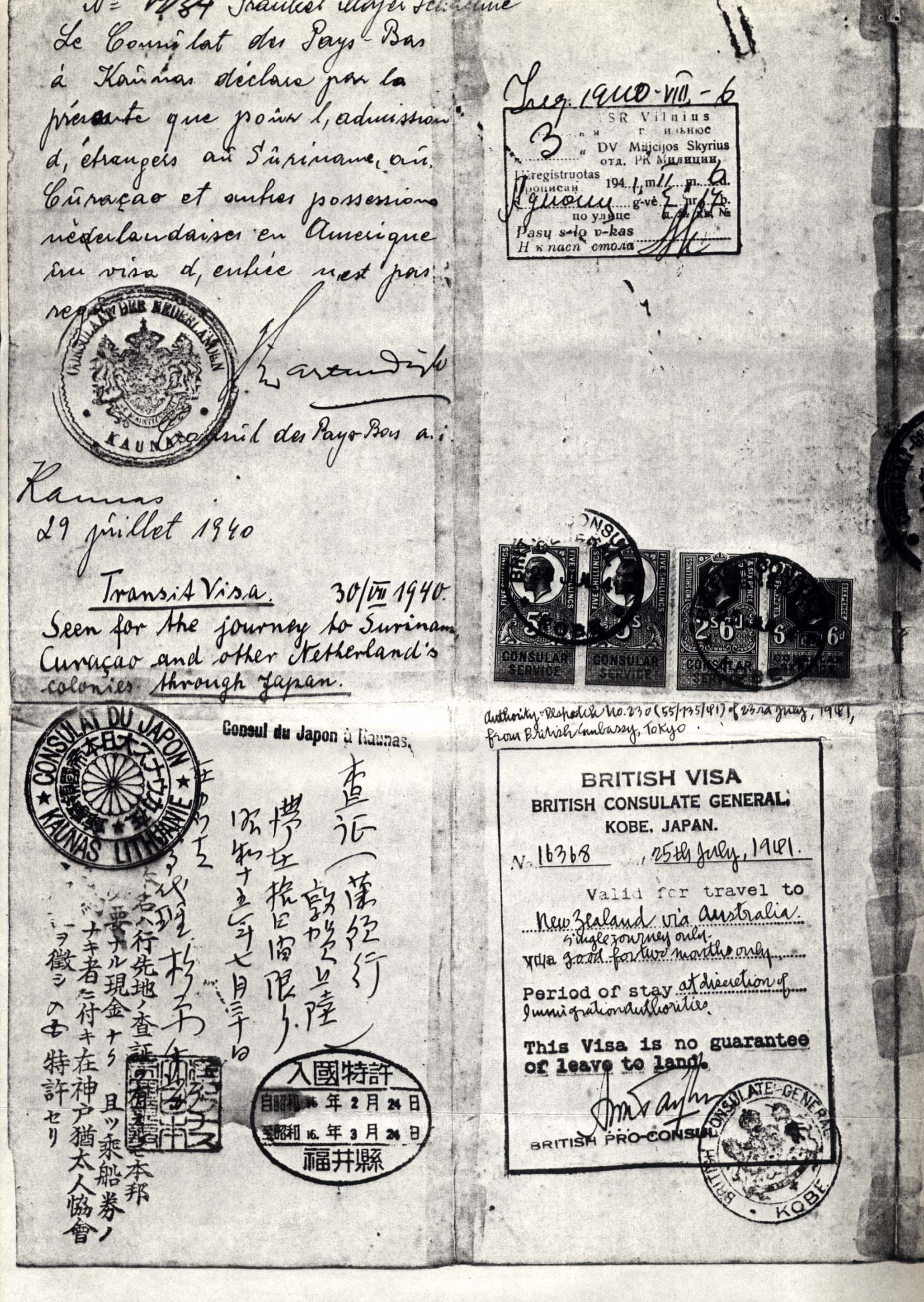
Sugihara's stamp names a destination nobody was going to: Surinam, Curaçao and the other Netherlands colonies. On 19 documents in this archive that line has been struck through by hand and a true destination written in its place — United States 9 · Canada 4 · England 4 · Palestine 2. (The count is of photographed pages; several belong to one family's booklet.) Some corrections are Sugihara's own, in the same ink as his signature; others were added later, by consulates down the line, as a family's actual chances changed somewhere between Kaunas and Kobe. Beyond the cases below, the same correction survives on Pinkus Berliner's British passport (No. 1256, "U.S.A."), on the passport of Helena Vaiman of Vilnius — "to U.S.A." against an American visa issued to her daughter on 19 August — and on Hersz Wulfson's document (No. 2095), where the hand wrote the rarest destination of all: "Iraq and Palestine."
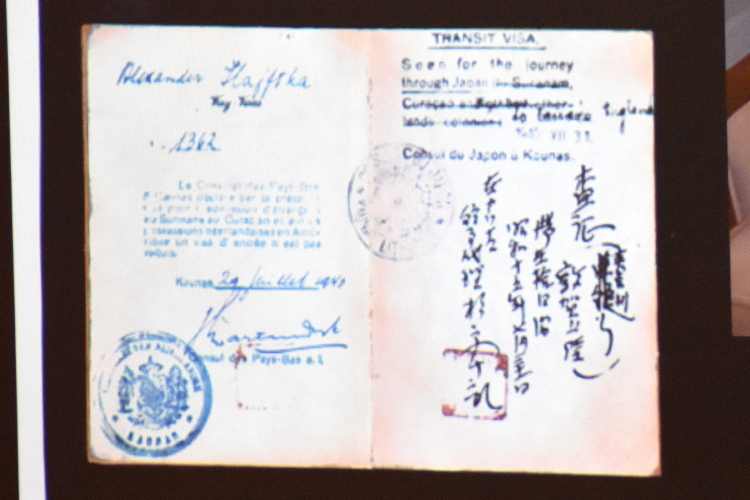
A visa of 31 July 1940 with the colonies struck out and England written above — a page of the Hafftka family's booklet, whose several visas carry the England and Canada corrections across three photographed pages.
The crossings-out are the plainest evidence that the Curaçao formula was understood by everyone as a device. Nobody sailed for Curaçao. The paper's job was to satisfy the Soviet exit clerk and the Japanese transit rule by naming somewhere; where a family already knew where they were really going, someone simply wrote it in. The best-documented cases:
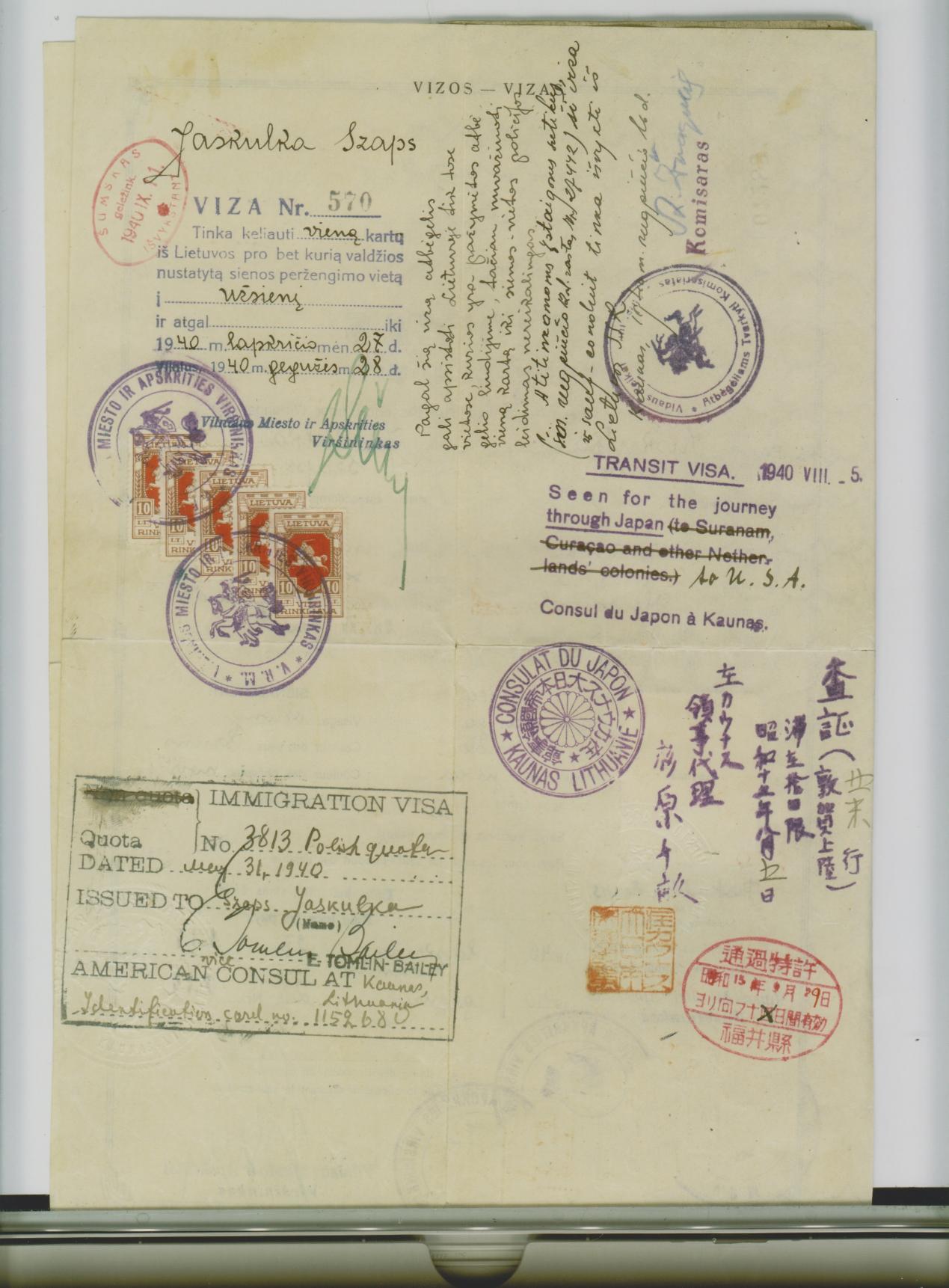
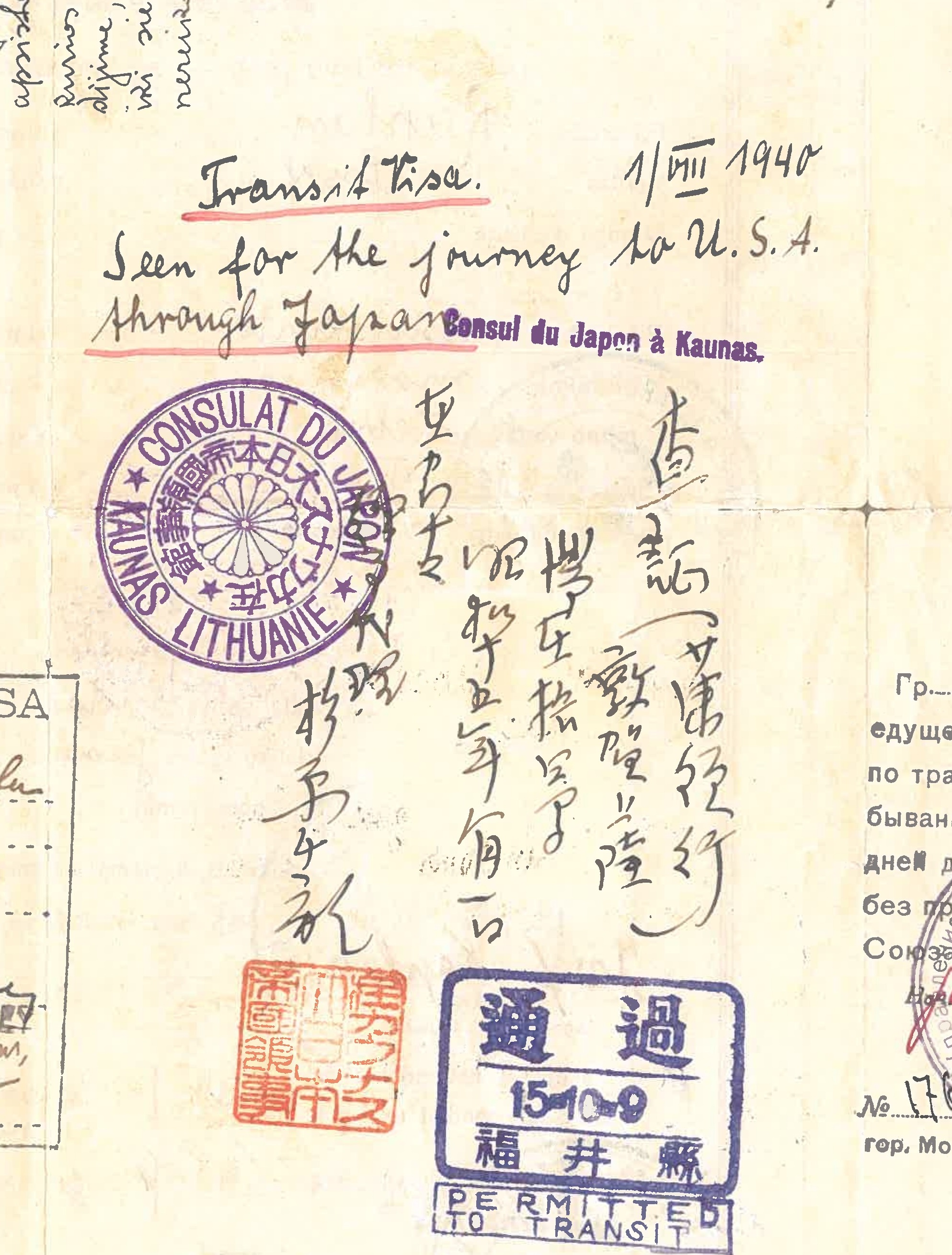
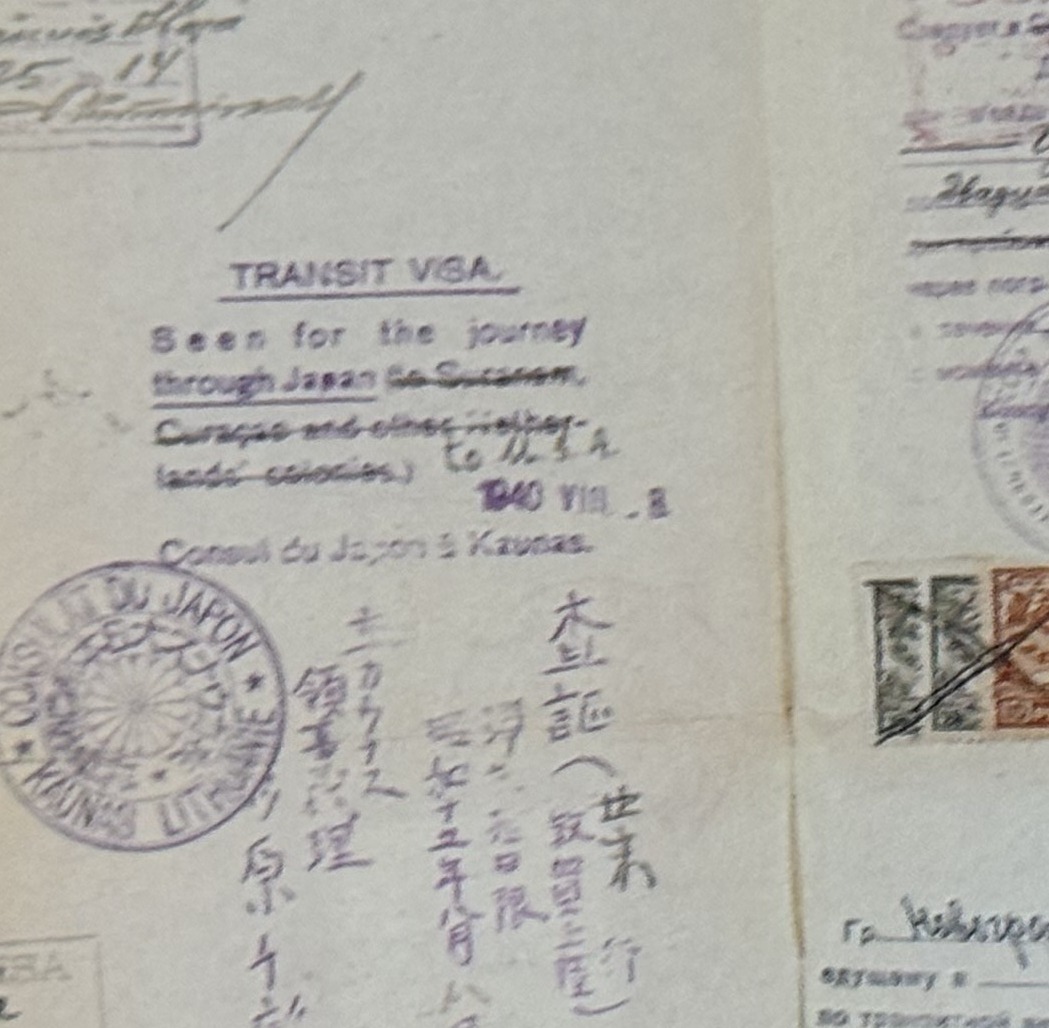
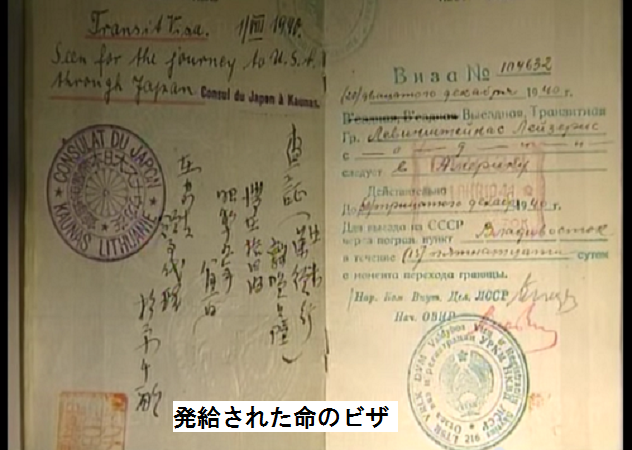
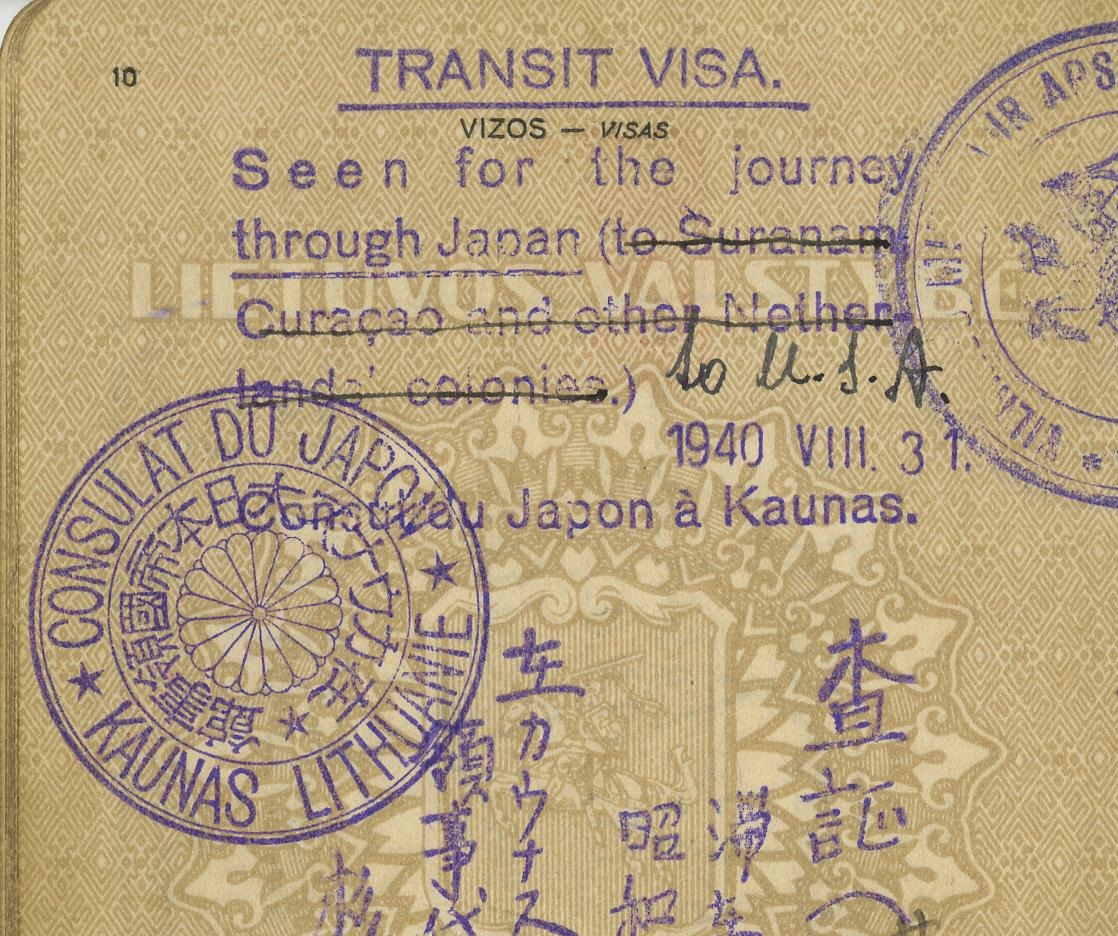
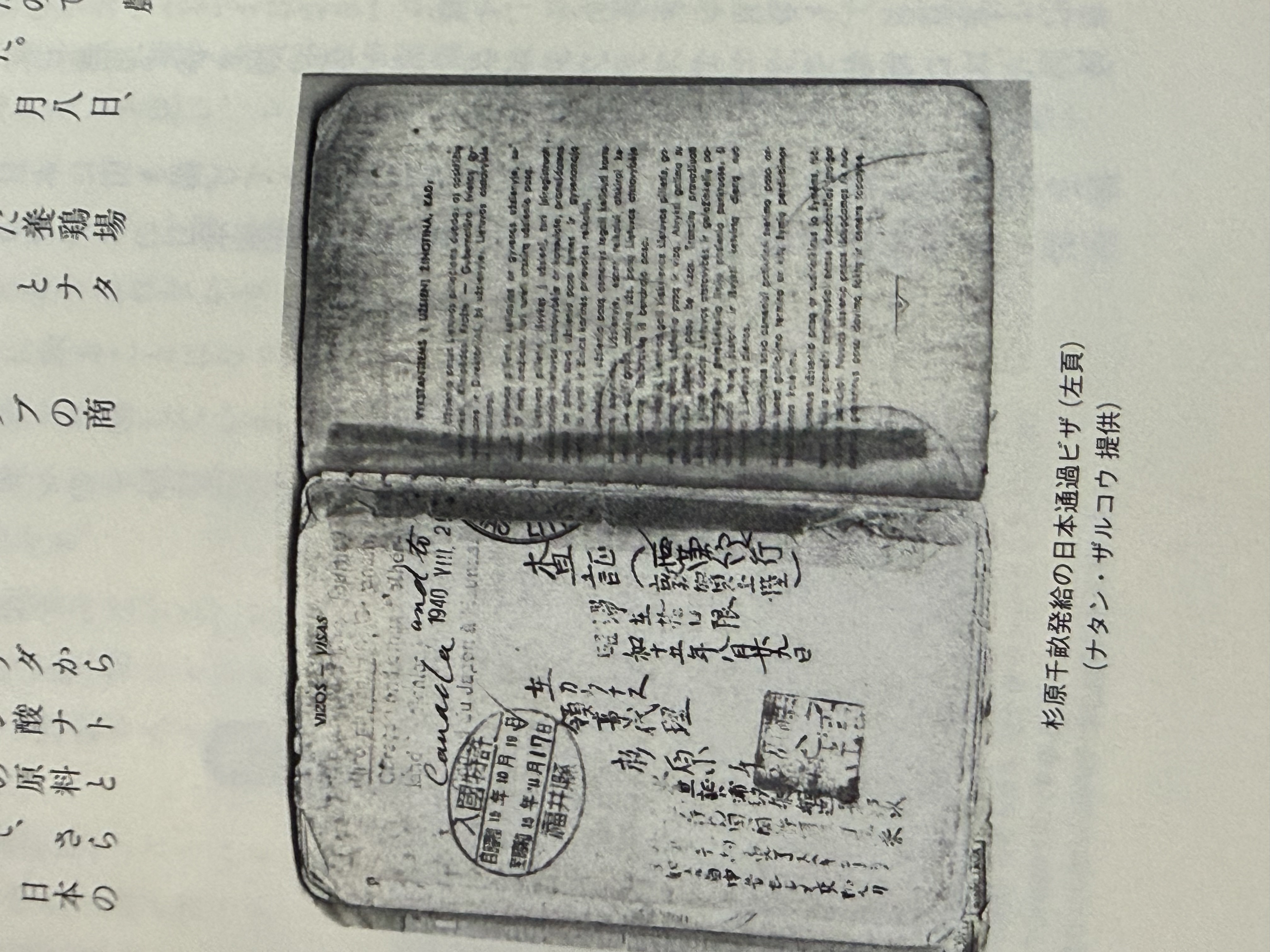
A further document — passport Nr. 13776, a visa of 24 July 1940 written out by hand, “Seen for the journey to Canada through Japan” — belongs to Zorach Warhaftig, No. 455: the Mizrachi leader who led the delegation to Sugihara's consulate. His name is inked across the sheet, beside an American immigration visa and a Canadian transit stamp — the true route in place of the island. His record →
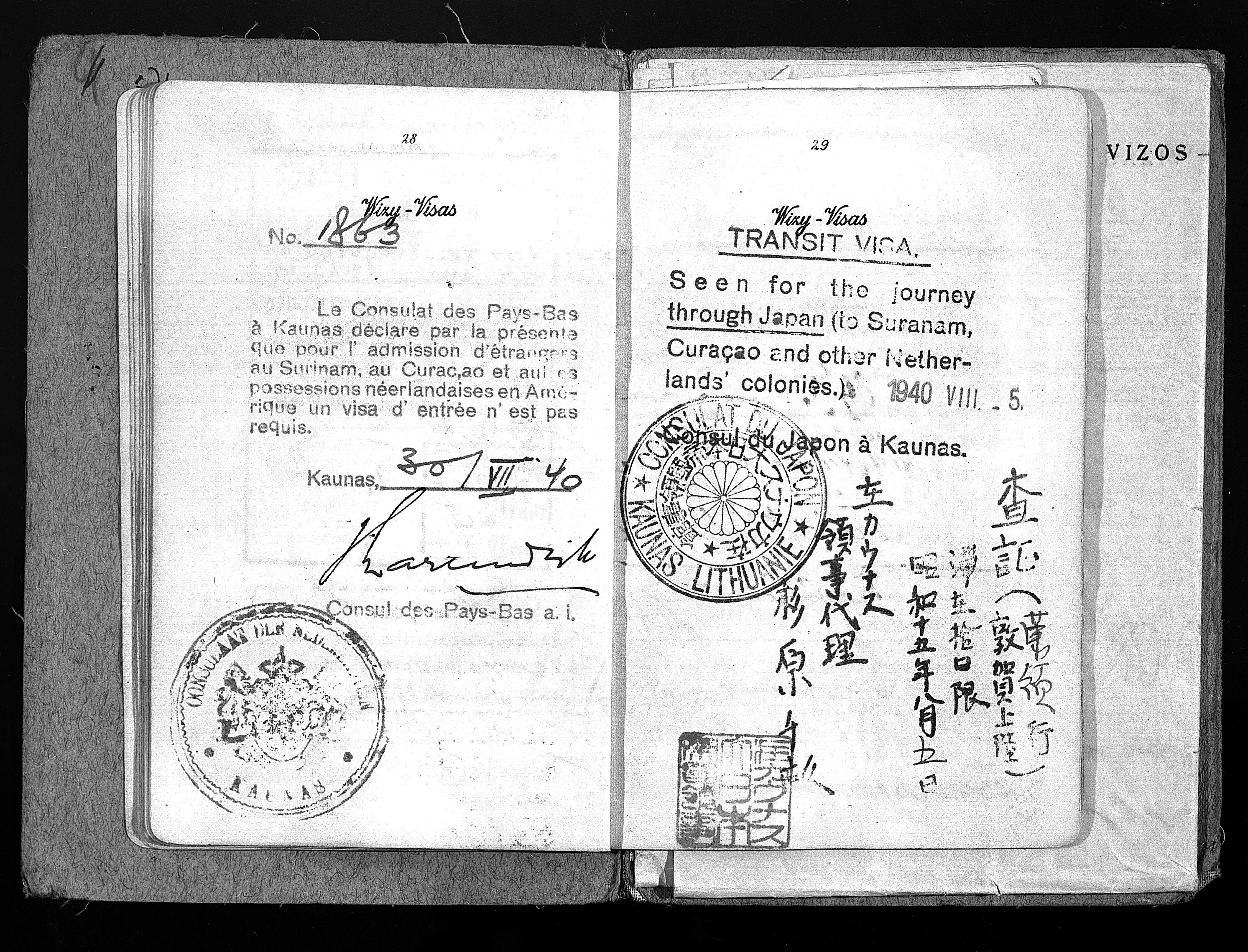
Every photographed document in this archive with a readable date, plotted by the form its endorsement takes. One distinction to hold first: what is tracked here is the roman-script transit line — Sugihara's English “Seen for the journey through Japan…” and Zwartendijk's French Curaçao declaration. Sugihara's Japanese brush columns and his signature are set aside: those he wrote by hand on every visa, stamped or not — the constant beneath the change. It is the English and the French that began as manuscript and, as the queues grew through late July, gave way to a rubber stamp: on this evidence Zwartendijk's manuscript peaks on 29 July, and from the first days of August Sugihara's transit line is overwhelmingly stamped. Then, in the last days of August — the consulate ordered closed, the register winding down — the handwriting returns: the final documents, written out where no stamp was to hand, down to 29 August 1940.
And the destination line itself was not sacred: on 17 of these dated documents the printed “Curaçao” formula is struck through and a real destination written in by hand — U.S.A (8), England (3), Canada (3), Canada, England (1), Iraq and Palestine (1), Palestine (1). The loophole had done its work; by the time these amendments were made, nobody was pretending anymore.
Hover or tap any bar to see the very document behind it; on touch screens use the arrows to step day by day. Based on 196 dated, photographed documents — the survivors' surviving papers, not the full register. A handful of early stamped readings are within the classifier's margin of error.
A genuine Sugihara visa is rare, and forgeries exist — fake stamps, made by a later hand and passed off as the real thing. What gives them away is the stamp itself: the shape of the consular seal, the weight and spacing of the type, the ink. Below, a genuine Sugihara transit-visa stamp beside a known forgery, for comparison.
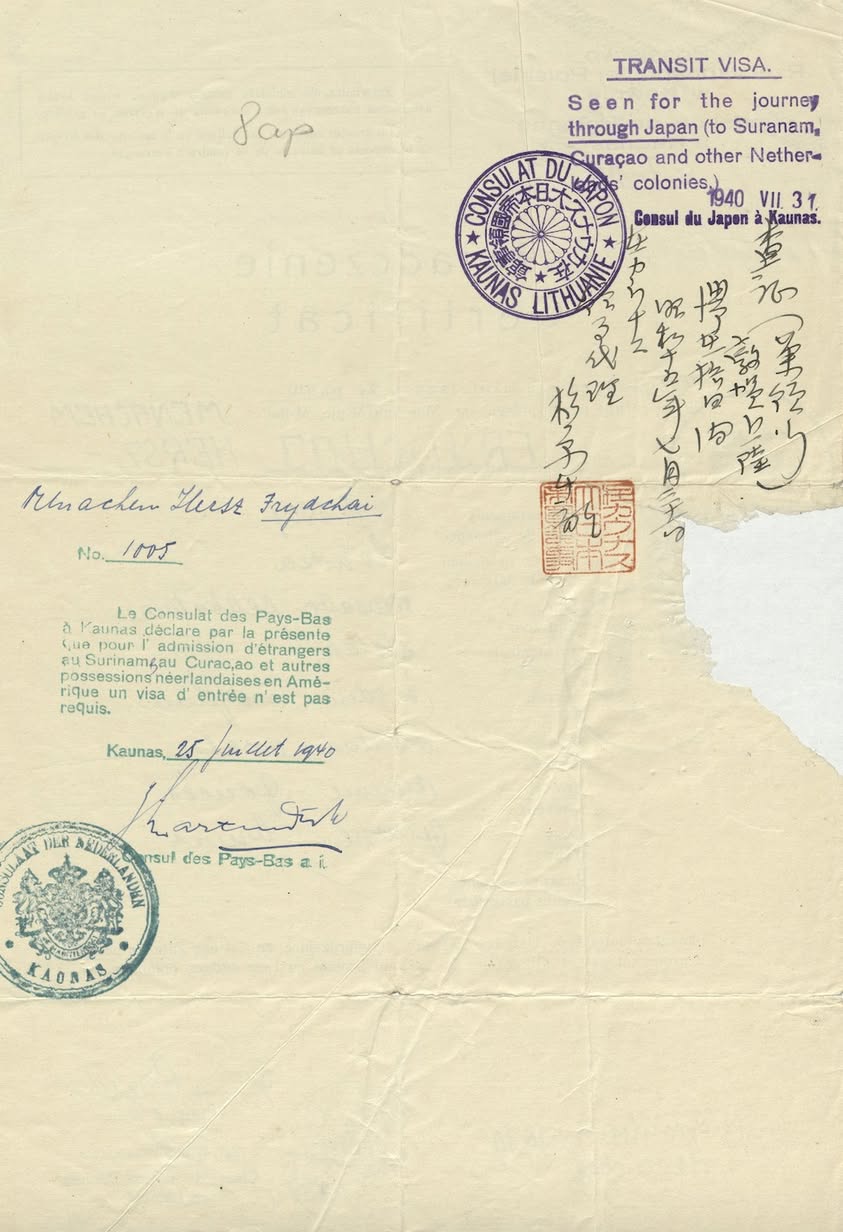
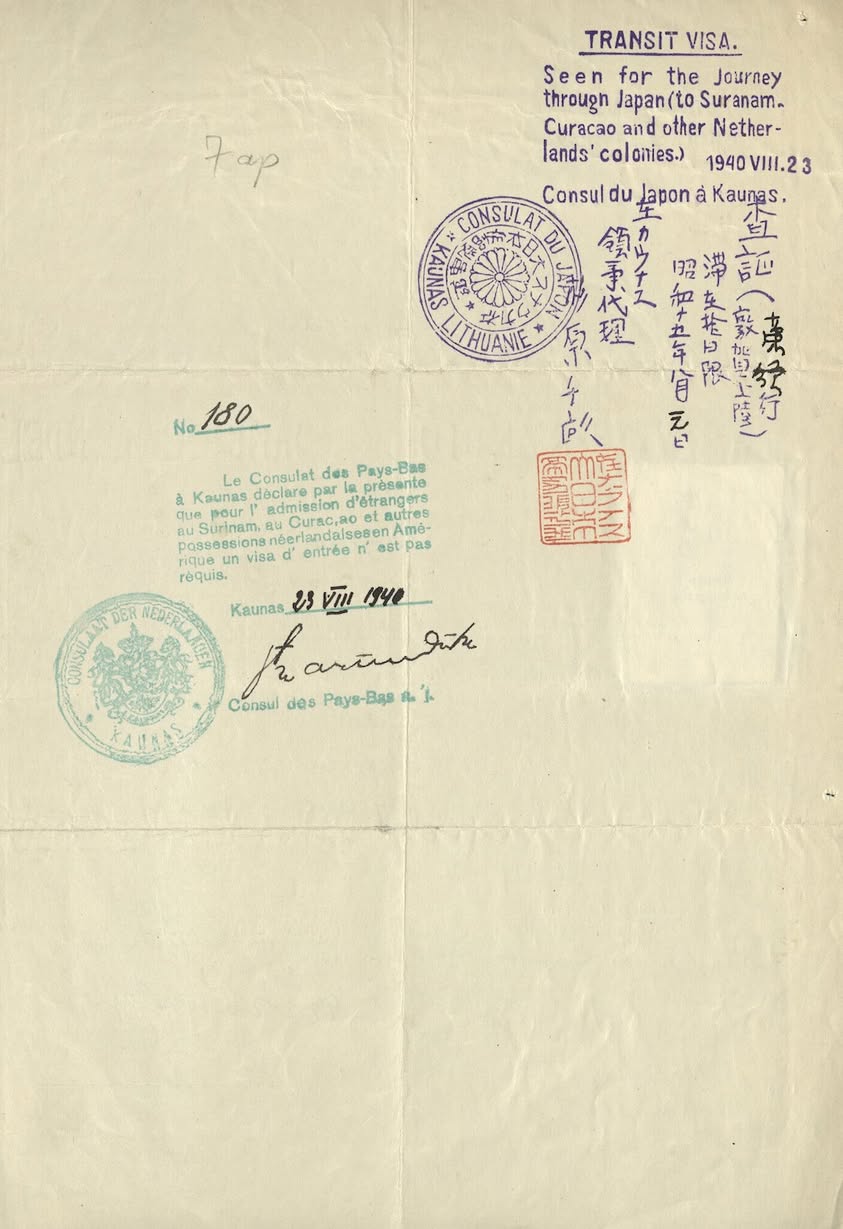
These are reference examples. The archive does not pronounce any family’s document a forgery; where a doubt about a specific document exists, it is kept internal and off the public record. A visa was worth more than money to the family it saved — which is exactly why fakes were made.
Not every irregular paper is a fake stamp. One document in this register is a genuine certificate that was changed to carry different people — and the change is legible, because a collector photographed it under infrared.
The paper is a Polish Legation Zaświadczenie of 30 November 1938, with Sugihara’s transit visa on the verso. It was issued to David Sielmann, who is No. 1752 on Sugihara’s register, his visa written on 14 August 1940. By the time the document travelled, it named two other people: Benno Lapidus, born in Warsaw on 20 November 1876, and Berta Lapidus, born there on 15 January 1899. New photographs of a man and a woman had been fitted, and the entries amended. Neither Lapidus appears anywhere on the register.
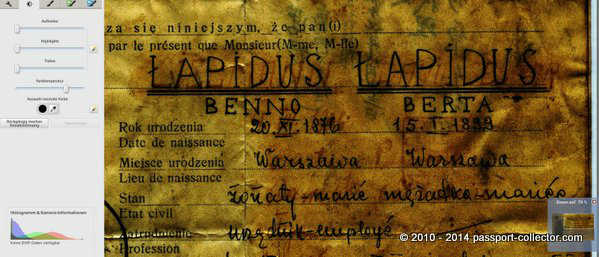
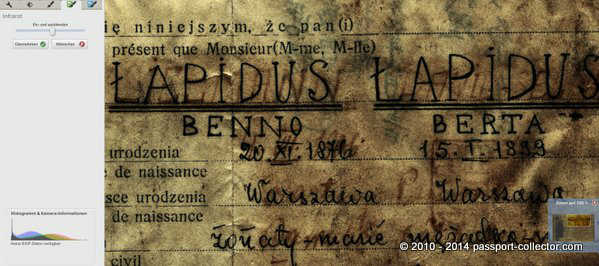
The reading is Tom Topol’s, of passport-collector.com, who owns the document and examined it under adjusted colour temperature, colour exchange and infrared; the images are his. The archive records what he found and adds nothing to it. He leaves the question that matters unanswered, and so does this page: whether the paper was taken, sold, or handed over. Did Sielmann give away his document so that two people could go instead of one?
Two small things do not line up, and are worth stating rather than smoothing: the certificate spells the name Sielmann with two n’s where the register has one, and the visa dates differ by a day. The archive files the document under Sielmann’s register line with all three names on it — his, and the two the paper carried out of Europe.
Tom Topol, “Altered Sugihara Travel Document — Save One Jewish Life? Two!”, passport-collector.com. Images © passport-collector.com, reproduced with the analysis they belong to. The full analysis →