Fajga Margolin
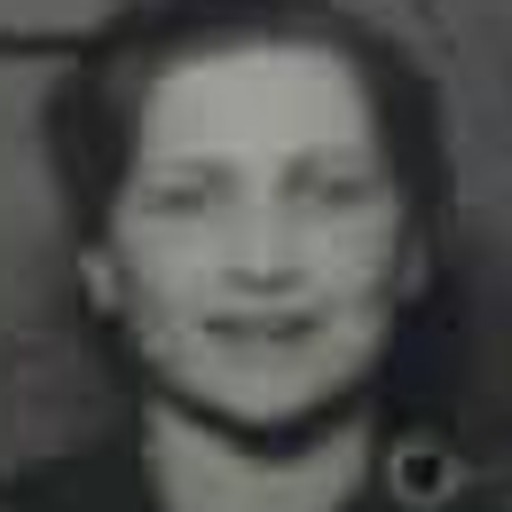
Fajga Margolin received transit visa no. 745 at the Japanese consulate in Kaunas on 1 August 1940. Aged 32 in 1940.
Documents
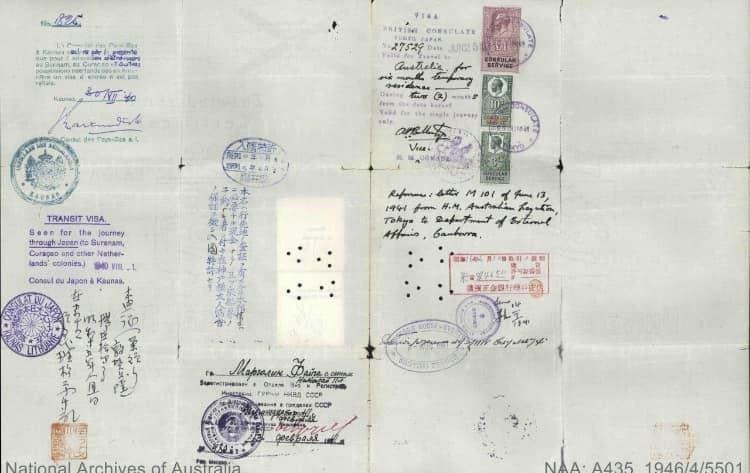
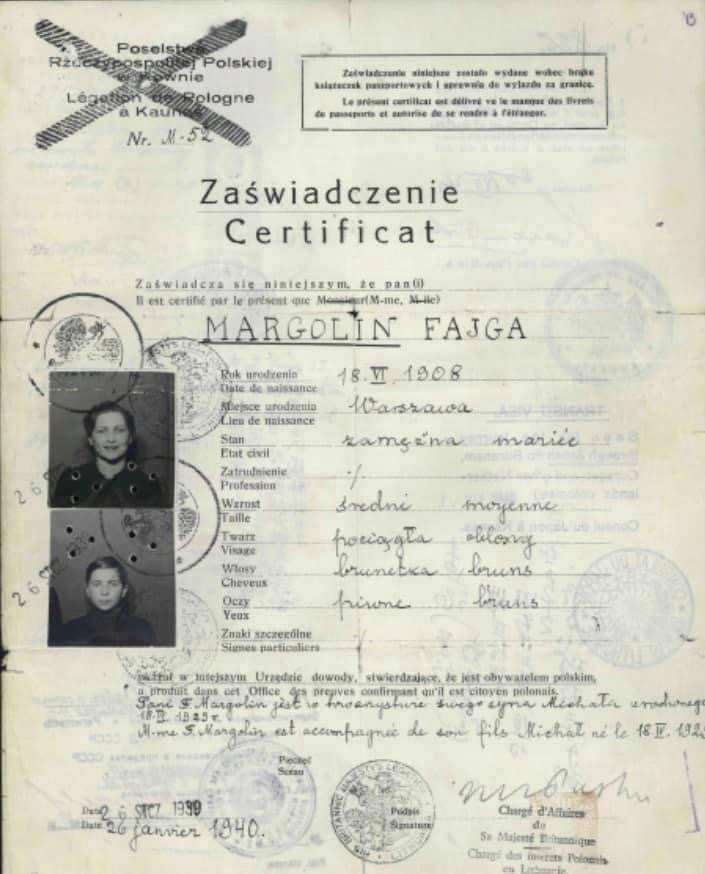
Click a document to see it larger.
What the register records
- Nationality as recorded
- Polnisch
- Age in 1940
- 32
- Family, per the Kitade-Bluman list
- wife of #746
The journey
Reached Japan; aided by the Polish ambassador Tadeusz Romer; registered in Kobe for Australia.
What is known
The Margolins of Warsaw escaped as a family: bookkeeper Mojżesz-Szloma (No.746), his wife Fajga (No.745) and their eleven-year-old son Michał, photographed solemn-faced beside his mother on her certificate. Their papers collected the full route — Zwartendijk's declaration, Sugihara's visas of 1 August 1940, NKVD registrations — and in June 1941 the British Consulate in Kobe granted them six months in Australia on the strength of a single telegram-letter from the Australian Legation in Tokyo. Their certificates now rest in the National Archives of Australia.
Where this comes from
- List of Refugees, Vilna, 1940 — JDC Archives, New York, collection AR 33/44, file 00876. The contemporary register of Polish Jewish refugees in Lithuania, running to more than nine thousand numbered entries; the fullest independent check…
The 1940 Vilna refugee list has, at entry 6834, Fajga Margolin, born 1908 at Warszawa, who came from Warszawa; the year agrees with the register's compiled age, and her husband Mojzesz Szloma, also on the register (No. 746), stands just above her on the list. - The Kobe relatives list — refugees at Kobe in 1941 recorded with their relatives abroad. Seventy-six pages in numbered sheets (LIST No. 7, No. 16 and others), each line giving a name, age, birthplace, occupation and citizenship, and then…
Entry 205 of the Kobe community's list of refugees and their relatives abroad: aged 33, Polish. - Certificate of Polish citizenship No. M-52, issued to Fajga Margolin by the Legation of the Polish Republic at Kaunas on 26 January 1940. Issued in place of a passport book: the printed text states that it is granted for want of passport…
The certificate names Fajga Margolin and gives her birth as 18 June 1908 at Warsaw, which agrees with the register's age of 32 in 1940. The line written across the foot records that she travels with her son Michal, born 18 April 1929 - eleven years old in 1940, the age the register gives for the Michal named with this family. Her married state agrees with the register, which pairs her with No. 746. Three points of agreement beyond the surname: the given name, the birth year, and the son's name and age. - JDC Archives, New York, collection AR 33/44 file 53 (the Jewish Community of Kobe's returns to the JDC, 1941; Set I, item 00761) — Set I pp. 5–7 — "List… — "List of persons who left Japan for Shanghai in the month of July 1941", Nos. 1–15
She left Kobe on the Canberra Maru on 2 July 1941, bound for Australia (the Jewish Community of Kobe's list of departures, July 1941 (JDC Archives, AR 33/44 file 53)). The list reads: "″ Fajga". (Canberra Maru, Kobe, 2 July 1941, destination Australia.) - A British Consulate transit visa for Australia (Tokyo, No. 27529, 20 June 1941, "six months temporary residence"), endorsed with a reference to letter M 101 of 13 June 1941 from the Australian Legation, Tokyo, to the Department of Extern…
- Certificate of Polish citizenship (Zaświadczenie/Certificat), No. M-52, issued by the Legation of the Polish Republic at Kaunas to Fajga Margolin, born 18 June 1908 at Warsaw, married, dated 26 January 1940; two photographs are affixed,…
- Sugihara Survivors and Descendants FB group photo 10224228710082453
- National Archives of Australia, NAA A435 1946/4/5501 — Margolin family certificates: MARGOLIN Fajga (b. 18 VI 1908 Warszawa, cert. Nr. M-52 of 26 Jan 1940, accompanied by son Michał b. 18 IV 1929, two photos) and MARGOLIN Mojżesz-Szloma…
- Family of Jewish man Chiune Sugihara saved from Holocaust gives tribute | The Jerusalem Post