Josef Kamieniecki
Josef Kamieniecki received transit visa no. 463 at the Japanese consulate in Kaunas on 31 July 1940. The register records journalist, aged 33.
Documents
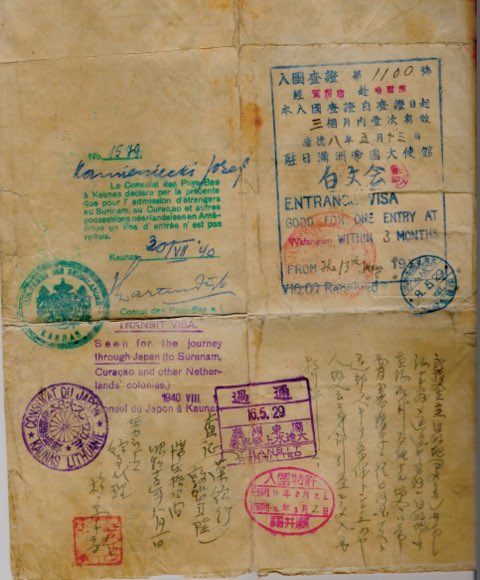
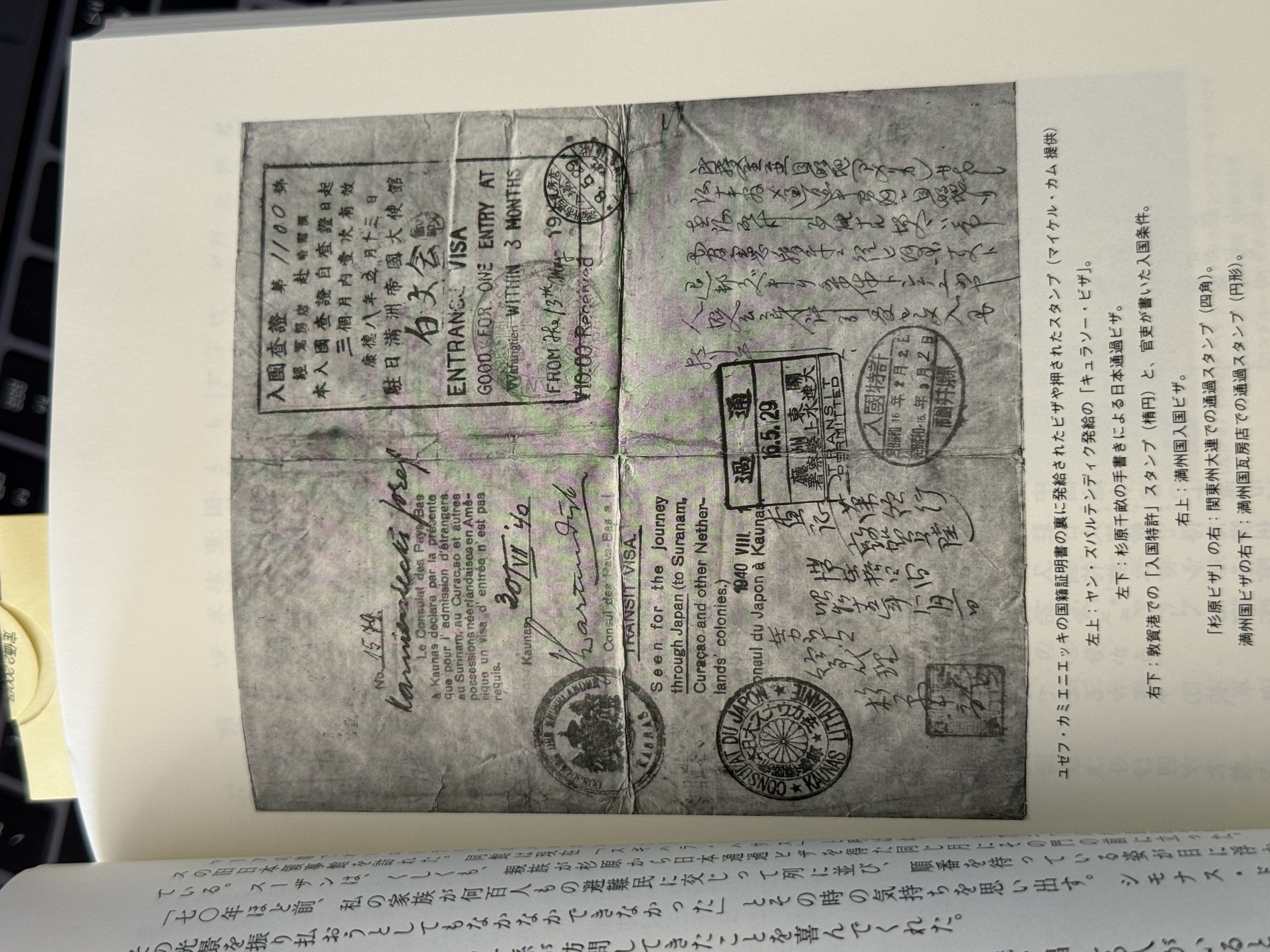
Click a document to see it larger.
What the register records
- Nationality as recorded
- Polnisch
- Age in 1940
- 33
- Occupation
- Journalist
The journey
Reached Japan; registered in Kobe for Australia.
What is known
This is the back of Jozef Kamieniecki's certificate of nationality, covered with the visas and transit stamps that document his escape route from Lithuania during WWII. It bears a Curaçao entry visa (No. 1579) issued in Kaunas on 30 July 1940 by Dutch acting consul Jan Zwartendijk, a handwritten Japanese transit visa issued by Chiune Sugihara at the Japanese consulate in Kaunas, a Manchukuo (Manchurian Empire) entrance visa (No. 1100) issued through the Manchurian embassy in Japan, and multiple transit stamps from Dairen (Kwantung), Wafangdian (Manchukuo), and Tsuruga port in Japan, showing the long overland and sea journey he took to escape Europe.
This composite document shows a Dutch 'end visa' issued by Consul Jan Zwartendijk in Kaunas on 20 July 1940, stating that no entry visa was actually required for Curaçao and Surinam, followed by a Japanese transit visa stamped by Chiune Sugihara authorizing travel through Japan toward those Dutch colonies. Together with a Japanese entrance/transit stamp (No.1100) and Manchurian and other transit chops, these stamps trace the bureaucratic path used by Josef Kamieniecki to flee Nazi-occupied Europe via the Trans-Siberian railway and Japan.
Seen for the journey through Japan (to Suranam, Curaçao and other Netherlands' colonies.) GOOD FOR ONE ENTRY AT Wafangtien WITHIN 3 MONTHS TRANSIT PERMITTED ユゼフ・カミエニエッキの国籍証明書の裏に発給されたビザや押されたスタンプ(マイケル・カム提供)
Le Consulat des Pays-Bas à Kaunas déclare par la présente que pour l'admission d'étrangers au Surinam et Curaçao et autres possessions néerlandaises en Amérique un visa d'entrée n'est pas requis. Seen for the journey through Japan (to Suranam, Curaçao and other Netherlands colonies) TRANSIT VISA
Where this comes from
- List of Refugees, Vilna, 1940 — JDC Archives, New York, collection AR 33/44, file 00876. The contemporary register of Polish Jewish refugees in Lithuania, running to more than nine thousand numbered entries; the fullest independent check…
The 1940 Vilna refugee list has a Josef Kamienicki at entry 3062, born 1893 at Białystok, who had come from Warsaw. It is shown as a lead, not as this person: born 1893 against the register's age of 33, which puts the birth about 1907. - List of Refugees, Vilna, 1940 — JDC Archives, New York, collection AR 33/44, file 00876. The contemporary register of Polish Jewish refugees in Lithuania, running to more than nine thousand numbered entries; the fullest independent check…
The 1940 Vilna refugee list has a Josel Kamieniecki at entry 3125, born 1928 in Poland, who had come from Wojdyslaw. It is shown as a lead, not as this person: Josel, born 1928, against a journalist of 33 — probably a child of another family. - List of Refugees, Vilna, 1940 — JDC Archives, New York, collection AR 33/44, file 00876. The contemporary register of Polish Jewish refugees in Lithuania, running to more than nine thousand numbered entries; the fullest independent check…
The 1940 Vilna refugee list has, at entry 8108, Jozef Kamienieckie, born 1908 at Warszawa, who had come from Warszawa; the year agrees with the register's compiled age. - The Kobe relatives list — refugees at Kobe in 1941 recorded with their relatives abroad. Seventy-six pages in numbered sheets (LIST No. 7, No. 16 and others), each line giving a name, age, birthplace, occupation and citizenship, and then…
Entry 131 of the Kobe community's list of refugees and their relatives abroad: born at Warszawa, Polish; relatives abroad: a brother-in-law, Zwi Siretkin, 23 Lifton Garden, London N.9. - The JEWCOM register — the refugee register kept by the Refugee Committee of the Jewish Community of Kobe (Ashkenazim) at No. 6 Yamamoto-dori, 1-chome, whose cable address was 'JEWCOM Kobe'. Eighty-four pages on the committee's own printe…
The Kobe Jewish Community's refugee register: aged 33, born at Warsaw, a journalist, who arrived in Japan from Kaunas on 2 February 1941. - Andrew Jakubowicz blog "Persona non grata — twelve minutes about Sugihara and me" (Apr 2016): Josef Kamieniecki Curaçao sheet No.1579 — use authorised by his son Michael Kamm (via Andrew Jakubowicz, 11 Aug 2026)
Andrew Jakubowicz, 'Persona Non Grata: twelve minutes about Sugihara and me' (30 April 2016) - a survivor family's own account. Josef Kamieniecki, a journalist who married the author's aunt and reached Australia in January 1947. Match: register No.463 Josef Kamieniecki, visa 31 July 1940, age 33, oc - The certificate of nationality of Józef Kamieniecki (No. 463), its reverse with his Curaçao declaration, Sugihara's transit visa and the Japanese entry and Manchurian transit stamps; its use authorised by his son Michael Kamm — a plate in 「太平洋を渡った杉原ビザ」authored by Aya Takahashi, printed by Gifu Shimbunsha, p. 212.
- Andrew Jakubowicz blog "Persona non grata — twelve minutes about Sugihara and me" (Apr 2016): Josef Kamieniecki Curaçao sheet No.1579 — use authorised by his son Michael Kamm (via Andrew Jakubowicz, 11 Aug 2026)
- Prof. Andrew Jakubowicz (University of Technology Sydney), email of 11 August 2026 to the archive, introduced by Arlette Liwer-Stuip — four answers: (1) Josef Kamien… — a belief he withdrew in his letters of 28 August and 2 September 2026