Apoteker Dawid
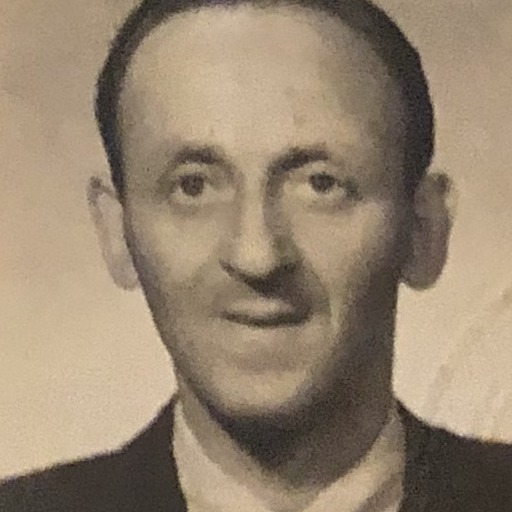
Apoteker Dawid received transit visa no. 1300 at the Japanese consulate in Kaunas on 6 August 1940. The register records diamond cutter, aged 31.
Documents
Click a document to see it larger.
What the register records
- Nationality as recorded
- Polnisch
- Age in 1940
- 31
- Occupation
- Diamond Cutter
The journey
Reached Japan; reached Shanghai; registered in Kobe for Belgium.
What is known
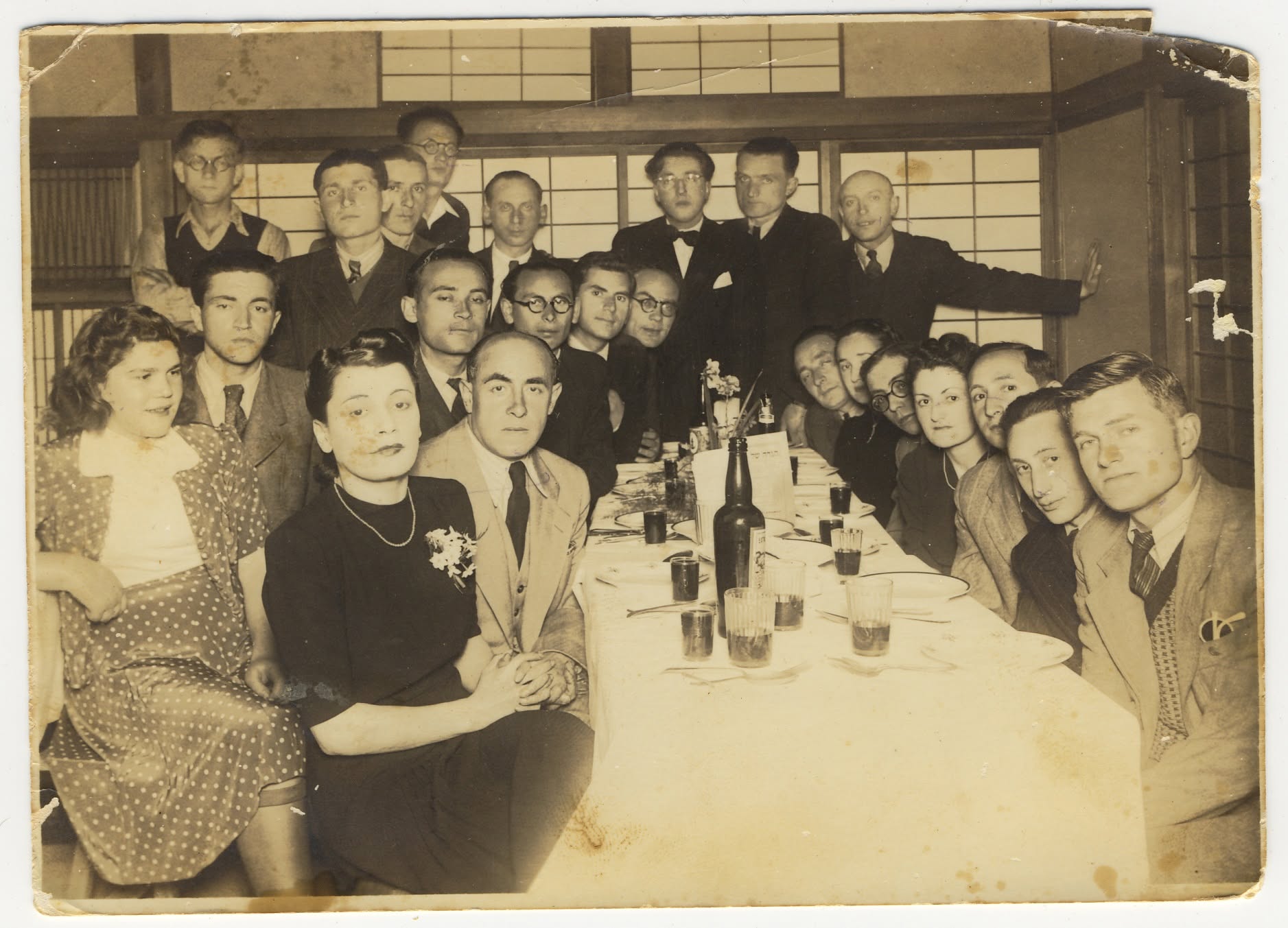
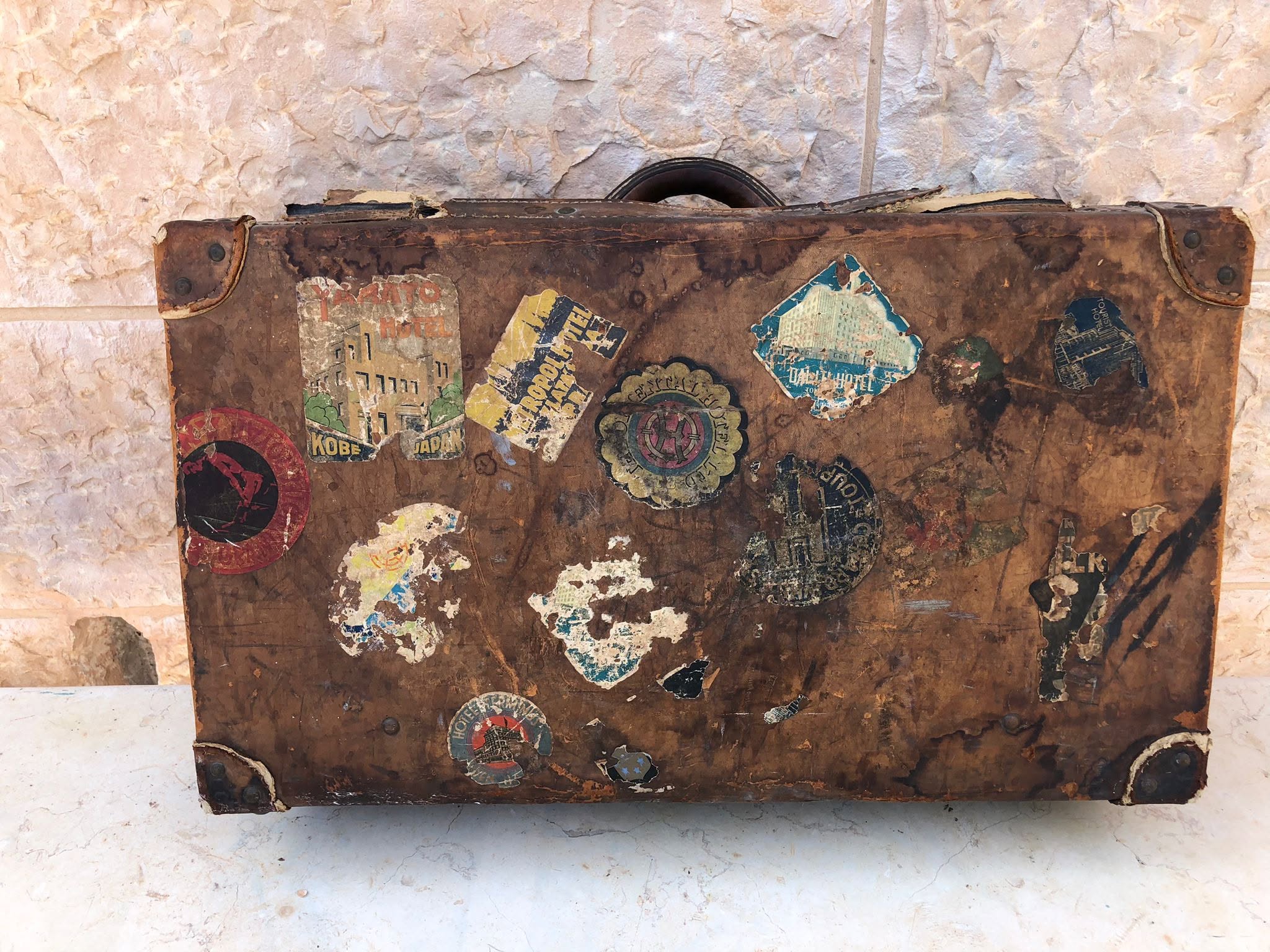
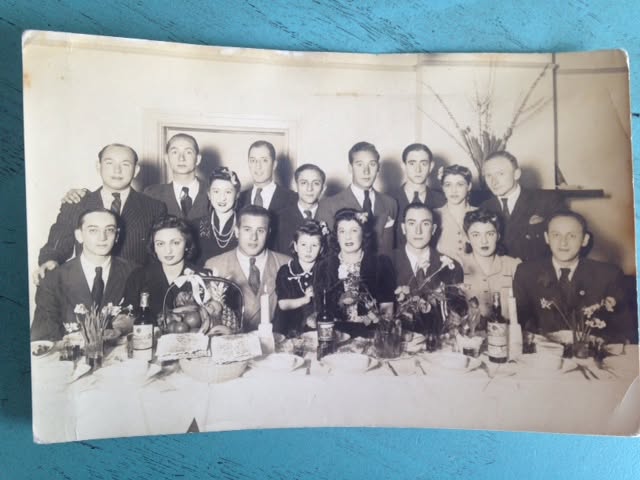
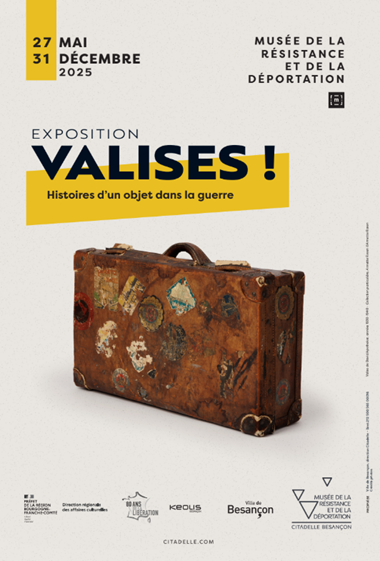
Spring 1941, a rented room in Kobe: two dozen refugees around a Seder table, a Haggadah open among the glasses, and at the back, standing with the guests, two Japanese men. Dawid Apotheker sits first from the right — a Sugihara-visa holder who wintered in Kobe and was moved on to Shanghai when the Pacific closed. His grandson's generation still keeps the suitcase, its lid papered with the Yamato Hotel Kobe and Daiichi Hotel Tokyo labels: the whole journey, in luggage stickers. The photograph surfaced in a descendants' circle eighty-five years later, and within hours another family recognized their own grandfather at the same table.
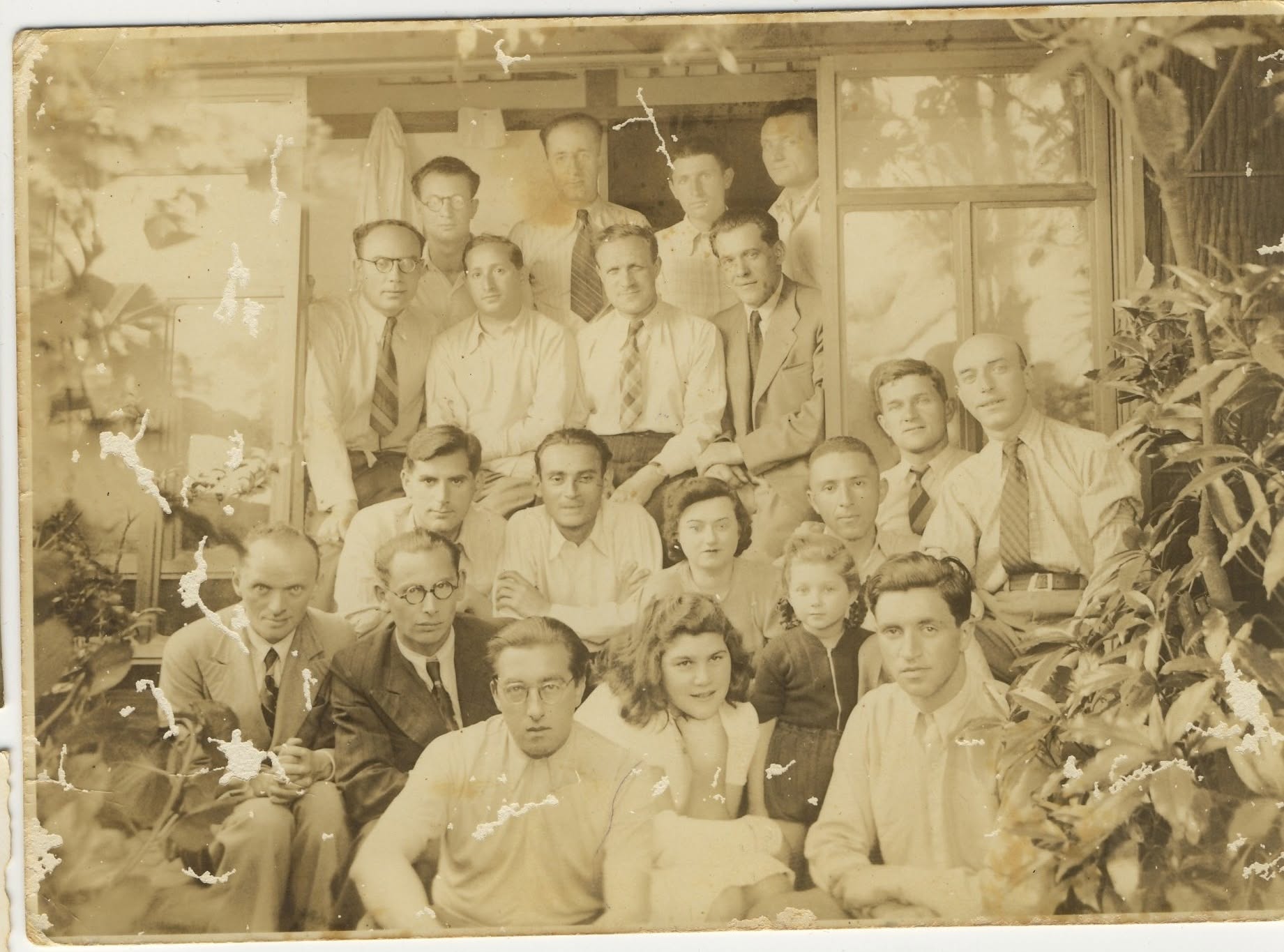
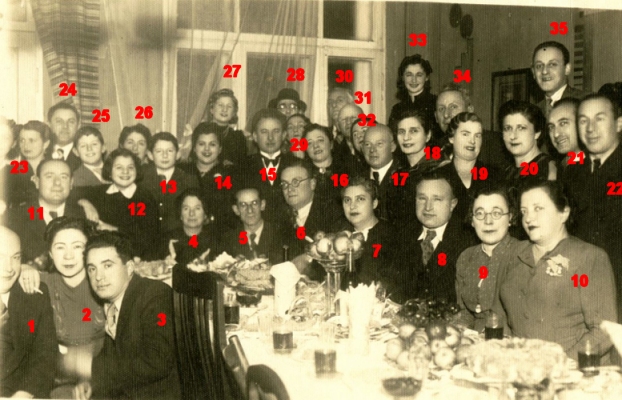
The photograph he chose to carry was not his own family's — he had none left to carry; of eight siblings, he alone survived. It was the bar-mitzvah picture of Miron Meller of Rokiskis, the town where refugee and resident were paired table by table in 1939, and where David Apotheker dined every day with the Mellers. He kept it through Siberia, through Vladivostok, through the Japan that — in his daughter's unsparing words — beat him and expelled him to Shanghai, through four years there, and through the empty Antwerp he found after the war. He stands in the picture himself, figure 35, a guest at another family's celebration: the only image of his face the archive holds. Half the people aro…
He was quite silent about those years, his son-in-law wrote — and so the reconstruction of David Apotheker took the family a quarter of a century. In 2003, eight years after his death, they found him on a Sugihara database and learned for the first time what paper had carried him east. In 2008 they were tracing his eight lost siblings and the Lauer in-laws of Presov. In 2025 the Arolsen Archives yielded a HIAS registration made in Shanghai in 1946: David had named a cousin — Henry Robinson, a lawyer in San Francisco's Mills Tower — and weighed America, before turning back to Europe, where an empty Antwerp and a second life in Holland waited. In 2026 the Seder photograph, the labelled suit…
Where this comes from
- The Kobe relatives list — refugees at Kobe in 1941 recorded with their relatives abroad. Seventy-six pages in numbered sheets (LIST No. 7, No. 16 and others), each line giving a name, age, birthplace, occupation and citizenship, and then…
Entry 7 of the Kobe community's list of refugees and their relatives abroad gives as relatives abroad an aunt, Sternberg, 4 Fair View, Portchester, New York; a cousin, Mendel Apoteker, 234 Delancey Street. - The JEWCOM register — the refugee register kept by the Refugee Committee of the Jewish Community of Kobe (Ashkenazim) at No. 6 Yamamoto-dori, 1-chome, whose cable address was 'JEWCOM Kobe'. Eighty-four pages on the committee's own printe…
Entry 10 of the Kobe Jewish Community's refugee register: listed among Czechoslovak subjects, aged 33, born at Bardojow, a merchant, who arrived in Japan from Kaunas on 2 February 1941. - Jacob Rosen-Koenigsbuch, email of 20 August 2026 (reply to the archive): there were TWO David Apothekers on the list — the Czechoslovak one is his father-in-law; the other, a Pole, sent a te… — and was the image on the exhibition's poster
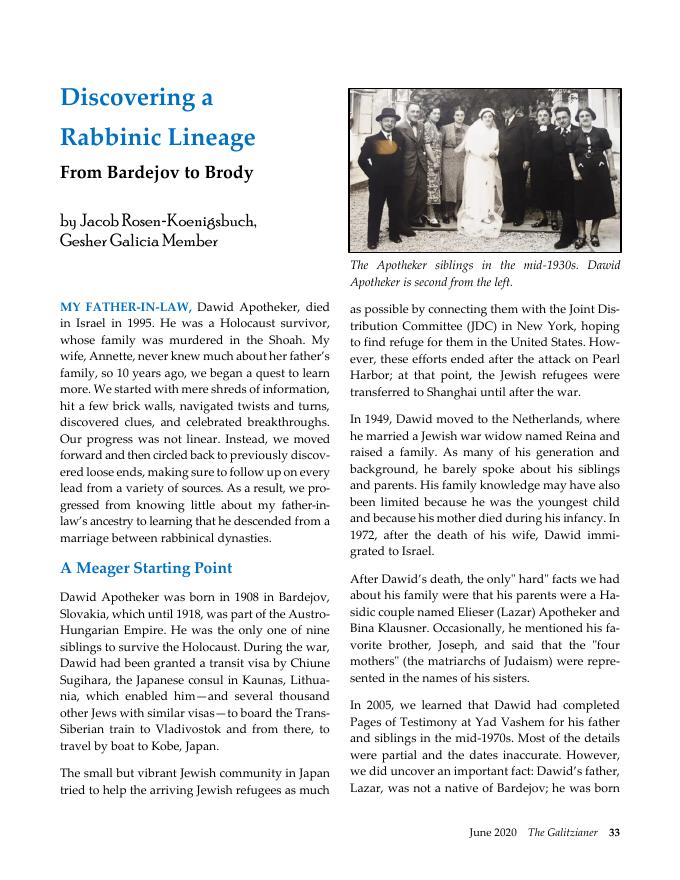
The register carries this name twice — here at No. 1300, visa of 6 August 1940, and again at No. 1654, a week later. They are two men. Jacob Rosen-Koenigsbuch, whose father-in-law this was, wrote to the archive in August 2026 that the Czechoslovak-born David reached Kobe and then Shanghai, while a Polish David Apotheker telegraphed friends in Kobe from Vilnius that he would follow, and never came. This line is the Czechoslovak one. Three things say so, and two of them owe nothing to the family: the Kobe community's arrival roster enters the man of this line as Czechoslovak, from Bardejov, aged 33; the annotation carried with this line gives his trade as diamond cutter; and the Shanghai identity book his family gave the archive on 29 August 2026 gives both together — Czechoslovakian, diamond cutter, born at Bardejov on 24 August 1908. A nationality and a trade agreeing across a Kobe roster, a list annotation and a Shanghai booklet is more than a shared name. The Polish David Apotheker is No. 1654, and what is known of him is written there. - Jacob Rosen-Koenigsbuch, "Discovering a Rabbinic Lineage: From Bardejov to Brody", The Galitzianer (Gesher Galicia), June 2020, pp. 33-38
Written by his son-in-law. Dawid Apotheker was born in 1908 at Bardejov, then Austro-Hungarian and later Czechoslovak, the youngest of nine surviving children of Elieser (Lazar) Apotheker and Bina Klausner; his mother died in his infancy and an aunt, Sara Plattner, raised him. He was the only one of the nine to survive. Granted a transit visa by Sugihara at Kaunas, he crossed Siberia to Vladivostok and took ship to Kobe, where the Joint Distribution Committee tried to place him in the United States; that route closed after Pearl Harbor and he was moved on to Shanghai for the rest of the war. In 1949 he went to the Netherlands and married a Jewish war widow, Reina. After her death he moved to Israel in 1972, and died there in 1995. The archive's own Kobe roster already carried the confirmation: it records him as Czechoslovak, aged 33, from 'Bardojow', and names his cousin Mendel Apoteker of 234 Delancey Street and an aunt, Sternberg, of Port Chester, New York — the same cousin the article reproduces from the JDC's copy of that list. - Library and Archives Canada, Tadeusz Romer fonds, MG 31 D 68, reel C-10451, frame 1067, via Canadiana Heritage — radiogram from the Polish Embassy (Polmission) at Kuybyshev to Ambassador Romer, 26 Route Delastre, Shanghai, received 14 Ju…
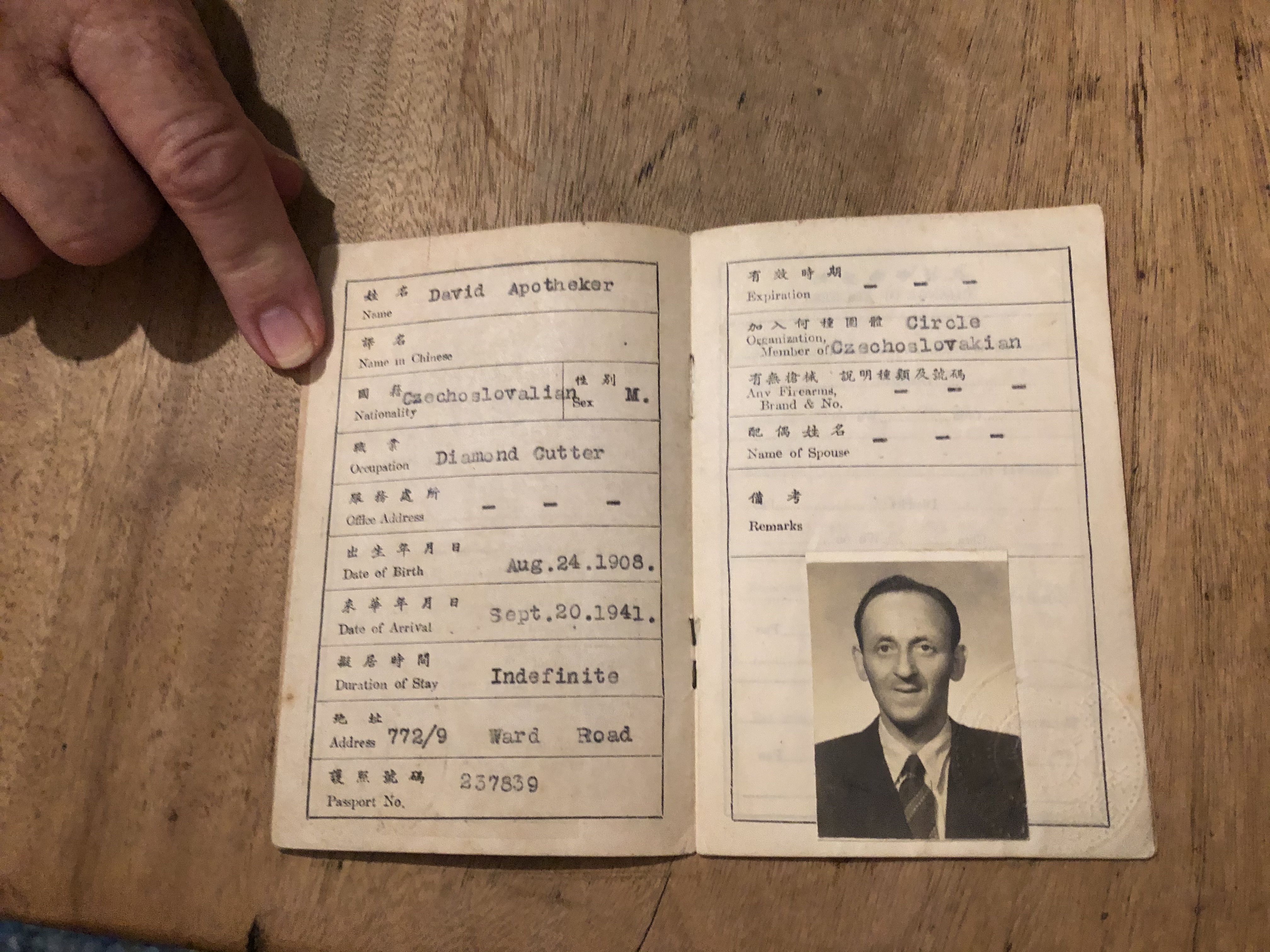
Named in the Polish Embassy's radiogram traffic of July 1942 (Romer fonds, reel C-10451, frames 1067 and 1072): on 14 July 1942 the Embassy in Kuybyshev asked Romer to pass to 'APOTHEKER, 704 [avenue] JOFFRE' the news that 'Jakub Plattner [and] wife [are] healthy' at Chusovaya, Molotov oblast (Lenina, stolovaya 25) — deportees in the Soviet Union — and on 20 July Romer cabled back 'Apotheker informed'. So David Apotheker was living at 704 avenue Joffre, Shanghai, in July 1942, and was in touch, through the Embassy, with a Plattner couple deported to the Urals; his aunt Sara PLATTNER raised him after his mother's death (Rosen-Koenigsbuch, The Galitzianer 2020), and the Plattners of Presov were married into his family — Jakub Plattner is very likely a relative (ask the family) — Jacob Rosen (23 Aug 2026): David's oldest sister married Pinhas Plattner of Bobowa, whose son Jakub was on Schindler's list; he presumes the radiogram's Plattners belong to the OTHER (Polish) David's circle — two readings remain open (see the finding); the consular register has no Apotheker, and 'Plattner'/'Apotheker' occur nowhere else on the seven Romer reels — Owner ruling of 24 Aug 2026: this line is D… CAUTION kept: WHICH Jakub Plattner is not fixed — JRI-Poland shows several born at Bobowa, and the Schindler's-list Jakub is a different man of the same family. - Shanghai identity book of David Apotheker, kept by his family — a bilingual Chinese and English booklet of the occupied city. Name: David Apotheker. Nationality: Czechoslovakian. Occupation: diamond cutter. Date of birth: 24 August 1908.…
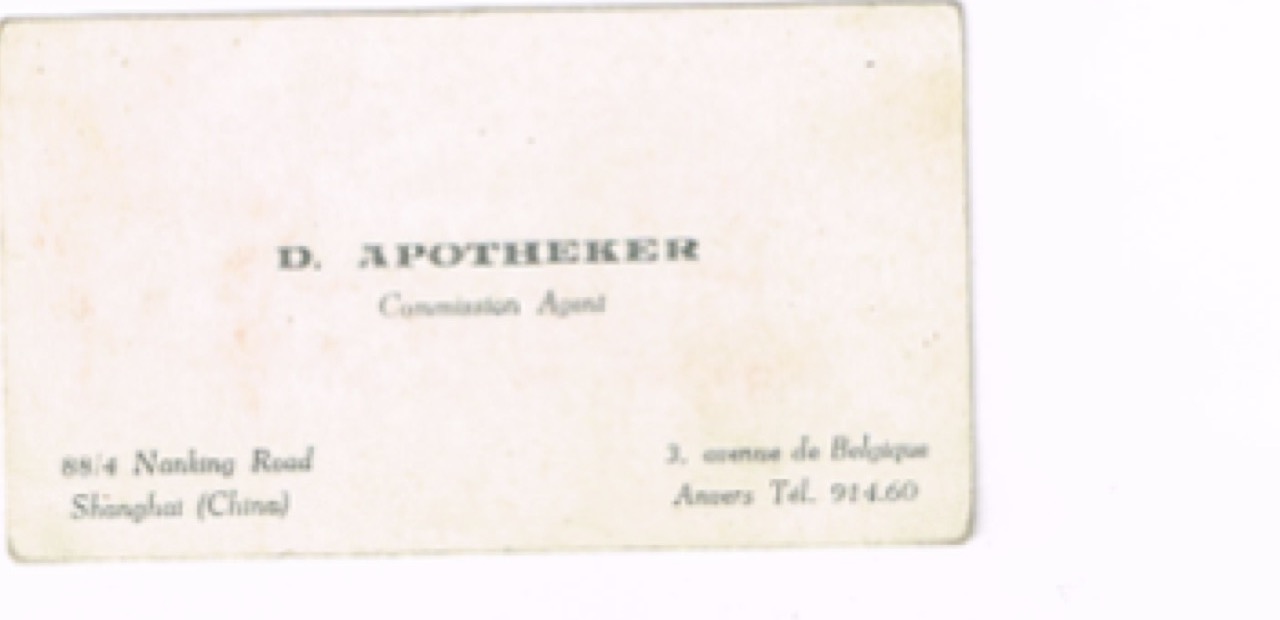
HIS SHANGHAI IDENTITY BOOK, given by the family 29 August 2026: David Apotheker, Czechoslovakian, diamond cutter, born 24 August 1908, arrived in China 20 September 1941, stay indefinite, living at 772/9 Ward Road, passport no. 237839, and a member of the Czechoslovakian Circle. Three things follow. It dates his arrival in Shanghai to 20 September 1941 — some months after the Kobe Seder of spring 1941. It gives his trade, diamond cutter, which the archive did not have. And its 'Czechoslovakian' nationality is the register's own reading of No. 1300 ('Tchechoslovakia, Bardojow') written again in the man's own papers. The booklet carries his photograph. - Business card of D. Apotheker, commission agent, kept by his family — '88/4 Nanking Road, Shanghai (China)' printed at one corner and '3, avenue de Belgique, Anvers, Tel. 914.60' at the other: the Shanghai years and the Antwerp of his re…
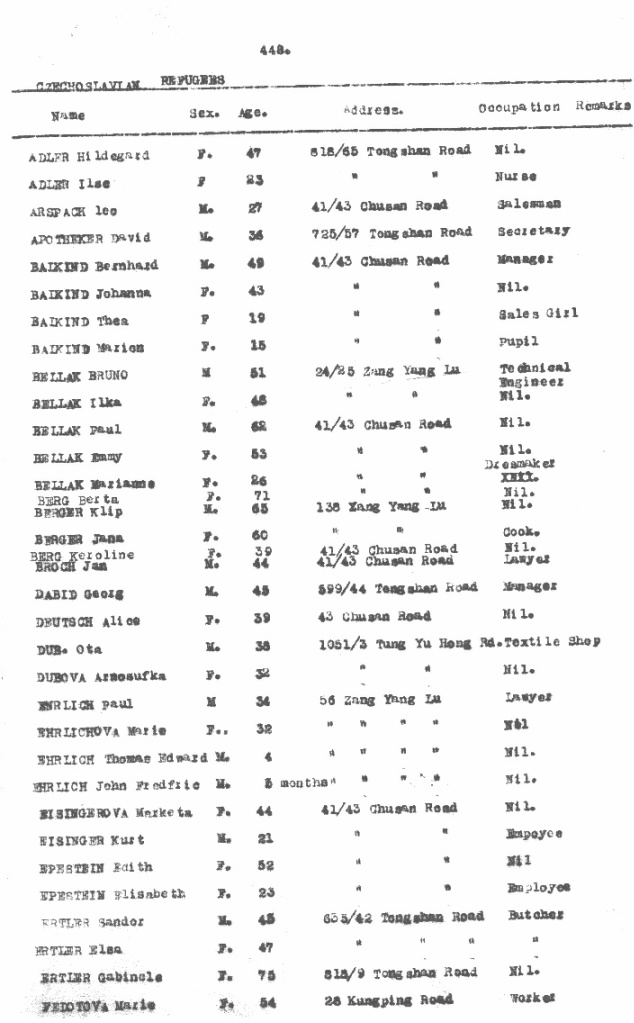
HIS BUSINESS CARD, given by the family 29 August 2026: 'D. APOTHEKER, Commission Agent, 88/4 Nanking Road, Shanghai (China)' at one corner and '3, avenue de Belgique, Anvers, Tel. 914.60' at the other. Undated, and the two addresses on one card belong to the turn between the Shanghai years and the Antwerp to which he went after the war. It also names a second Shanghai address, on Nanking Road in the International Settlement, distinct from the Ward Road of his identity book and the 704 avenue Joffre of the Polish Embassy's radiogram of July 1942. - A page of a Shanghai roll of Czechoslovakian refugees — typescript, page 448, columns for name, sex, age, address, occupation and remarks — reading 'APOTHEKER David, M, 36, 725/57 Tongshan Road, Secretary', in a column of Adlers, Baikind…
A SHANGHAI ROLL OF CZECHOSLOVAKIAN REFUGEES, page 448, given by the family 29 August 2026: 'APOTHEKER David, M, 36, 725/57 Tongshan Road, Secretary'. Aged 36 he is in his thirty-seventh year, which places the page about 1944; Tongshan Road is in Hongkew, the district into which the occupying authorities confined the stateless refugees in 1943. It is his fourth known Shanghai address and his second recorded occupation, and it puts him among his own countrymen — the roll lists only Czechoslovakians. - Arolsen Archives, Reference Services (Martin Kriwet), reply of 18 September 2026 to the archive's search order of 25 August 2026, inquiry IQ-0000111735 — Dawid (David) Apotheker, born 1908 at Bardejov: four documents held, all in collect…
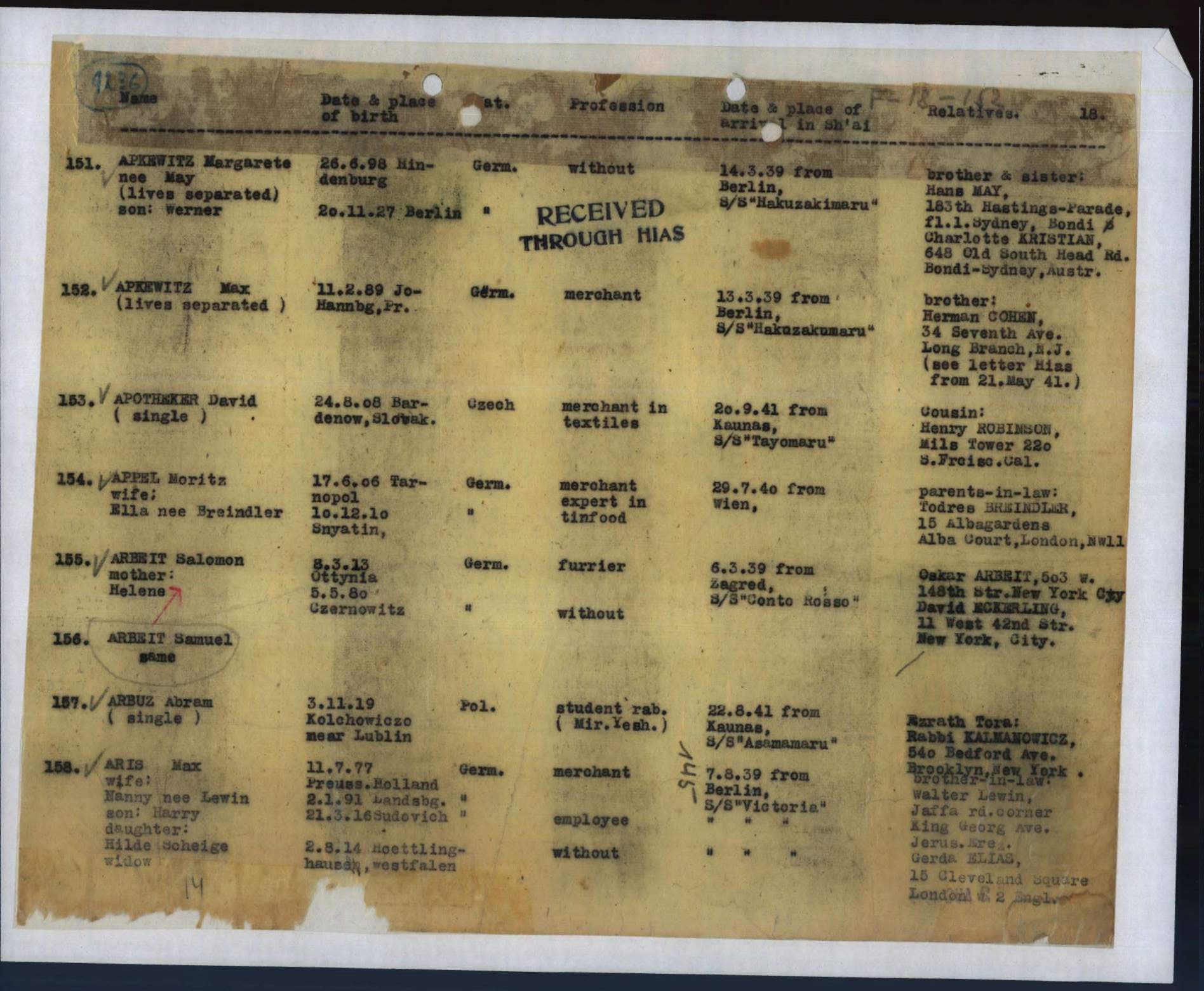
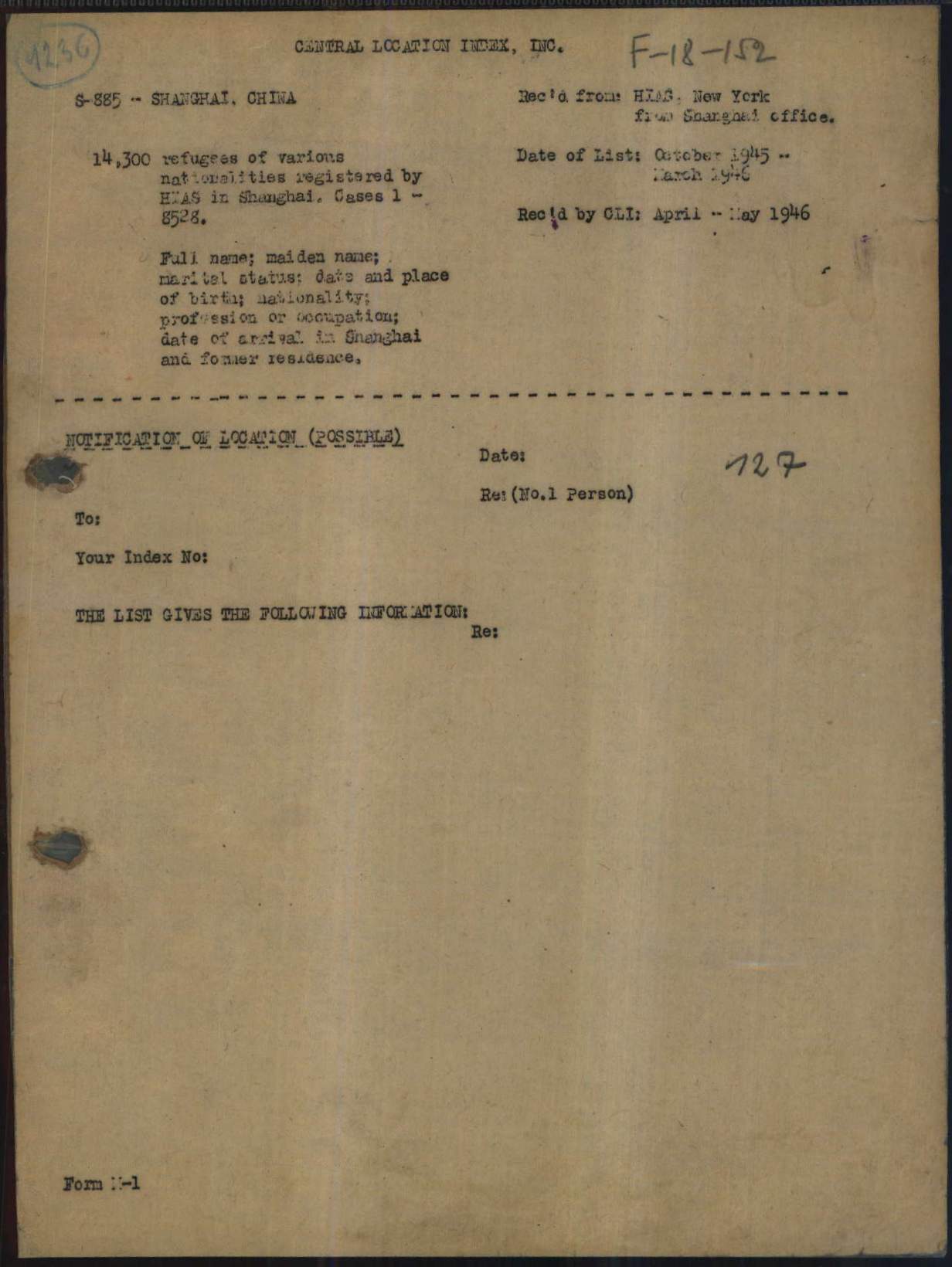
The Arolsen Archives, answering the archive's search order of 25 August 2026, replied on 18 September 2026 that they hold four documents for Dawid (David) Apotheker, born 1908 at Bardejov, all in collection 3.1.1.3, the F18 lists and HIAS Shanghai registrations (documents 78796444, 78796462, 78796287 and 78796289). The search was made with the consent of his son-in-law, Jacob Rosen-Koenigsbuch. The documents were read on 18 and 21 September 2026 and, with the Archives' permission of 21 September, are shown on this page. - The HIAS Shanghai registration list of refugees (Central Location Index case S-885: 14,300 refugees registered by HIAS in Shanghai, cases 1–8528, list dated October 1945 – March 1946, received by the CLI April–May 1946), page 18, entries…
Entry 153 of the HIAS Shanghai registration list of 1945–46, read in the Arolsen Archives' online collection on 18 September 2026 (collection 3.1.1.3, folder 0139): 'Apotheker, David, single, born 24 August 1908 at Bardejov, Slovakia, Czech national, merchant in textiles, arrived 20 September 1941 from Kaunas by the S.S. Tayo Maru; cousin Henry Robinson, Mills Tower, San Francisco.' The birth date and the arrival date are the ones in his own Shanghai identity book, already on this page, so the entry is his; it adds the cousin in San Francisco whom HIAS was to write to. The Arolsen Archives supplied the reference in answer to the archive's search order of 25 August 2026. - World Jewish Congress, London: 'List of refugees in Shanghai', received in London 11 June 1946, 10 sheets, no list of nationalities — sheet 3, headed 'List of Jewish refugees registered with HIAS Shanghai, China, address c/o HIAS, Shangh…
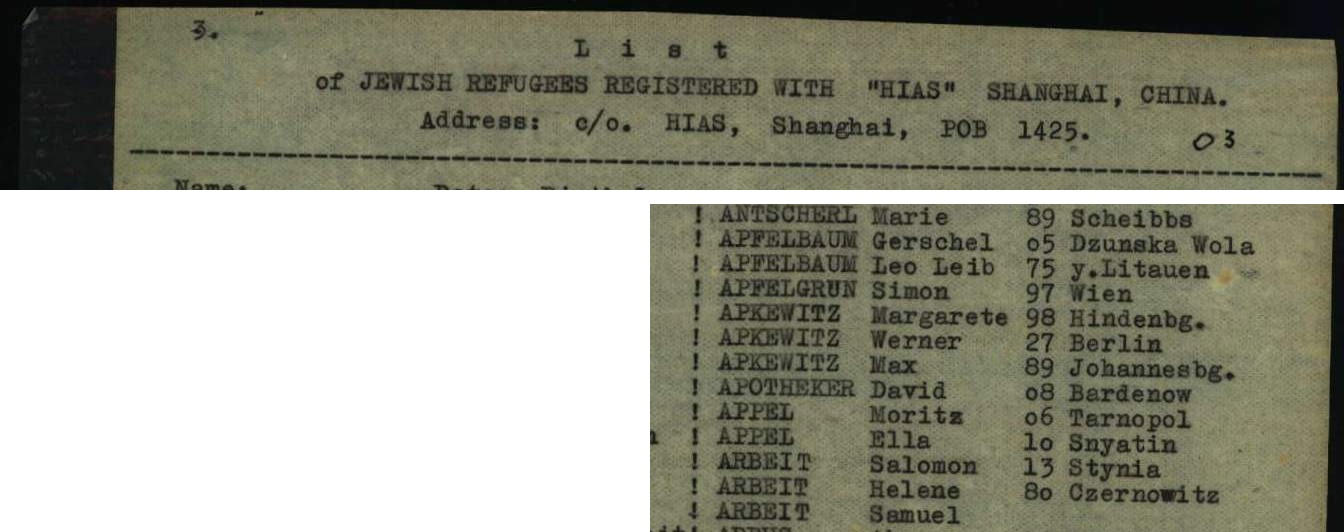
Sheet 3 of the World Jewish Congress's copy of the HIAS Shanghai list (received in London 11 June 1946; Arolsen Archives 3.1.1.3, DocID 78796289, read online 18 September 2026) lists 'Apotheker David, 08, Bardenow' — the birth year and the spelling of the birthplace in his HIAS registration, entry 153, which his own Shanghai identity book already ties to this page. The sheet is the summary list and adds nothing new; it is recorded so the reference is complete. - UNRRA China Office, S-1132-0000-0183, Repatriation — correspondence, with the list of Polish refugees wishing to return to Poland, Shanghai 1946 (UN Archives, AG-018-001)
UNRRA's China Office repatriated a David Apotheker, travelling on a Czechoslovak passport, from Shanghai to Czechoslovakia on the Sontay at the end of 1946; whether he is this entry on the register or the other David Apotheker on the register is not known. (United Nations Archives, UNRRA China Office records.) - La-karov ve-la-rachok, 21 March 1946 — the Far Eastern Palestine Committee's list of Jewish refugees in Shanghai (National Library of Israel, Historical Jewish Press)
The Far Eastern Palestine Committee's list of Jewish refugees in Shanghai, printed by the Jewish Agency Search Bureau's bulletin La-karov ve-la-rachok on 21 March 1946, lists David Apotheker: born 1908 at Bardenow, in the textile trade, arrived in 1941 from Kaunas; the year and the town agree with the Kobe Jewish community's refugee register (National Library of Israel, Historical Jewish Press). - Post by Jacob Rosen-Koenigsbuch (Sugihara descendants group, Aug 2026): Dawid Apotheker at a Passover Seder in Kobe, spring 1941 — he sits first from the right, two Japanese guests stand at the back left; stayed some months in Kobe befor…
and 21 further records, shown on the full entry.
Open this entry in the full register →