Iwri Samuel
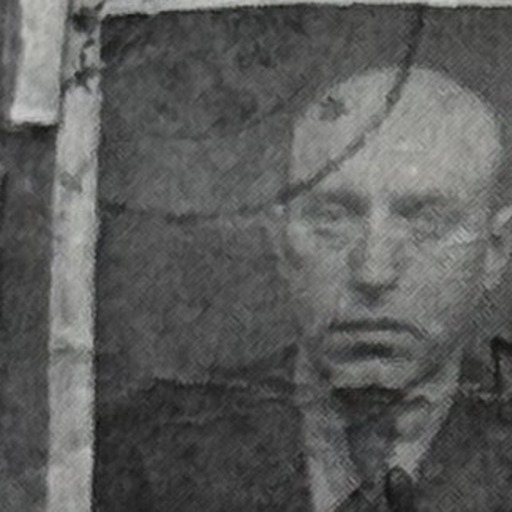
Iwri Samuel received transit visa no. 1046 at the Japanese consulate in Kaunas on 5 August 1940. The register records teacher - yeshiva, aged 29.
Documents
Click a document to see it larger.
What the register records
- Nationality as recorded
- Polnisch
- Age in 1940
- 29
- Occupation
- Teacher - Yeshiva
- Family, per the Kitade-Bluman list
- wife Nina (23)
The journey
Reached Japan; reached Shanghai; registered in Kobe for USA.
Travelled with, and never given a number
- Nina — wife, aged 23
The register recorded visa holders. It did not reliably record the wives and children who travelled on somebody else’s visa, so these people have no entry of their own and cannot be searched for. Where the archive has recovered a name, it is here.
What is known
Samuel Iwry's oral history 'To Wear the Dust of War: From Bialystok to Shanghai to the Promised Land,' edited by L.J.H. Kelley, recounts his escape from Bialystok, Poland, through wartime routes (paralleling the Sugihara/Kaunas escape corridor) to Shanghai, and eventually onward to build a new life, described by reviewer Elie Wiesel as an oral history of 'a turbulent century's triumphs and victories.'
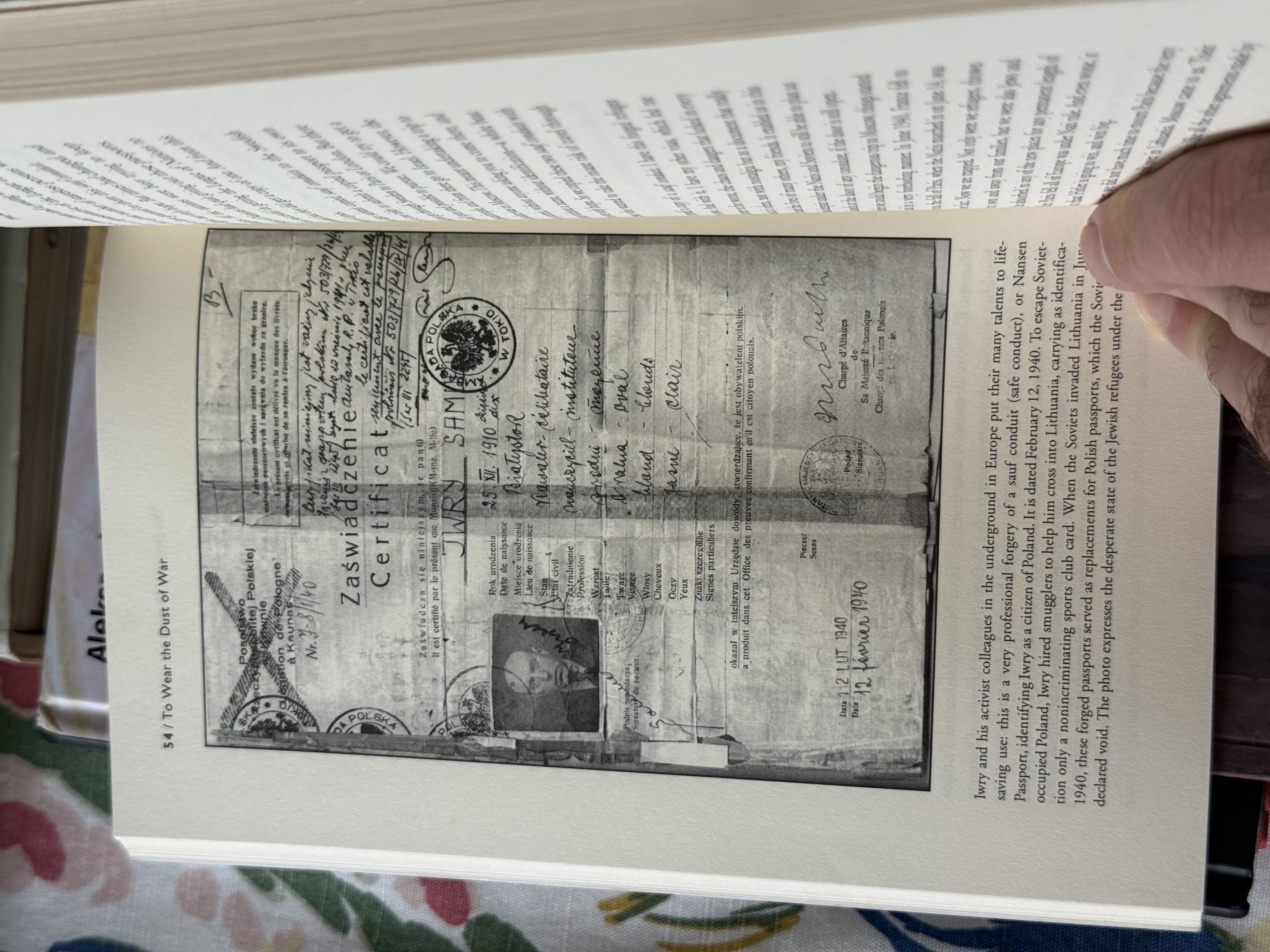
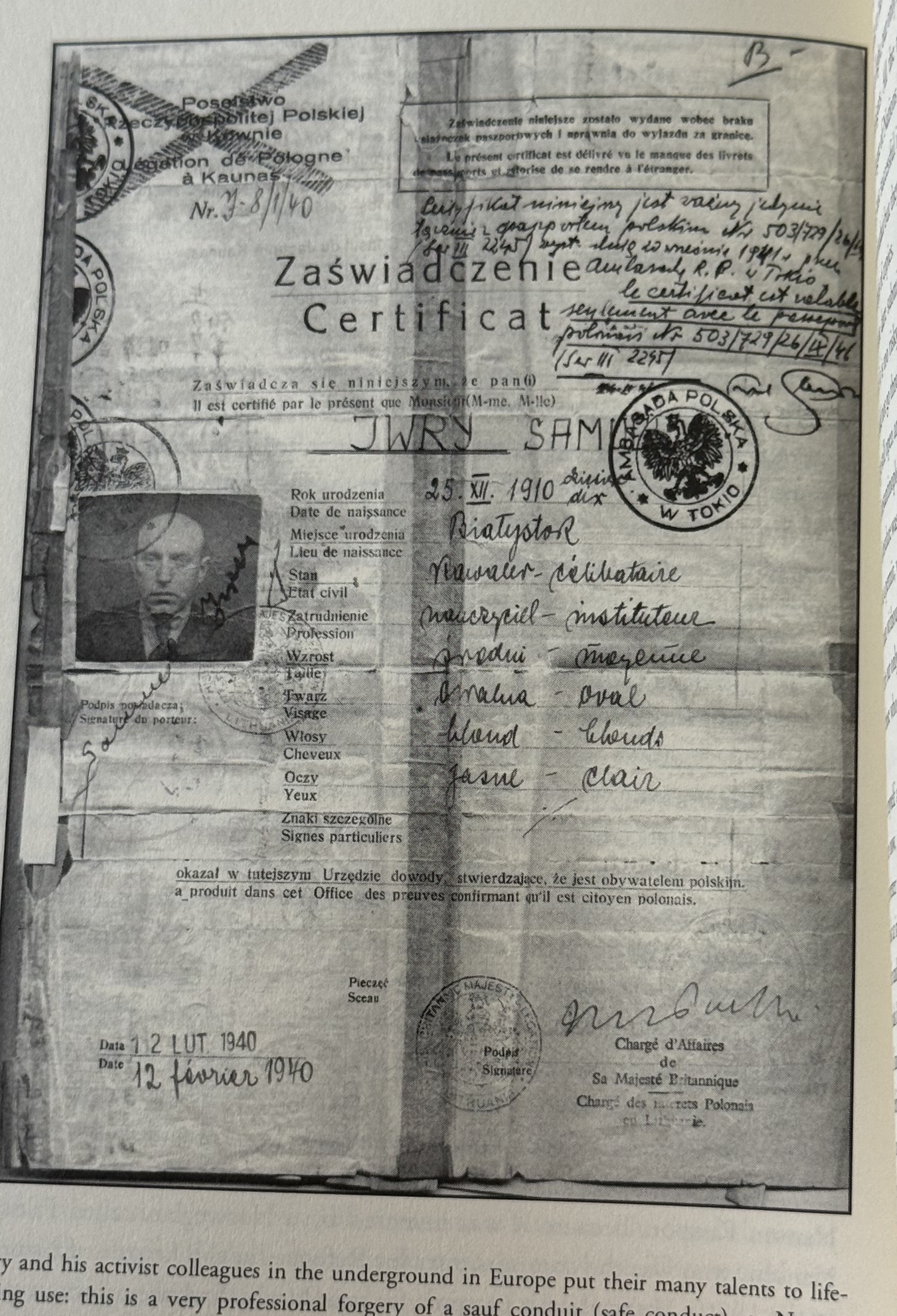
This is a forged Polish safe-conduct certificate (Zaświadczenie/Certificat) created for Samuel Iwry, born 25 December 1910 in Białystok, listing him as an unmarried teacher. The document, dated 12 February 1940 and bearing seals of the Polish Legation in Kaunas and later a Polish Embassy in Tokyo stamp, was produced with the help of Iwry's underground activist colleagues in Europe, who used their forging skills to create life-saving travel documents for refugees fleeing through Lithuania and onward via Japan.
Samuel Iwry, a Polish Jew born in Bialystok in 1910, used a professionally forged Nansen 'sauf conduit' (safe conduct) certificate identifying him as a Polish citizen to escape Soviet-occupied Poland into Lithuania, hiring smugglers and carrying only a nonincriminating sports club card for identification. When the Soviets invaded Lithuania in June 1940 and voided Polish passports, this forged document served as a replacement. The accompanying text describes the desperate, dangerous journey of refugees attempting to travel onward—risking travel through Moscow and seeking routes to places like Sweden or Palestine—amid the chaos of the war's escalation in Europe.
FROM BIALYSTOK TO SHANGHAI TO THE PROMISED LAND \u2014 AN ORAL HISTORY This volume of oral history by Samuel Iwry, Hebrew scholar and Zionist activist, is not only an autobiography but also a superb commentary on a turbulent century's triumphs and victories.
Zaświadczenie / Certificat il est certifié par le présent que Monsieur... Iwry Sam... okazał w tutejszym Urzędzie dowody stwierdzające, że jest obywatelem polskim. and his activist colleagues in the underground in Europe put their many talents to life-saving use: this is a very professional forgery of a sauf conduit (safe conduct)
This is a very professional forgery of a sauf conduit (safe conduct), or Nansen Passport, identifying Iwry as a citizen of Poland. To escape Soviet-occupied Poland, Iwry hired smugglers to help him cross into Lithuania, carrying as identification only a nonincriminating sports club card. The photo expresses the desperate state of the Jewish refugees under the...
Where this comes from
- List of Refugees, Vilna, 1940 — JDC Archives, New York, collection AR 33/44, file 00876. The contemporary register of Polish Jewish refugees in Lithuania, running to more than nine thousand numbered entries; the fullest independent check…
The 1940 Vilna refugee list has, at entry 2460, Samuel Iwri, born 1910 at Białystok, who came from Suwałki; the year agrees with the register's compiled age, and the town with what the archive already holds for this line. - The Kobe relatives list — refugees at Kobe in 1941 recorded with their relatives abroad. Seventy-six pages in numbered sheets (LIST No. 7, No. 16 and others), each line giving a name, age, birthplace, occupation and citizenship, and then…
Entry 117 of the Kobe community's list of refugees and their relatives abroad: born 1910 at Bialystok; relatives abroad: an uncle, Lazar Evry, Bronx, New York. - The JEWCOM register — the refugee register kept by the Refugee Committee of the Jewish Community of Kobe (Ashkenazim) at No. 6 Yamamoto-dori, 1-chome, whose cable address was 'JEWCOM Kobe'. Eighty-four pages on the committee's own printe…
Entry 224 of the Kobe Jewish Community's refugee register: aged 31, born at Bialystok, a teacher, who arrived in Japan from Vilnius on 25 February 1941. - United States Holocaust Memorial Museum, Holocaust Survivors and Victims Database — the Flight and Rescue electronic dataset (source 20725): USHMM's own transcription of the Kaunas register, 2,140 persons with citizenship, visa type, iss…
USHMM Flight and Rescue dataset: arrived in Japan 25 Feb 1941 (line 1046) - Certificate of Polish citizenship No. J-8/1/40, made out to Samuel Iwry and dated at Kaunas 12 February 1940, reproduced as a full-page plate in Samuel Iwry's published oral history. It records his birth on 25 December 1910 at Bialystok,…
The sheet names Samuel Iwry and gives his birth as 25 December 1910 at Bialystok, which agrees with the register's age of 29 in 1940, and his profession as teacher, which is the occupation the register records. One difference should be set down: the sheet, drawn up in February 1940, describes him as unmarried, where the register notes a wife. The account in which the plate appears carries the author's own commentary on how the document came to him; that commentary is left to the book. - La-karov ve-la-rachok, 31 March 1946 — the Far Eastern Palestine Committee's list of Jewish refugees in Shanghai (National Library of Israel, Historical Jewish Press)
The Far Eastern Palestine Committee's list of Jewish refugees in Shanghai, printed in La-karov ve-la-rachok on 31 March 1946, has Samuel Iwry, born in 1910, a teacher, who came in 1941 by way of Siberia. - Certificate of Polish citizenship No. J-8/1/40, made out to Samuel Iwry and dated at Kaunas 12 February 1940, reproduced as a full-page plate in Samuel Iwry's published oral history. It records his birth on 25 December 1910 at Bialystok,…
- The certificate issued by the Polish Legation in Kaunas to Samuel Iwry (No. 1046), born 1910 in Białystok, dated 12 February 1940, with his photograph, as reproduced in a printed memoir.